Beyond and Through Pipelines: Integrating Kurdistan into Iraq’s Energy Future
Iraq is pursuing one of its most ambitious energy infrastructure projects in decades: a new pipeline network connecting the country’s southern oil fields to alternative export outlets on the Mediterranean. A cornerstone of Iraq’s efforts to diversify its energy export routes, the 1,000-kilometer project centers on a pipeline between Basra in southern Iraq and Haditha in western Anbar province. From there, it would branch westward toward Baniyas in Syria and extend northward toward Fishkhabour on the border with Türkiye, eventually connecting with Türkiye’s pipeline network and the Mediterranean port of Ceyhan. A possible route to Jordan’s Aqaba port might be also implemented.
The project reportedly commenced in May with $1.5 billion out of the expected cost of $15 billion allocated, and it is estimated to take between one and four years to complete, depending on the availability of funding. To secure international investment and expertise, Baghdad has signed preliminary agreements with U.S.-based Chevron and TI Capital and Qatar’s UCC Holding to form a consortium to participate in development of the new pipeline network.
However, the significance of this project goes beyond energy infrastructure and export diversification. It also presents an opportunity for a new political-economic bargain among Baghdad, Erbil, and Iraq’s neighbors. Its long-term viability and security will depend not only on protection against armed threats but also on creating a framework that gives key actors a shared economic stake in its success.
Iraqi Oil Exports
Iraq previously operated pipelines carrying crude oil from the northern Kirkuk fields to both Baniyas and Ceyhan. The Ceyhan route remains operational through the Kurdistan Region’s pipeline system, while the Kirkuk-Baniyas pipeline has been out of service since 2003, when it sustained extensive damage during the U.S.-led invasion. Large sections of the pipeline have since deteriorated, requiring extensive rehabilitation or replacement. Crucially, the new network has taken on greater strategic significance because it is also intended to substantially reduce Iraq’s dependence on exports through the Strait of Hormuz – a vulnerability highlighted dramatically by the ongoing conflict involving Iran, the United States, and Israel.
Until the outbreak of the war in February, more than 90% of Iraq’s nearly 3.5 million barrels per day (mbpd) of oil exports passed through the Strait of Hormuz. Iraq lost the bulk of that export capacity for several months after the war began. Exports started recovering in July and have risen to more than 3 mbpd since early September, aided significantly by Iran’s decision to permit tankers carrying Iraqi oil to transit the Strait again.
Before that partial restoration, Iraq had been forced to rely heavily on alternative outlets, including the Kurdish-operated pipeline system carrying more than 250,000 bpd of Kirkuk crude toward Ceyhan and tanker trucks moving around 50,000 bpd toward Syria. Both alternatives remain operational, but their limited capacity compared with Iraq’s southern terminals has reinforced the urgency of establishing larger and more reliable export corridors.
Once operational, the new pipeline network is expected to add between 2 mbpd and 2.25 mbpd of export capacity, according to Iraqi Oil Minister Bassim Mohammed Khudair. A senior Iraqi oil official recently said the Fishkhabour-Ceyhan and Haditha-Baniyas routes would each have an export capacity of around 1 mbpd.
The project also fits into Iraq’s broader ambitions to dramatically expand oil production. Prime Minister Ali al-Zaidi has set a target of increasing output to 10 mbpd by 2030, nearly triple the amount Iraq exported before the Iran-U.S.-Israel war. To put the scale of this proposed undertaking into perspective, Iraq’s oil production increased by only around 80% between 2003 (2.5 mbpd) and January 2026 (4.5 mbpd).
Factors Determining the Viability of the Proposed Pipeline
Beyond the technical and financial requirements, the viability of Iraq’s planned pipeline network will depend on a range of other factors. The proposed routes cross some of the country’s most politically and security sensitive territory, which could complicate the project’s materialization. Because the project is taking shape amid a regional war and considerable geopolitical uncertainty, its security challenges deserve particular attention.
Given Iran’s objections to alternative trade routes that would bypass the Strait of Hormuz, Tehran and some Iran-backed groups could view such projects as part of a broader, Washington-backed effort to reduce regional dependence on the waterway and, by extension, weaken one of Iran’s principal sources of geopolitical leverage. The possibility of sabotage or other attacks by Iran-aligned Shia armed factions inside Iraq should therefore not be ruled out, particularly if regional tensions continue to escalate. These factions have repeatedly been accused of targeting energy facilities in the Kurdistan Region in recent years, while Iran is suspected of carrying out recent attacks on tankers transporting Iraqi oil.
The Islamic State group (ISIS) poses another potential threat. A recent uptick in ISIS violence in both Iraq and Syria, including attacks on energy infrastructure, demonstrates the continuing vulnerability of critical infrastructure in areas where the group retains an operational presence. The proposed pipeline network could therefore become a target for ISIS attacks along both its Iraqi and Syrian stretches, adding another layer of security risk.
Kurdistan’s Significance
Against the backdrop of these risks, the Kurdistan Region could offer a comparatively more secure corridor for the northern leg of the project. The region has been largely insulated from ISIS-related violence since 2017, and Iran-backed armed factions do not maintain the same physical presence or operational capabilities there as they do in other parts of Iraq. Yet, under current plans, the northern route appears designed to largely bypass Kurdish territory before reaching Fishkhabour rather than incorporating the autonomous region more extensively into the new pipeline network. Its comparatively stable security environment represents an asset that Baghdad should factor into its energy planning. If political sensitivities can be set aside, the Kurdish region is well positioned to host a longer stretch of the northern export corridor toward Türkiye. Hence, Baghdad needs to view Kurdistan as a partner whose energy resources could strengthen its northern export corridor.
At a time of growing regional efforts to enhance connectivity through new trade routes and energy infrastructure, Iraq’s planned pipeline network should be viewed as more than an infrastructure project. It also offers an opportunity for a new political-economic bargain between Baghdad and the Kurdistan Regional Government (KRG). The federal government should incorporate the Kurdish oil industry into the corridor’s economic logic. Expanding Kurdish production within an agreed national framework could strengthen the strategic significance of the Fishkhabour-Ceyhan route while fostering deeper political cooperation and economic integration between Baghdad and Erbil. The network’s long-term security will thus depend not only on protection against armed threats but also on creating shared economic incentives for key stakeholders to preserve its viability. Kurdistan could contribute to both the security and economic value of the northern corridor, giving Baghdad and Erbil a common stake in its success.
Federal Iraqi and Kurdish authorities should use this corridor as an opportunity to negotiate a durable oil and revenue framework rather than allowing it to become another source of competition and score-settling. Baghdad should support commercially viable expansion of Kurdistan’s oil sector within a national framework ensuring transparency over production, exports, and revenues. Kurdish oil production should be treated as an asset to Iraq’s overall export capacity, particularly if security or other challenges delay the completion or disrupt the operation of the Haditha-Fishkhabour pipeline. Increased oil production capacity in Kurdistan would be a major asset to Iraq in the event of a future crisis. With the right political environment and investment incentives, production in Kurdistan could rise from its overall capacity of a few hundred thousand bpd, with actual production currently even lower, to between 1 million and 2 million bpd, a range previously envisioned by the KRG.
Ultimately, Iraq’s pipeline ambitions will be most successful if diversification is treated not merely as a matter of building alternative routes but as an opportunity to construct durable political, economic, and security partnerships around them as well.
Policy Recommendations
Turning the northern corridor into a source of cooperation rather than another point of contention will require deliberate policy choices from Baghdad and Erbil, as well as support from Washington. The following steps could help align their interests and ensure that Iraq’s energy diversification also contributes to greater political and economic stability:
- Establish permanent Baghdad-Erbil coordination mechanisms: Baghdad and Erbil should establish specialized energy, commerce, and security committees that meet regularly, with the explicit goal of integrating the Kurdistan Region into Iraq’s plans to expand energy production, as well as the regional pipeline and trade-transit projects in which Iraq participates. Viewing bilateral relations largely as a zero-sum game has been a major obstacle to realizing the full benefits of cooperation across various areas for both sides. This mindset needs to change, particularly in Baghdad, which exercises sovereign powers in this relationship.
- Integrate Kurdistan into Iraq’s national energy-production strategy: The Kurdistan Region should be incorporated into Iraq’s plans for expanding oil and gas production. Foreign energy companies should be encouraged to further develop existing fields and, where commercially feasible, explore for new reserves. Increased Kurdish production under a transparent national framework would strengthen Iraq’s overall production and export capacity.
- Rein in armed factions: The federal government in Baghdad should ensure that armed factions do not threaten energy projects across the country, particularly in the Kurdish region. This requires taking decisive action against any future attacks and holding those responsible accountable. Otherwise, strategic projects across Iraq will remain vulnerable to the actions of these militias, whose transnational interests and ideological ties to Iran may undermine Iraq’s economic and security priorities.
- Offer U.S. diplomatic support for a Baghdad-Erbil energy bargain: Washington should actively encourage these efforts, particularly as they align with the New Lines Institute-conceived Four Seas Initiative and its broader designs for greater regional connectivity and integration. Greater Baghdad-Erbil cooperation on energy and regional trade would improve Iraq’s prospects for long-term stability while helping establish a durable framework for coordination between the KRG and the Iraqi federal government.
The views expressed in this article are those of the author and not an official policy or position of New Lines Institute.
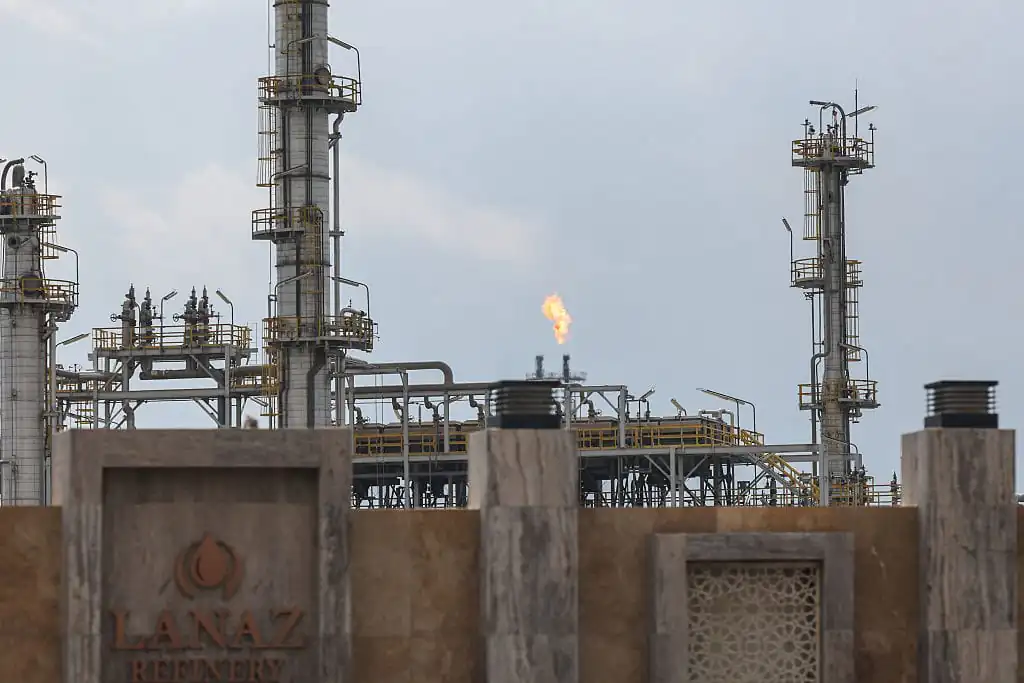
Photo: A view of the Lanaz Oil Refinery on March 17, 2026 in Erbil, Iraq. (Sedat Suna/Getty Images)