The Four Seas Initiative
Syria and Türkiye as the Energy Redistribution Hub of the 21st Century Linking the Persian Gulf, Caspian Sea, Mediterranean Sea, and Black Sea
Executive Summary
The post-Assad stabilization of Syria opens a narrow but historically decisive window to transform the Levant from a theater of energy conflict into a continental energy corridor. This paper calls on the White House and the European Commission to jointly sponsor a Four Seas Initiative – a framework to link the Persian Gulf, the Caspian Sea, the Mediterranean, and the Black Sea through a Syria-Türkiye pipeline and transit corridor. Modelled on the architectural logic of the Three Seas Initiative championed by the United States and Poland in 2017, the Four Seas Initiative would deliver four compounding strategic goods: European energy sovereignty from Russian and Iranian dependence; American commercial primacy in the Middle East’s most strategically leveraged infrastructure; Syrian economic reconstruction underwritten by transit revenues; and a durable geopolitical settlement that rewards alignment with the West.
The moment is not theoretical. In March 2026, U.S. Special Envoy for Syria Thomas Barrack formally revived the Four Seas concept at the Atlantic Council.1 Chevron and ConocoPhillips have signed preliminary agreements.2 Saudi Arabia has launched a $2 billion Syria investment fund.3 The infrastructure logic is sound, the political alignments are the best they have been in a generation, and the cost of inaction measured in continued Russian leverage over European energy and the steady drift of Middle East hydrocarbons toward China is unacceptable. This paper sets out the strategic case, the infrastructure architecture, the financing model, and the governance framework required to make the Four Seas Initiative the defining energy project of the 2020s.
Recommendations to the White House and the European Commission
This paper concludes with a set of concrete, time-bound recommendations addressed to both the White House and the European Commission, structured around the three-year window in which the foundational decisions must be made.
Immediate Actions (2026)
- The White House should formally designate the Four Seas Initiative as a U.S. strategic infrastructure priority, explicitly linking it to the energy security commitments made under the Three Seas framework and directing the U.S. Development Finance Corporation to prepare an initial $500 million facility for Four Seas infrastructure development.
- The European Commission should include the Syria-Türkiye overland corridor in the next revision of the EU’s Projects of Common Interest list under the Trans European Energy Networks regulation, making it eligible for EIB project finance and European structural fund
co-investment. - The U.S. special envoy for Syria, in coordination with the European commissioner for energy, should convene a founding Four Seas Ministerial Forum in Istanbul before the end of 2026, bringing together the energy ministers of the corridor states and establishing the Four Seas Infrastructure Consortium as a legal entity under a multilateral framework agreement.
- The U.S. Department of Energy and DG Energy of the European Commission should jointly fund a Syrian Energy Law Technical Assistance Program, with a mandate to produce a draft production sharing and transit fee framework within 12 months.
Near-Term Actions (2027-2028)
- The Four Seas Business Forum should hold its inaugural session, convened by the Atlantic Council in partnership with the European Policy Centre, with a mandate to identify the first tranche of bankable infrastructure projects, prioritizing the Gulf-Mediterranean corridor and the Iraq-Syria pipeline rehabilitation as the highest impact near-term investments.
- The Four Seas Infrastructure Consortium should achieve first financial close, mobilizing the initial $8 billion to $10 billion tranche, with Gulf sovereign wealth fund co-investment confirmed and private equity commitments from at least three international oil companies.
- Pipeline construction should begin on the Gulf-Mediterranean corridor (Jordan-Syria segment) and the Iraq-Syria corridor (Kirkuk-Deir ez Zor segment), with construction timelines of 24-36 months for initial operational capacity.
- The White House and European Commission should issue a joint Four Seas Energy Security Communique, establishing the shared governance principles, security guarantee framework, and benchmarks for Syrian political and legal reform that will unlock successive tranches of FSIC financing.
Long-Term Objectives (2029-2035)
- Full operational capacity across all four corridor segments, delivering an estimated 3 million to 4 million bpd of oil and 40 billion to 50 billion cubic meters per year of gas to Mediterranean and European markets.
- Syria generating $8 billion to $12 billion annually in combined production and transit revenues, providing the fiscal foundation for sustainable reconstruction and public service delivery.
- Integration of the Four Seas corridor with the Three Seas Initiative’s Eastern European interconnectors, creating a continuous energy infrastructure network from the Persian Gulf to the Baltic Sea – the first truly continental energy architecture of the post-Cold War era.
- A Four Seas Energy Summit, convened at head-of-state level, ratifying the corridor as a permanent feature of the transatlantic energy security architecture, with the same institutional permanence and political visibility as the G7 Energy Ministerial.
The views expressed in this article are those of the authors and not an official policy or position of New Lines Institute.
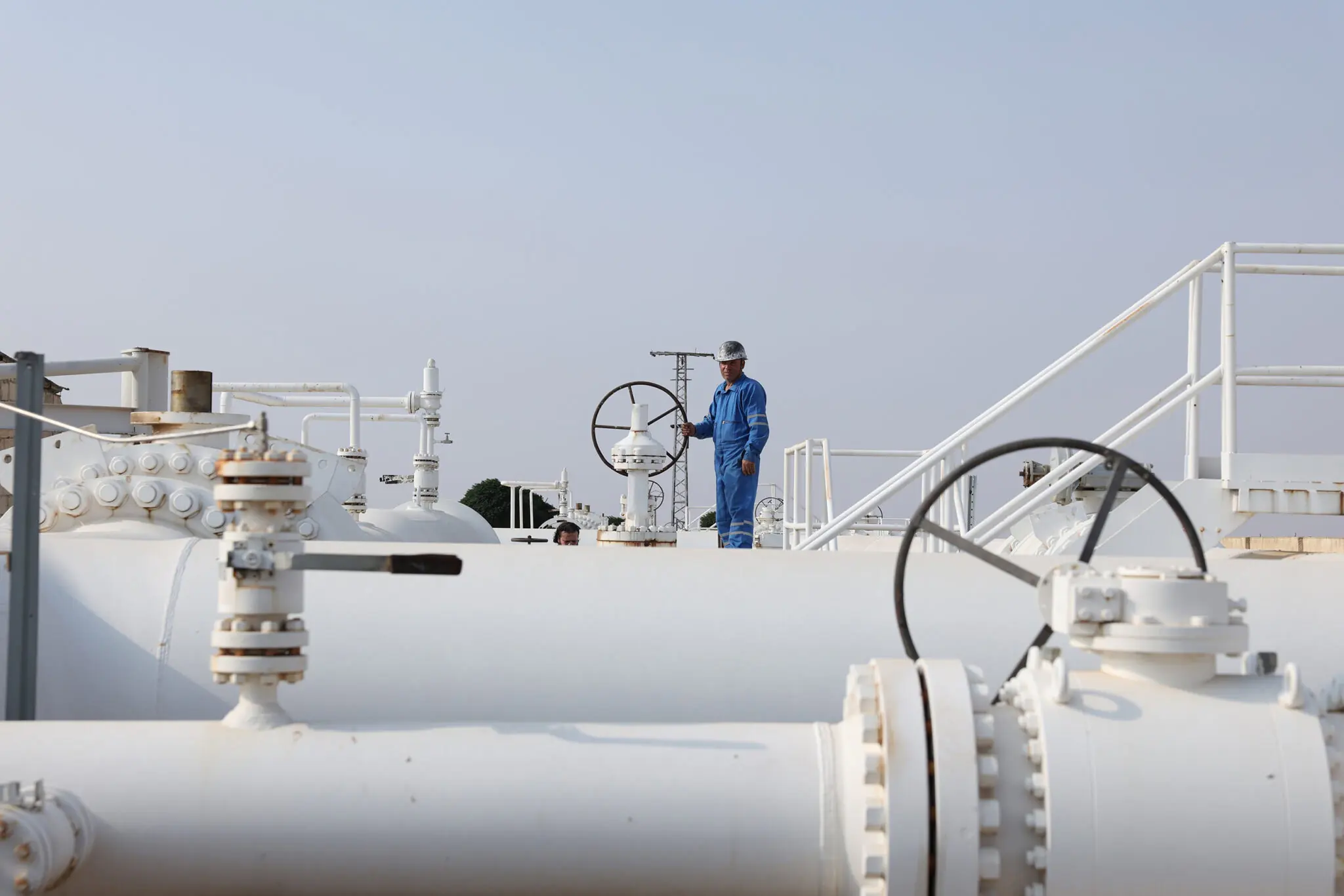
Photo: A view of the gas transmission station in Syria’s Al-Mazra’a village near the Turkish border, where the first natural gas flow from Türkiye to Syria has started, on Aug. 2, 2025. (Bakr Al Kasem/Anadolu via Getty Images)