Real-Time Analysis: Supreme Leader Choice Shows Regime Losing Coherence
Mojtaba Khamenei’s installation as supreme leader underscores the extent to which the Iranian regime has been weakened by the U.S.-Israeli air campaign. His succession to his father’s role reflects the acute disarray among the Islamic Republic’s principal power centers during the ongoing war. The conflict has upended what had long been carefully managed plans for a more orderly transition from former Supreme Leader Ayatollah Ali Khamenei. With a weak stature both as a religious figure and a politician, Mojtaba is unlikely to stabilize a regime already buckling under the sustained pressure of the airstrikes.
Iran’s regime installed 56-year-old Mojtaba Khamenei as the Islamic Republic’s new supreme leader. The 88-member Assembly of Experts announced the decision on March 8 after an emergency deliberation to select the country’s third supreme leader since the 1979 revolution. The younger Khamenei has long been an influential but largely behind-the-scenes figure with strong ties to the Islamic Revolutionary Guard Corps. His elevation marks the first time power in the Islamic Republic has effectively passed from father to son, a controversial step as Iran confronts its most severe military and political crisis since its inception.
All things being equal, Mojtaba would have not succeeded his father for several reasons. First, the regime’s legitimacy has long been based on the fact that it toppled a monarchy and thus it could not be seen as engaging in dynastic rule, especially as public opposition has grown considerably in recent decades. Second, the supreme leader is supposed to have at least some stature in terms of religious credentials. Third, there are many factions that oppose the move based on the son’s ability to lead. Finally, there were many others who were better positioned, such as Ayatollah Ali Khomeini, a grandson of the founder of the republic.
Beyond the major war, the death of the elder Khamenei created an unprecedented situation while the country is faced with massive internal agitation. According to the constitution, in the event of the death or incapacitation of a supreme leader, he would be replaced by an interim 3-man leadership council consisting of the president, chief justice, and a cleric from the Guardian Council while the Assembly of Experts goes through the process of electing the successor. In practice this has never happened before, even when the Ruhollah Khomeini died in 1989, Ali Khamenei was appointed the very next day.
The supreme leader’s death after a 37-year rule created an extraordinary leadership vacuum at the very outset of the most severe war the Islamic Republic has faced in its nearly half-century history. The convergence of leadership decapitation and large-scale conflict placed the regime in an unprecedented situation, threatening to paralyze decision-making at the moment of greatest strategic peril. Under such circumstances, the regime’s key stakeholders had strong incentives to fill the vacuum as rapidly as possible to project continuity and prevent the perception that the system was unraveling amid an existential crisis. An interim leadership council composed of figures from rival political and institutional camps would have risked internal paralysis, making a single – however controversial – successor a more viable option during wartime.
Evidence has emerged that Mojtaba faced significant opposition from several elite quarters within the regime, but he also enjoyed backing from influential segments of both the Islamic Revolutionary Guard Corps and the political clergy. In other words, while no consensus existed around his candidacy, the competing factions broadly agreed that the leadership vacuum had to be filled quickly to preserve regime cohesion. Mojtaba’s principal advantage was that he had long functioned as his father’s trusted aide and gatekeeper, giving him familiarity with the levers of power at a moment when continuity was paramount.
Mojtaba had long managed his father’s secretariat, particularly in recent decades, effectively serving as a chief of staff. This position allowed him to cultivate extensive networks and influence across the regime’s diverse power centers and competing factions. Supporters of his ascension likely emphasized the need for continuity, arguing that an alternative candidate, including figures like Ali Khomeini, would have faced the daunting task of building authority from scratch. In a period of acute crisis, Mojtaba’s entrenched access to institutional levers made him the most expedient choice to preserve the regime’s cohesion.
That Mojtaba succeeded his father underscores the extreme pressure on the Iranian regime. Chaos within the Islamic Republic’s institutions has intensified, with internal disagreements reaching unprecedented levels. In this context, Mojtaba was installed as a placeholder, reflecting the imperative that the supreme leader’s office cannot remain vacant, especially during war. Yet by elevating Mojtaba, the regime has effectively embraced a dynastic principle it once repudiated, bolstering the arguments of opposition figures like Reza Pahlavi, son of the former shah, and leaving open serious questions about whether Mojtaba can maintain authority as the conflict continues.
Mojtaba is unlikely to stabilize the Iranian regime because his authority rests more on wartime expediency and factional deals than on broad institutional or popular legitimacy. His limited formal religious credentials and low public profile, combined with deepening fractures within Iran’s power structure, constrain his ability to build durable consensus across competing political, clerical, and security networks. Moreover, his elevation amid an existential war reinforces hardline imperatives over pragmatic governance, potentially intensifying repression and internal dissent rather than defusing it. In a regime already under unprecedented external and internal pressure, these structural weaknesses make sustained stabilization under his leadership very unlikely.
The views expressed in this article are those of the author and not an official policy or position of New Lines Institute.
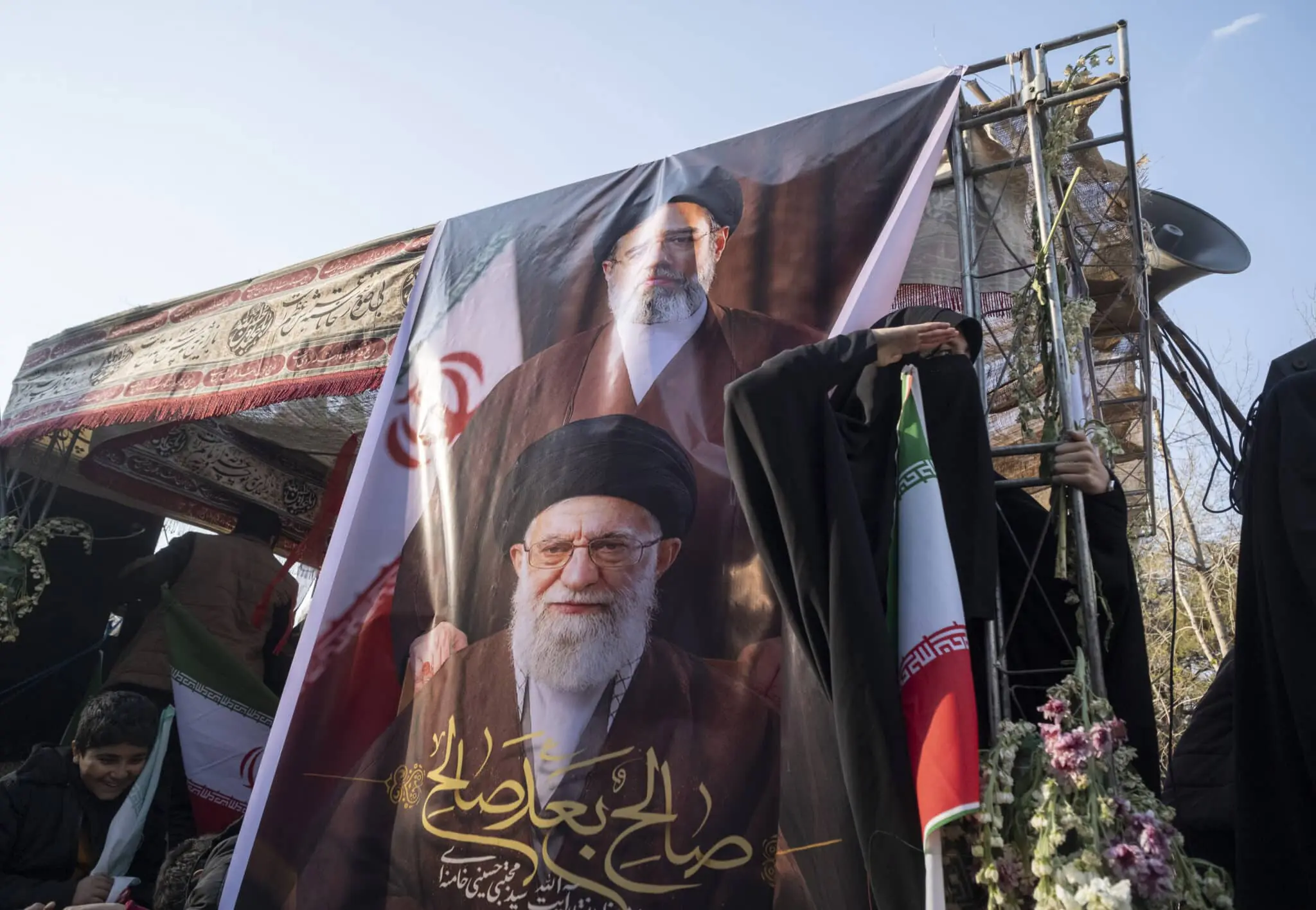
Photo: A woman salutes as she stands on a truck next to a banner depicting portraits of late Supreme Leader Ayatollah Ali Khamenei (bottom) and new Supreme Leader Ayatollah Mojtaba Khamenei amid the U.S.-Israeli military campaign in Tehran, Iran, on March 9, 2026. (Photo by Morteza Nikoubazl/NurPhoto via Getty Images)