Four Seas Initiative
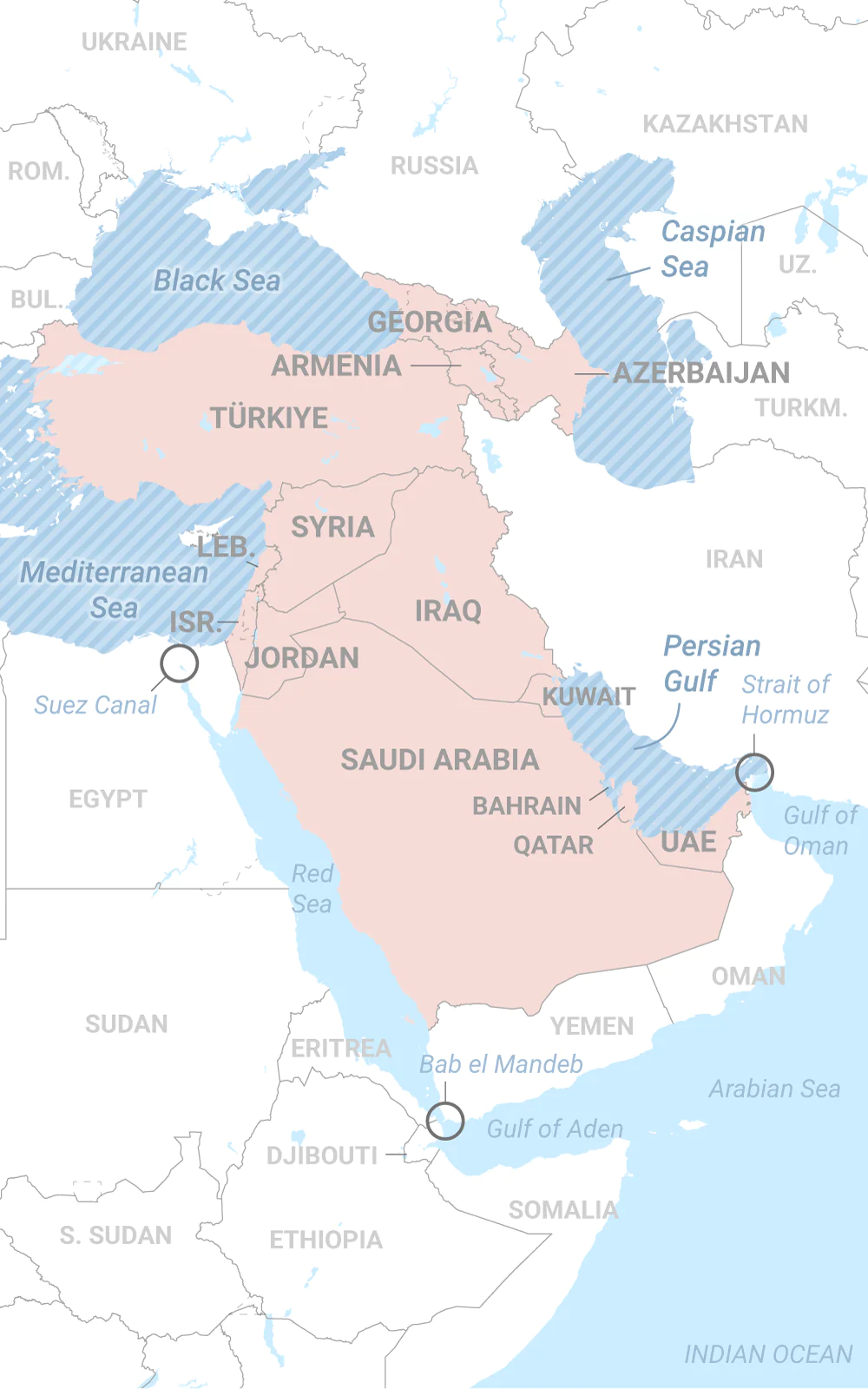
The Four Seas Initiative is a proposed transatlantic framework connecting the Persian Gulf, Caspian Sea, Mediterranean Sea, and Black Sea through a Syria–Türkiye pipeline and transit corridor. The project, modeled on the Three Seas Initiative championed by the United States and Poland in 2017, would incorporate 6,300 kilometers of Syria’s recoverable prewar pipeline network alongside existing Turkish infrastructure to route Gulf, Iraqi, and Caspian hydrocarbons overland to European markets.
The initiative sits at the intersection of three declared White House priorities: maximizing U.S. energy exports and influence; educing European dependence on adversarial suppliers; and achieving a commercially grounded stabilization of the Middle East. The window is open. The policy architecture is not yet in place.
THE INFRASTRUCTURE ARCHITECTURE
Four interlocking corridors converge on the Syria–Türkiye border zone:
- Gulf–Mediterranean Corridor: Saudi Arabia, the UAE, and Kuwait through Jordan and Syria
to the Banias terminal; reviving the historic Tapline route with expanded capacity of 1.5 to 2 million barrels per day. Bypasses both Hormuz and the Suez Canal. - Iraq–Syria Corridor: Rehabilitation and expansion of the Kirkuk–Banias pipeline (closed since 1979; historic capacity 200,000 bpd). The Syrian Petroleum Company assesses 1.4 million bpd as technically feasible.
- Caspian–Anatolian Corridor: Syrian infrastructure linked to the Trans-Anatolian Natural Gas Pipeline (TANAP) and a planned expansion of Azerbaijani and Turkmen gas exports through Türkiye to European markets.
- Arab Gas Pipeline Modernization: $1.2 billion rehabilitation of the Egypt–Jordan–Syria–Türkiye line, adding Egyptian, Cypriot, and Lebanese offshore gas to the portfolio and enabling Nabucco connection.