Complicity and Consequence: U.S. Alignment with El Salvador’s Human Rights Violations
As the U.S. continues to deport a record number of people as part of U.S. President Donald Trump’s crackdown on undocumented immigrants, El Salvador has become a key partner in the country’s immigration enforcement apparatus. That partnership has evolved from diplomatic to transactional, as the State Department has paid El Salvador $6 million since January 2025 to detain a combination of Salvadoran deportees and third-country deportees.
The United States’ immigration enforcement apparatus already operates in breach of its international legal obligations, including the principle of nonrefoulement. Financing detention in a country whose security forces have faced sustained, well-documented allegations of torture, including in the State Department’s own reporting, compounds that exposure. It places U.S. enforcement further along a continuum of complicity in serious human rights abuses. Any such arrangement should therefore be conditioned on verifiable standards for detention conditions and treatment, so that U.S.-supported detention does not facilitate foreign torture or other abuses.
The State Department’s El Salvador 2024 Human Rights Report (HRR) omitted significant abuses, a clear break from over 20 years of consistent documentation. This marks a crucial shift in either the State Department’s monitoring or substantial reform to El Salvador’s security apparatus. In 2024, the same year the HRR covers, El Salvador’s incarceration rate climbed to the highest in the world, approximately 1,917 per 100,000 people, under a state of emergency that suspended due process and was linked to arbitrary detentions and deaths in custody. With emerging evidence on El Salvador’s current abuses, it appears that the State Department’s reporting will continue downplaying the ongoing abuse in pursuit of this administration’s immigration agenda.
To ensure the credibility and validity of its immigration/deportation apparatus, the U.S. government should distance itself from El Salvador. This complicity in El Salvador’s abuses degrades the long-standing credibility of the HRRs’ findings. Moreover, El Salvador’s human rights violations are a threat to the reputation and legality of the U.S. deportation system both domestically and internationally. Outsourcing immigration enforcement to governments with entrenched records of abuse binds U.S. policy to partners it cannot control. Each documented violation becomes a legal, diplomatic, and political liability that Washington inherits, handing adversaries a ready-made case against U.S. credibility and exposing the arrangement to litigation, congressional backlash, and collapse.
A History of Reports and Abuse
El Salvador, among other countries examined by the State Department, has perpetrated significant human rights abuses for decades. As early as 1999, the State Department noted poor prison conditions, prison abuse, arbitrary detentions, and corrupt judges. By 2001, El Salvador’s own pretrial detention data shows over half the prison population was being held before conviction, a widely recognized indicator of systemic overcrowding. This pattern of overcrowding and abuse continues for the following 22 years.
The consistency of this reporting reveals a persistent institutional failure to uphold basic human rights standards. The repetition of similar violations year after year suggests that the problem isn’t a lack of awareness, but a lack of political will to reform the security policies driving mass incarceration.
According to the 2011 report, prison conditions were “dangerously substandard.” In the 2012 report, the State Department flagged evidence of El Salvador’s government restricting freedom of speech and the press from covering the situation in the prisons. This marked a turning point. As the government silenced journalists and human rights watchdogs, accountability became increasingly difficult, and abuses of prisoners could expand unchecked. Beginning in 2012, the scale and scope of human rights abuses escalated.
In 2023, credible evidence of the military arbitrarily killing or disappearing people, serious government corruption, invasion of privacy, and intimidation/censorship/legal attacks on journalists and human rights organizations, accompanied by the aforementioned prison abuse, informed that year’s human rights report. Years of unfettered human rights abuses reveal a systemic pattern: Human rights violations are enabled and empowered by leadership at the top and carried out across the many branches of government and security forces.
Salvadoran presidents have repeatedly thrown their support behind security forces, streamlined the arrest process, and dehumanized detainees in public rhetoric, thereby creating the conditions for widespread abuse. Including the military in enforcement, the police in arrests, and the government in fast-tracked prosecution in a system of abuse is legally significant as it transforms scattered incidents of abuse into conduct attributable to the state itself.
El Salvador’s gang crisis did not begin in El Salvador but in the U.S. Both MS-13 and Barrio 18 formed in Los Angeles among Salvadoran refugees fleeing their country’s civil war. Following waves of mass deportations back to their country in the 1990s, thousands of gang-affiliated youth arrived in an El Salvador that had almost no institutional capacity to handle them. By the early 2010s, the two gangs had turned El Salvador into one of the most violent countries on earth. In 2015, the country’s murder rate was the highest in the world. President Nayib Bukele was elected in 2019 on promises of anticorruption initiatives and a stronger security apparatus to solve the gang problem. This same expansion of detention later made the country an attractive partner for Trump’s deportation policy.
Leadership and the Expansion of Abuse
Bukele promised an “iron fist” approach to crime upon taking office, shifting El Salvador’s crime-ridden trajectory substantially. In 2022, when gang violence spiked, so did Bukele’s strategy in response. In March 2022, he announced a state of emergency. With this increased authority, each increase in crime became a vehicle for amassing Bukele’s executive power. The U.S. State Department’s 2023 report suggests that prior to the state of emergency, Salvadoran prisons were already well beyond capacity. The mass arrests that followed, many without evidence, further exacerbated prison overcrowding.
The scale of these arrests is central to understanding the current crisis. By prioritizing rapid detention over evidence-based arrests, the Salvadoran government effectively traded due process for immediate security gains. While this approach yielded reductions in crime, it simultaneously overwhelmed the capacity of the prisons and eroded any remaining legal safeguards designed to prevent abuse.
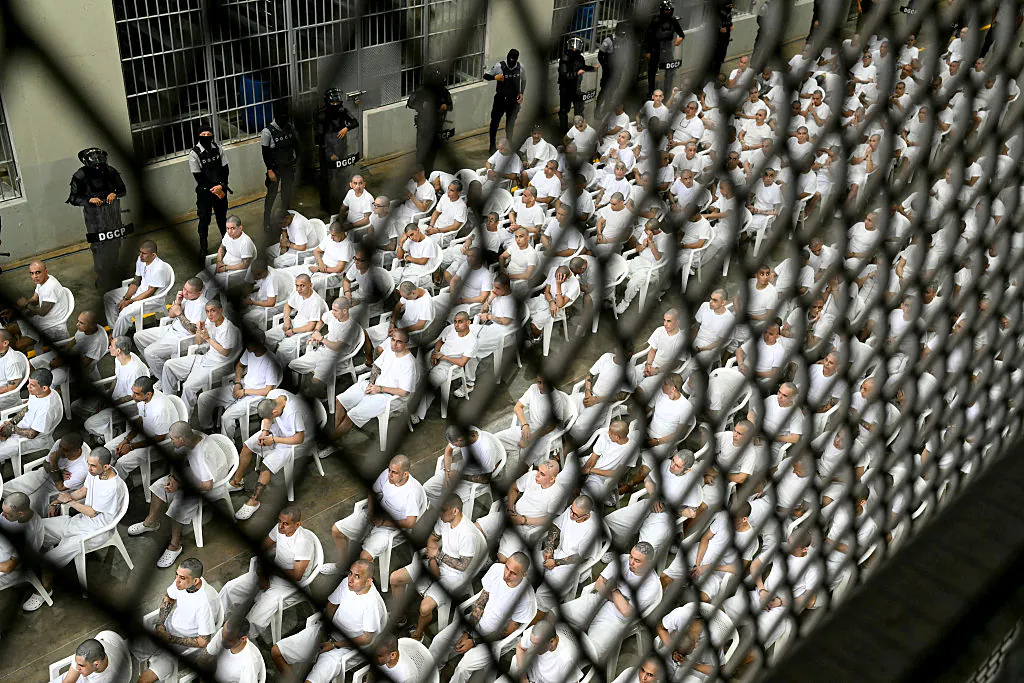
Despite the opening of mega-prisons like CECOT, El Salvador’s largest Terrorism Confinement Center, Salvadoran prisons remained widely overcrowded and rife with human rights violations. According to accounts from prisoners held at CECOT, most deportees held were subject to abuse in some form. The abuses included instances of food and water deprivation, inadequate sanitation, denial of medical services, sleep deprivation, beatings, rape, and torture, documented in the State Department’s 2023 report and in another report by Human Right Watch. The U.S. role in transporting deportees into these dangerous conditions constitutes a serious breach of national, regional, and international laws.
Given the documented conditions inside Salvadoran prisons, continued U.S.-supported detention should be conditioned on independent access to detention facilities and detainees and continuous human rights monitoring. Regular monitoring would provide a mechanism to verify conditions rather than relying solely on assurances from the Salvadoran government. Such oversight need not preclude cooperation with Bukele, despite criticism of his treatment of alleged gang members, he remains widely popular among the Salvadoran population and internationally.
The Trump administration pursued mass removals as a signature priority, but doing so meant finding a partner willing to detain migrants the U.S. labeled as gang members or “terrorists“. Bukele’s El Salvador, with its state of emergency and CECOT, offered a solution.
Early in his second term, Trump moved quickly to formalize a deportation arrangement. In exchange for the confinement of approximately 300 Venezuelans and Salvadorans, Trump would send $6 million to El Salvador, with another $15 million allocated for the detention of additional deportees. Bukele could arrange the holding location for U.S. deportees, and in exchange, the U.S. could provide financing for El Salvador’s struggling economy.
Because U.S. funds directly support this detention arrangement, Washington retains leverage over the conditions under which cooperation continues. That leverage could include suspending funding or transfers when Salvadoran authorities fail to meet established human rights benchmarks such as the Nelson Mandela rules.
This continued stream of deportees worsens El Salvador’s detention crisis. Sending additional detainees into prisons already operating beyond capacity increases the risk of abuse and expands the number of people exposed to it. More importantly, transferring U.S. detainees into a detention system marked by credible reports of torture and inhumane treatment may itself violate U.S. and international legal obligations.
The International Law Commission’s draft Articles on Responsibility of States for Internationally Wrongful Acts is central to understanding the implications of this arrangement. Under international law, a state may be responsible for its direct actions as well as for aiding or assisting another state in committing internationally wrongful acts. By knowingly transferring deportees into a system where cruel, inhuman, or degrading treatment are well documented, and paying El Salvador for it, the United States risks being complicit in those violations.
The principle of nonrefoulement, which prohibits transferring people to a state in which they face a substantial risk of torture or inhumane treatment, further governs this arrangement. Given the State Department’s extensive documentation of abuse in Salvadoran prisons, the threshold for “knowledge” is arguably met. This evidence transforms the deportations into a legally actionable violation. At minimum, the United States must verify the legal basis and destination of each transfer before deportation occurs to avoid potential state responsibility, sanctions, or civil and criminal liability. Such verification should include an assessment of whether the receiving country presents a foreseeable risk of torture, arbitrary detention, or other prohibited treatment.
Detention Holdings and Legal Ramifications
With Trump and Bukele’s arrangement, hundreds of deportees were funneled into CECOT in March and April 2025, where CECOT’s director greeted them with, “Welcome to my prison…. You are here as convicts…. The only way out of here [is] in a black bag.” This showcases exactly what they were going to be subjected to in CECOT and other detention facilities in El Salvador: no due process, no expectation of release, no appeal to law, and being held incommunicado.
Many deportees were removed without a trial in the United States, leaving their alleged violations untested in court and the legality of the deportations themselves unsettled in several Supreme Court cases. Furthermore, the limited documentation surrounding the deportations made it difficult to trace where individual deportees were sent within El Salvador, amounting to what Human Rights Watch claims to be enforced disappearances and arbitrary detention. Without adequate tracking, these individuals are at high risk of abuse. A disappearance into a massive prison system without the means of communicating outside that system means that prison casualties could go unreported.
By limiting transparency regarding who is deported, where they are sent, and under what legal authority, both governments reduce the likelihood of legal challenges and public scrutiny. This obfuscation complicates efforts by families, lawyers, and human rights organizations to track detainees or advocate on their behalf. Documentation gaps further shield officials from accountability by making it difficult to determine which agency, official, or government authorized a specific transfer, detention, or act of abuse. Closing these documentation gaps should therefore be a prerequisite for continued transfers. The United States and El Salvador should maintain accessible records identifying who is transferred, the legal authority for each transfer, and the facility in which each individual is held.
These deportees were not given due process in the United States. The Trump administration invoked the Alien Enemies Act, allowing for the deportation of immigrants without a standard trial, but due process remains a key concern for judges, politicians, and academics alike, as well as a foundational right in the U.S. Constitution. In March 2025, one of the many planes shuttling El Salvadoran and Venezuelan deportees to CECOT was blocked from taking off by a federal judge. Despite the verbal order, the plane took off anyway.
The Immigration and Nationality Act, international treaties such as the U.N. Convention Against Torture (UNCAT), and various inter-American treaties (signed and ratified by El Salvador) note that U.S. and El Salvador are in violation of treaty obligations. The American Convention on Human Rights and the Inter-American Convention to Prevent and Punish Torture provide legal pathways for El Salvador’s prosecution.
Avoiding Accountability
Despite El Salvador’s disregard for international law, the State Department’s response has been to narrow, rather than expand, its reporting of abuses. The State Department omitted all accusations of “significant human rights violations” from its 2024 Human Rights report. Released in August 2025, the report on El Salvador in 2024 omits the prison conditions that featured prominently in each of the preceding reports. The 2024 report’s omission of previously documented abuses coincides with the period in which the U.S.-El Salvador detention arrangement was being formalized, a point that warrants additional scrutiny given the absence of independent evidence that conditions improved. El Salvador’s violations in the reports notably peaked in 2022, only two years prior.
Human Rights First President and CEO Uzra Zeya has described the broader rewrite of the reports as an abandonment of values integral to U.S. national security, arguing that the administration has bent human rights policy tools toward rewarding abusive partners rather than scrutinizing them. An accompanying Human Rights First press release warns that the HRRs particularly misrepresented countries that are aligned with the Trump administration’s political interests. These discrepancies warrant an independent review of the 2024 Human Rights Report and the methodology used to assess detention conditions by the U.S. Government Accountability Office (GAO). Restoring confidence in State Department reporting requires determining whether the omissions reflected changes in conditions or shortcomings in the reporting process.
Other warning signs suggest that El Salvador is doing its part to restrict independent reporting and civil society access. In July 2025, Cristosal, El Salvador’s leading human rights organization, fled the country after a series of government threats and arrests, including the head of Cristosal’s anti-corruption and justice program, Ruth Lopez.
The forced exit of one of El Salvador’s only human rights organizations further entrenches the lack of transparency surrounding prison conditions and detainee treatment. Without independent observers on the ground, the flow of reliable information diminishes, allowing abuses to continue with even less scrutiny. Now, more than ever, a push for transparency from both the U.S. and El Salvador is necessary to ensure accountability.
Stakes and Implications
Established legal mechanisms are in place to address immigration law violations, and states retain the sovereign right to control their borders. The method of enforcement of these civil offenses is equally important. Deportation cannot become a vehicle for exposing individuals to torture, indefinite detention, or inhumane treatment. The distinction is critical: When enforcement practices drift outside legal boundaries, they do more than violate statutory and treaty obligations; they erode U.S. credibility, weaken its ability to assert moral authority abroad, and expose it to reputational and diplomatic consequences.
Key members of Trump’s Cabinet, such as Deputy Chief of Staff Stephen Miller, describe immigration as an invasion in sweeping justifications of U.S. deportations. Framing this issue as a binary choice between border security and human rights is both misleading and dangerous. Effective immigration enforcement and adherence to legal and ethical standards are not mutually exclusive; in fact, they are complementary. When enforcement mechanisms violate human rights, they undermine the legitimacy of the laws they are intended to uphold.
The U.S. decision to partner with El Salvador in this capacity reflects a broader willingness to prioritize expediency over legality and human rights, the same shift El Salvador made just a few years ago. In doing so, the United States risks the foundational values that underpin its legal and political system.
Without a change in course, the trajectory outlined above – continued transfers, documentation gaps, and divergence between State Department reporting and independent findings – carries numerous consequences. Abuses within El Salvador’s detention system will continue without the external scrutiny that accurate reporting is designed to enable. Simultaneously, continued reliance on expedited removals and wartime authorities such as the Alien Enemies Act weakens the due process protections that constrain executive power domestically. Moreover, the U.S. pattern of noncompliance with judicial orders to return wrongfully deported individuals establishes precedent for executive action operating outside judicial review, reducing the incentive for accountability.
The cumulative effect extends beyond legal exposure and diplomatic standing. It sets a precedent for treating reporting obligations, judicial oversight, and human rights commitments as optional. Addressing these risks requires three measures: conditioning U.S. cooperation on verifiable human rights standards, ensuring legal and documentary transparency in deportations, and establishing independent monitoring of detention facilities.
What the Future Holds
Considering the changes in scope and omitted content in its 2024 Human Rights Report, the State Department’s 2025 Human Rights Report on El Salvador will likely downplay El Salvador’s human rights violations, if it is published at all. This year’s HRR is months past its due date. If future reports with other relevant partners also omit or minimize the size and scope of abuse, it would reinforce a narrative of cooperative policy over legal standards. A continuation of this dynamic diminishes the credibility of the HRRs, which have historically served as some of the strongest tools to assess global human rights conditions.
Simultaneously, external pressure from human rights organizations, investigative journalists, and international bodies is likely to intensify. As more evidence emerges, or as the deportation crisis worsens, the gap between official narratives and documented reality may become increasingly difficult to sustain. Although El Salvador has tightened media restrictions, the Trump administration will struggle to do the same in the U.S.
In the immediate future, U.S complicity in these abuses will generate further stigma about U.S. immigration enforcement for the public. That reputational harm can make other countries more reluctant to cooperate with U.S. deportation efforts, further shrinking an already limited set of states willing to accept non‑nationals.
Policy Recommendations
Suspend Transfers and Condition Cooperation
Congress should immediately suspend all funding and impose a moratorium on all deportation transfers to El Salvador pending a formal review of detention conditions. The U.S. should only resume cooperation if El Salvador demonstrates verifiable compliance with international human rights standards, including prohibitions on torture and other abusive methods. To prevent future cases of abuse, Congress and the U.S State Department should establish clear, enforceable benchmarks: legal access, humane conditions, and transparency, with automatic suspension mechanisms in place for non-compliance.
Ensure Legal Integrity and Transparency
The U.S. Department of Justice should verify the legal basis of all deportations to ensure compliance with due process and nonrefoulement obligations. The State Department should publicly release the terms of United States-El Salvador agreements to restore transparency and accountability. The U.S. Government Accountability Office should conduct and publish a formal review of the 2024 Human Rights Report to assess whether its omissions are consistent with available evidence and to preserve the credibility of State Department reporting.
Establish Independent Monitoring
The international community should implement independent, third-party monitoring of Salvadoran detention facilities, including regular and unannounced inspections by the U.N. Special Rapporteur on Torture and the Inter‑American Court of Human Rights. El Salvador should ensure full access to detainees, facilities, and records, including paperwork and CCTV recordings. The international community should require public reporting of findings, and the U.S. should link continued cooperation to demonstrated, sustained improvements in prison conditions.
The views expressed in this article are those of the author and not an official policy or position of New Lines Institute.
Photo: Alleged members of the MS-13 gang attend a remote court hearing by videoconference at the Terrorism Confinement Center (CECOT) in Tecoluca, El Salvador, on April 23, 2026. (Photo by Marvin RECINOS / AFP via Getty Images)