Preventing Industrialized Atrocity: From World War to the Age of Automation
Mutual dependence often defines the relationship between industry and warfare. Wartime technological demand places pressure on civilian industries to support state defense-building while providing powerful financial incentives to do so — and most technologies developed with dual-use potential have inherently blurred the line between civilian and military applications. In Europe, this Cold War-era “military-industrial complex” concept has become a recurring structural condition driven by strategic necessity.
Core to this concept is the persistent blurring of boundaries between civilian and military production. In peacetime, these two spheres appear distinct. Civilian industries build cars, planes, and software and enhance the exchange of commercial goods. In periods of geopolitical stress, however, these industries are rapidly reconfigured for military production. This is the reality of dual-use industries, adapted in both world wars and currently reemerging in Europe.
While wartime production mobilization may be necessary, the rapid transition toward a conflict-driven industrial economy must be governed by legal and ethical constraints to prevent the conversion of dual-use technologies into instruments of atrocity. World War I’s mobilization of civilian industries to World War II’s total war methods and today’s rearmament and proliferation of dual-use industries illustrate the necessity of legal and policy integration by highlighting the risks posed by these industries when unconstrained.
A History of Military-Industrial Complexes
World War I greatly accelerated the process by which private civilian businesses were tapped as military manufacturers. European economies at the dawn of WWI were unprepared for the scale of the conflict. Unable to keep up with wartime demand for weapons and materiel, governments turned to civilian industrialists to regulate production.
In 1916, not long before the United States entered the war, the U.S. Chamber of Commerce wrote that “a ‘mobilized economy’ will make individual manufacturers and business men and the Government share equally in responsibility for the safety of the nation.” Upon request of the U.S. government, this partnership was the first time these separate spheres were explicitly integrated. Across Europe, firms including Rolls-Royce and Bayer shifted from civilian to military production, establishing partnerships with governments that would persist long after the war ended.
World War II strengthened this connection. The conflict represented the most complete manifestation of the European military-industrial complex, mobilizing entire societies for war production. As a result, companies focused on civilian production became key to warfare strategy. Rolls-Royce and other companies surged, and production for civilian use was relegated to a secondary concern.
In the hands of the German state under the Nazis, however, the same productive apparatus that enabled the Allies’ victory became a mechanism for systematic atrocity. Firms such as Volkswagen, Daimler-Benz, and BMW became deeply integrated into the German war economy. Following Hermann Göring’s Four-Year Plan to make the German economy self-sufficient, these companies fit seamlessly into the wartime production model: They were direct participants in sustaining the regime’s military and labor systems. These manufacturers not only produced military vehicles critical to the Nazi’s erasure of the Jews and other minority populations, but they also used forced labor drawn from occupied populations and labor camps extensively.
Nazi-directed industrial production touched other economic sectors, including chemical manufacturing. Even before the war began, the pharmaceutical conglomerate IG Farben demonstrated support for the Nazi regime with large campaign contributions to the National Socialist party and by shifting production to synthetic rubber, fuel, and explosives designated to sustain war efforts. As its partnership with the Nazi regime deepened, the company sponsored construction of a massive factory near concentration camps in Auschwitz, Poland, which provided prisoners both to build the factory and to perform forced labor there. IG Farben and other companies were later held directly responsible for war crimes, including the harsh labor conditions resulting in the deaths of tens of thousands of workers. IG Farben also mass-produced Zyklon B, a cyanide-based pesticide used in Nazi extermination camps to kill more than 1 million people, which was quickly deployed in the final stages of the conflict in the European theater.
As this history demonstrates, when left unchecked, civilian-military integration can create the capacity for new atrocities. As governments mobilized civilian industries for war, they also conscripted them – explicitly or implicitly – into chains of command that extended the state’s capacity for violence. Who stands in that chain, who has the power to say no, and where does culpability attach when the machinery of war produces war crimes becomes serious points of concern when private industries are contracted for military production? Defense mobilization using civilian industries can be essential for national survival and success in war, but when it results in atrocity crimes, diffusion of responsibility across state and corporate actors makes accountability all the harder to assign.
In the case of the Rwandan genocide in the 1990s, France supplied the Hutu-led government with weapons from state-owned and dual-use civilian manufacturers. Despite numerous investigations, neither the French government nor its companies were held accountable. This provides a stark example of the diffusion of responsibility that obscures blame when civilian industry becomes enmeshed in the machinery of war.
The Push for Proliferation
Consolidation in the U.S. industrial base increased its fragility, with the government contracting weapons manufacturers overseas to support its defense capabilities. This model of defense procurement, overly reliant on overseas production, is prone to inefficiency and waste. In 2017, however, this paradigm started to shift. President Donald Trump’s first administration began laying the groundwork for an overhaul of the U.S. military-industrial complex, reflected in the 2017 U.S. National Security Strategy’s emphasis on creating and maintaining a solid defense industrial base and resilient supply chains as a matter of national importance. In the beginning of his second term, Trump began demanding that Europe do the same. In the post-WWII era, Europe has depended on U.S. weapons and defense systems, with European defense needs requiring weapons from dwindling U.S. stockpiles, considered alarmingly low and slow to replenish.
In 2025, the U.S. increased pressure on its European allies to expand defense spending and industrial capacity. In September 2025, the U.S paused some weapon shipments to Europe, advancing its objectives of an “America First” military, consequently spurring Europe’s military industry. Despite some pushback, many European NATO members capitulated to U.S. pressure and increased their defense spending. Germany, for one, committed to major military expansion, including renewed conscription and increased defense production. Across Europe, defense spending in 2025 increased 11% from the previous year.
As funding increased, civilian businesses flocked to defense-sector contracts in a reemergence of large-scale military-industrial mobilization. Firms across Europe such as ICEYE, IVECO Group, and Kelluu have transitioned from civilian technology production to defense sector manufacturing and logistics. The long-dormant postwar military-industrial complex of Europe has begun to reactivate. Manufacturers across Europe, especially in Germany, are scrambling to capitalize on European rearmament.
A Cautionary Tale
As civilian companies push to claim unallocated money in the military-industrial space, ethics become an afterthought. Effective enforcement and compliance with international humanitarian law on arms manufacturing remains sparse. In the U.S., corporations refute liability for the misuse of their weapons with the Arms Export Control Act (AECA) and the “Battlefield Preemption” doctrine. These, among many parallel laws across Europe, directly undermine international humanitarian law and shield arms manufacturers. It cannot be reasonably maintained that most military manufacturers, at odds with the provisions made by domestic laws, operate in full compliance with international humanitarian law, but companies that create products with dual-use functions offer increasingly creative and complex opportunities for the automation of warfare, systems that could easily be used to commit atrocity crimes. AI software companies such as Palantir and Anduril are operating at the front lines of software warfare, developing systems for automated targeting, thus creating the possibility that weapons systems could target and kill people with merely the click of human approval.
Ongoing Pentagon negotiations over AI usage constraints around targeting and surveillance restrictions have sparked widespread debate. Critics argue that expanding AI-driven targeting risks atrocity crimes and accelerating battlefield decisions beyond the pace of human oversight, whereas supporters contend that such systems can reduce reaction times and maintain military competitiveness. Despite this dilemma, modern companies respond primarily to demand as did their 20th century predecessors, and wartime demand remains among the most financially incentivizing forces, overriding ethics.
Historical precedent suggests that corporate complicity in wartime abuses is not beyond legal accountability. The post-World War II Nuremberg war crimes trials provide a stark example: 24 IG Farben executives were prosecuted on charges of complicity in wartime atrocities. While 10 of them were acquitted, this proves that economic contribution is not morally neutral in contexts of systematic violence. The international military tribunal treated industrial production as a potential form of participation in atrocity, not just as indirect support.
Since then, the United Nations Human Rights Council (OHCHR) has broadened and strengthened its cases against businesses complicit in war crimes. The OHCHR has determined that businesses must use “due diligence to identify, prevent, mitigate and account for how they address impacts on human rights,” effectively moving corporate accountability from a reactive responsibility to a proactive obligation. Furthermore, international criminal law assesses causation or contribution, knowledge and foreseeability, and proximity or remoteness, giving real, measurable metrics by which businesses and corporations could be determined as complicit. With codified legal criteria, international prosecutions no longer rely on the ad hoc appeals to humanity that characterized the Nuremberg trials. In effect, these laws offer both a warning light and a brake system, emphasizing the necessity to anticipate and avoid conditions.
Yet the lesson of industrial contributions in WWI and WWII is not simply that corporations can be punished after atrocities occur; it is that accountability must exist before those atrocities take place. While the IG Farben trials demonstrated that corporations and their executives are not immune from legal prosecution when they know their products enable mass atrocities. That reckoning, however, came only after immense destruction had already taken place. In the modern era, where proliferating military-industrial complexes offer technology like automated targeting systems that can accelerate the speed and scale of warfare, reactive justice is insufficient.
If history offers a warning, it is that unleashing industrial capability without ethical restraint invites catastrophe. As Europe moves to bolster industrial capabilities in the military sphere, legal and moral principles guiding the production of equipment by dual-use manufacturers are critically important. What appears compliant under current contracting powers and laws in the U.S and Europe may later be reinterpreted by international courts as legally actionable involvement in abuses, with consequences extending to executives, firms, and supply chains. Ensuring robust oversight, transparent contracting, and enforceable international legal standards is not merely a legal necessity but a strategic one for a stable world. Without deliberate safeguards for atrocity prevention, the same industrial innovations that strengthen nations’ security may once again enable abuses with consequences extending far beyond the battlefield.
The views expressed in this article are those of the author and not an official policy or position of New Lines Institute.
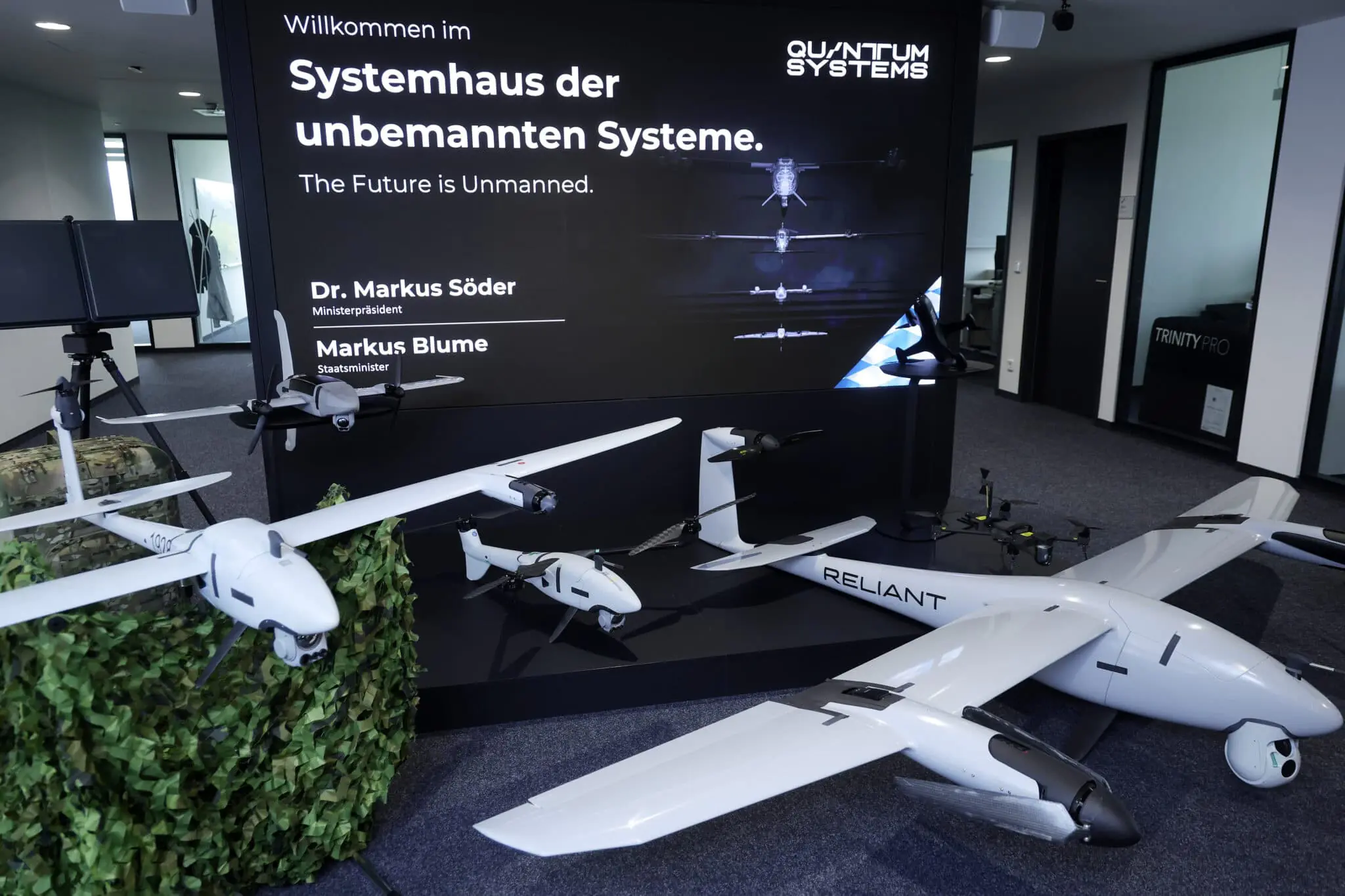
Photo: Drone models are displayed during the Bavarian Premier Markus Soeder’s visit to the Nexus Drone Port at Quantum Systems on Oct. 10, 2025, in Gilching, Germany. German defense spending has leaped as Europe pursues rearmament. (Photo by Johannes Simon/Getty Images)