The United States Battles International Law
On Aug. 11, Human Rights Watch, joined by the American Friends Service Committee, the Center for Constitutional Rights, and the Open Society Foundations, sued the administration of U.S. President Donald Trump for targeting the International Criminal Court (ICC) and sanctioning judges, prosecutors, and prominent human rights organizations.
The lawsuit’s complaint argues that sanctioning and targeting the ICC is an attack on the rule of law that causes “grave damage to the ability to bring to justice the perpetrators of genocide, war crimes, and crimes against humanity.” Plaintiffs argue that the sanctions infringe upon their constitutional rights to free speech, association, and religion, and violate United States law and U.S. obligations under international law.
The lawsuit highlights decades of U.S. hypocrisy, noting the country’s integral role in drafting the 1998 Rome Statute that created the ICC, despite not choosing to be a member. It also notes that U.S. Democratic and Republican administrations alike have supported ICC investigations in Uganda, the Democratic Republic of the Congo, Central African Republic, Mali, Venezuela, the Philippines, Ukraine, Georgia, Bangladesh/Myanmar, Sudan, and Libya. However, the United States has openly opposed investigations by the ICC into Afghanistan and Palestine, including a long-stalled investigation that could potentially incriminate U.S. forces for committing war crimes in Afghanistan. No U.S. citizen has ever been prosecuted or investigated by the court.
How Did We Get Here?
The International Criminal Court is an independent international tribunal created by the 1998 Rome Statute to prosecute individuals for the world’s most serious crimes: genocide, crimes against humanity, war crimes, and the crime of aggression. Often described as a “court of last resort,” the ICC intervenes only when national authorities are unwilling or unable to investigate or prosecute these crimes themselves. It operates on a principle of complementarity – existing in tandem with domestic courts and frameworks, seeking only to intervene when no one else will.
The United States signed the Rome Statute in 2000 but informed the United Nations in 2002 that it did not intend to become a party to it and therefore considers itself not bound by the treaty’s obligations, to “protect” U.S. service members and leaders from “politically motivated prosecutions” and to protect U.S. state sovereignty. Successive U.S. administrations have since maintained that the ICC lacks jurisdiction over U.S. nationals. The United States has also adamantly argued that the Court lacks jurisdiction over Israeli officials for the same reason. Beyond this, U.S. law itself places significant limits on cooperation with the ICC. The American Service-Members’ Protection Act of 2002 largely restricts U.S. cooperation with the Court absent specific statutory authorization.
The U.S. has largely cooperated with ICC actions, as detailed within the complaint. In multiple instances, the U.S., despite not being party to the Rome Statute and not obligated to execute arrest warrants, has facilitated transfers of individuals subject to an ICC warrant twice, has supported ICC verdicts, and even endorsed investigations.
On Nov. 21, 2024, ICC Pre-Trial Chamber I issued arrest warrants for Israeli Prime Minister Benjamin Netanyahu and then-Defense Minister Yoav Gallant. The judges found there were reasonable grounds to believe the two men may bear criminal responsibility for war crimes and crimes against humanity allegedly committed in Palestine. The alleged crimes include starvation as a method of warfare, intentionally directing attacks against civilians, murder, persecution, and other inhumane acts.
Following the issuance of the warrants for Netanyahu and Gallant, the Trump administration imposed “draconian” sanctions against senior ICC officials involved in the investigation and the U.N. Special Rapporteur on Palestine. These sanctions have been described as a sort of “financial death penalty.” Sanctioned individuals and their families are barred from entering the United States, they have U.S.-based assets frozen, and they lose access to all American products and services, with accounts such as Apple, Amazon, Airbnb, and PayPal being suspended immediately and without warning. Those who support sanctioned individuals or organizations, either through legal, educational, advisory, or informational services, may face up to 20 years in prison if they are U.S. persons or risk sanctions if they are not.
The Trump administration stated in a 2025 executive order sanctioning the ICC that the ICC had undertaken “illegitimate and baseless actions” against the United States and its ally Israel in issuing said warrant and maintained that neither country recognizes the Court’s jurisdiction. Netanyahu dismissed both the ICC charges, calling the warrant “bogus” and denying that Israel has committed war crimes in Gaza.
In his 2025 United Nations General Assembly address, Trump called for reform of the United Nations, accused the organization of treating the United States unfairly, and questioned the purpose, efficacy, and motives of the U.N. He further alleged, without evidence, that the U.N. was financing undocumented migrants to facilitate their entry into the U.S. through the southern border. This is consistent with his longstanding criticism of international institutions, including his condemnation of the U.N. Human Rights Council for protecting human rights abusers while targeting the U.S. and condemned the ICC as violating “all principles of justice, fairness, and due process.”
In July 2026, Secretary of State Marco Rubio issued a sweeping condemnation of the ICC, vowing to “dismantle” the ICC “brick by brick” if necessary. And on Aug. 18, 2026, Rubio issued further sanctions targeting ICC officials, including ICC President Tomoko Akane of Japan and Senior Trial Lawyer Abdoulaye Seye of Senegal. In a statement, Rubio said the ICC poses a threat to state sovereignty, describing it as “a corrupt and fatally politicized supranational court that has maliciously abused its authority and exceeded its mandate.” He further stated that the United States would continue its efforts to systematically dismantle the ICC until it could no longer threaten U.S. sovereignty and that he expected other countries to join this effort.
Rubio has framed the Court’s scrutiny of U.S. actions, including deportations to El Salvador and military strikes against alleged narco-terrorists and striking civilian infrastructure without due diligence, as evidence of an institutional campaign against the United States. Despite Rubio’s complaints, applying international legal standards to alleged violations is not an attack on the U.S. It is part of the broader effort to hold states and individuals accountable under international law.
Crumbling World Order
Calls to reform the international order are not new. Rates of global conflict are at a record high. International crimes are committed seemingly with impunity while the U.N., international courts, and multilateral organizations appear increasingly unable to exercise authority in the very domains they were created to govern.
The United States at one point played a central role in championing and sustaining this order. The U.S. became a global hegemon, presenting itself as a principled defender of liberal international norms, while at the same time holding itself separate and often above much of the international law it had helped to draft and create. Over the past three decades, however, this order has entered a period of marked deterioration.
The liberal international order has faced sustained criticism for privileging major powers, centering the Global North, and reproducing structural inequalities rooted in colonial-era power dynamics. Within the United Nations Security Council (UNSC), the permanent members wield disproportionate authority through the veto, often enabling them to block action that conflicts with their national interests rather than advancing collective peace and security.
Academics, U.N. member states, the ICC and International Court of Justice, human rights organizations, and increasingly policymakers have openly criticized the international legal order for its uneven application, political gridlock, and perceived impunity for powerful states. On July 13, Rubio issued a sudden accusation against the ICC, claiming it was “waging a war against [the U.S.], not with bullets or missiles, but with statutes, compacts, and the force of so-called international law.”
Critics have also pointed to the ICC’s geographic imbalance, with roughly 87% of its investigations originating in Africa. This perceived imbalance has fueled renewed calls for withdrawal from the ICC among several African states. Chad announced its decision to leave the Court on July 27, 2026, describing the ICC’s capabilities as “limited and unbalanced.” The move follows the decisions by Mali, Burkina Faso, and Niger to withdraw from the Court 10 months earlier, accusing the ICC of functioning as a neocolonial instrument of the West. Proposed reforms to the Court have included limiting or eliminating the U.N. Security Council veto, expanding representation for underrepresented regions, particularly Africa and South America, and increasing transparency in international institutions.
Trump’s Board of Peace
At the same time, the often-transactional U.S. approach to international law has included sanctioning senior ICC prosecutors and pursuing a broader, whole-of-government effort to constrain the Court while advancing its own proposals for restructuring the international system. Trump’s “Board of Peace” (BoP), envisioned as an alternative to the U.N., reflects a competing model of global governance grounded less in legality and more in authoritarian geopolitical alignment.
Invitations to join the BoP were extended to many countries with poor human rights records, including those whose leaders have active arrest warrants issued against them by the ICC, such as Russia and Israel. Under Trump’s leadership, however, the BoP has been framed as a broader alternative to the existing multilateral system. Trump has outlined a plan to “fix Gaza” before expanding to address other conflicts, a trajectory that has raised concerns that the BoP could evolve into a parallel institution that undermines or replaces the United Nations. Critics warn that the initiative may be used to bypass established multilateral mechanisms and redirect funding away from widely supported U.N. agencies toward a Trump-controlled framework.
Overall, the BoP appears to reproduce and amplify many of the systemic flaws attributed to the current international legal order, including top-down governance dominated by powerful states, exclusion of the Global South, absence of key parties to the conflict under discussion, gender-blind implementation that disregards women’s role in peacebuilding, and the use of political alliances rather than legal standards to determine whether human rights violations have occurred. Rather than correcting the shortcomings of the U.N. system, the BoP risks reproducing them in a more overtly partisan, personalized, and authoritarian form.
Conclusion
The international legal order is undoubtedly in need of reform. It has been applied unevenly and wielded as a political tool over state parties’ heads. Many western countries have gone as far as acknowledging that they have benefited from this. However, neither abandoning existing systems like the ICC and the U.N., nor implementing a system that behaves like the United States’ personal global police force, will create better governance for human rights. The lawsuit against the Trump administration highlights the contradiction at the heart of the White House’s approach. It invokes U.S. and Israeli sovereignty to reject ICC jurisdiction and justify sanctions against the Court, while that same principle appears far less important when the United States uses force beyond its borders, including in Venezuela and Iran. “America first” unilateralism has seen global trust in America eroded, international law ignored, and state sovereignty overstepped – all to prioritize short-term national advantage over global legal order.
The views expressed in this article are those of the author and not an official policy or position of New Lines Institute.
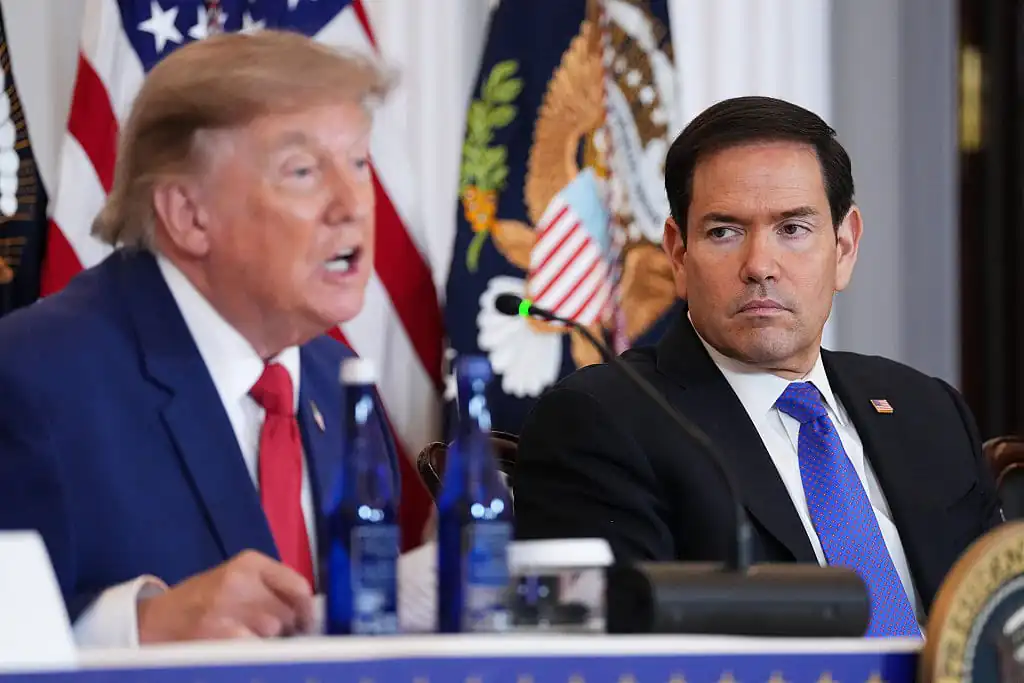
Photo: U.S. Secretary of State Marco Rubio (R) listens as U.S. President Donald Trump speaks at the U.S. Department of State on Aug. 7, 2026, in Washington, D.C. (Photo by Eric Lee/Getty Images)