Condemnation of Israeli Settler Violence Must Be Correctly Framed
Israeli settler violence has dominated media coverage of Israel and the Palestinian territories over the last few weeks. Escalating violations of human rights and international law continue to be blamed on the government of Israeli Prime Minister Benjamin Netanyahu. Many in the international community see the upcoming October 2026 election in Israel as an opportunity to unseat Netanyahu. However, while he has helped build the system that conducts genocide in Gaza and atrocities in the West Bank, it needs to be viewed as such – a system.
Messaging about the core issues driving settlement proliferation and settler violence can be lost without a holistic view that focuses blame solely on Netanyahu’s government. Blaming Netanyahu for atrocities in the Palestinian territory is accurate, but it must be paired with an acknowledgment of the larger machine. Netanyahu is both a driver and a symptom of a system that will continue to wage violence across the West Bank whether his Likud party is in power or not.
The System Supporting West Bank Settlement
Settlement and settler violence are state-backed activities that are larger than one man or party. The central goal of settling the West Bank is to prevent a Palestinian state and consolidate Israeli control over the land. In the short term, this goal has been realized. A two-state solution, or a Palestinian state, is further from reality than it has been in decades. The policy roadblock is in part due to the conflict and tensions stemming from the Oct. 7, 2023, massacre of Israelis by Hamas and the subsequent genocide in Gaza. However, it is also largely due to the massive settler population and infrastructure erected in the West Bank. The territory’s landscape is laden with more than 500,000 Israeli settlers living in 148 state-backed settlements and 390 relatively unofficial outposts.
The settlement population and its physical footprint are major obstacles that would require a massive population transfer or land swaps to achieve the aims of a two-state solution. Originating from the 1995 Oslo II Accords, the two-state solution is the official U.S. stance – operating in tandem with the normalization policy of the Abraham Accords. Any development toward a Palestinian state, and therefore sustainable stability, requires Palestinian self-determination and autonomy over the West Bank. It is impossible to achieve this with over half a million armed citizens of another nation living within those borders. To pursue any sustainable peace path, settlers must be returned to Israel in a sustainable and ethical way.
In the immediate future, the required land swaps or population transfer and substantial progress toward a Palestinian state are unlikely to come to fruition. The recent conflicts and Oct. 7 massacre have put the Israeli public on edge and fractured trust between the two sides. Only 21% of Israelis, polled in 2025, said they believed in the possibility of a peaceful coexistence with a Palestinian state. In the current political landscape, no politician has the political capital or base to advance a peace path that is perceived as threatening Israelis’ existence by the public. With its settlement campaign helping provide a bulwark against a Palestinian state, and the political will for one lacking, settlers and those driving the movement are able to continue unabated.
The Upcoming Election
The movement’s top-down leader, Netanyahu, is flanked by a coalition of far-right, pro-settlement extremists and has repeatedly accumulated political capital by maintaining steady support from these factions. However, support for settlement does not stop at the fringe of Likud’s coalition. The opposition parties, rallying behind accountability for the current government and its handling of the Oct. 7 massacre, do not stray far from Netanyahu and his allies on the issue of settlements and settler violence.
B’yahad – “Together” in Hebrew – coalition leader and former Prime Minister Naftali Bennett, who is attempting to regain the premiership, condemned settler violence in March 2026. Yet, Bennett’s statement does not reflect his true position. He has deep ties to the settlement movement, previously heading the Yesha Council, the organization for Israeli settlements in the occupied territories, and in June of 2026 he claimed that “Area C will ultimately be part of the State of Israel.” Area C is the Zone of the West Bank fully administered by the Israeli government, established at Oslo II. It is also where the majority of settlements and settler violence is conducted, as the lack of Palestinian authority provides sweeping impunity for settlers. Under his leadership, Bennett, like Netanyahu, will condemn the most outrageous acts and abuses, thereby legitimizing the rest of the activity, which is all illegal under international law.
The other major opposition candidate and leader in the polls, Gadi Eisenkot, former chief of staff of the Israel Defense Forces (IDF) under Netanyahu, has stated his opposition to a Palestinian state, adding “I very much believe in settlement in Judea and Samaria.” While his party is largely driven by reactionary ideals, including government accountability, he is laying the groundwork for a governing coalition, which will include pro-settlement elements. Aside from Bennett and Eisenkot, no other viable opposition leaders have emerged. The Arab parties have been excluded from any larger coalition, and the left has bowed the knee for fear of being left out in the cold.
The alternatives to Netanyahu may be perceived as more diplomatically amicable, but they have no intention of rolling back the Netanyahu government’s settlement progress or preventing further proliferation. If elected to replace him, neither Bennett nor Eisenkot will drive change from the top. If they want to hold on to power, they must appease their ruling coalition. Any opposition coalition will have to be a diverse body that includes powerful pro-settlement elements. Therefore, to gain and maintain power, they must apply the same playbook Netanyahu utilizes, catering to the more radical elements of their base, furthering settlement expansion and therefore enabling increased settler violence.
Analysis of the upcoming Israeli election must be anchored in history, with particular regard to the 2021-2022 coalition government under Bennett. While the Together coalition has been overtaken in opposition polling by the rising Yashar party under Eisenkot, lessons for an anti-Netanyahu government still apply. Bennett constructed a diverse coalition to secure the premiership in 2021, yet he could not hold its disparate imperatives together, leading to a coalition collapse and an election that returned Netanyahu to power.
If Eisenkot or Bennett is victorious, that candidate will have to weave together a coalition that includes, at the very least, far-right conservatives and centrists and balance their imperatives. The last time Netanyahu’s opposition won, it unseated him for a year and a half. Now, he once again lacks the votes to maintain power. However, with the opposition so fractured and driven by single-issue demands, a brief opposition victory followed by imminent collapse is likely. Following the potential collapse, a path to return to power with a unified coalition would present itself to Netanyahu.
The Detriment of the Netanyahu Settlement Bogeyman
Unseating Netanyahu is important for Israel’s internal stability, and his opponents will bring much-needed change. Namely, Netanyahu’s instinct to cater to his radical fringe has led him down a path against the Haredi draft, a highly polarizing and destabilizing issue, and to maintain gray-area conflicts against Hezbollah and Hamas that keep IDF reservists deployed, straining the country’s economy. He is also a detriment to regional security. His imperative to achieve Israeli security through an applied doctrine of offensive, high-pressure conflicts with little regard for international law or human rights is highly destabilizing.
Yet fixating on him, rather than considering him within the larger system, is an ineffective use of diplomatic pressure. It produces a miscalculation, which in turn prevents effective policy solutions. When the conversation fixates on one individual and not the holistic picture, it allows the system to continue without reproach. The core of the issue is the system that elects pro-settlement leadership, entrenches and proliferates hundreds of thousands of settlers in the West Bank, and allows violence against civilians to go unchecked. The growing international acceptance of Netanyahu’s condemnation is progress, but the crisis’ systemic nature must be made clear in order to apply effective pressure. If condemnation continues to center on one man instead of the root cause, diplomatic pressure and its weight will remain underutilized.
The views expressed in this article are those of the author and not an official policy or position of New Lines Institute.
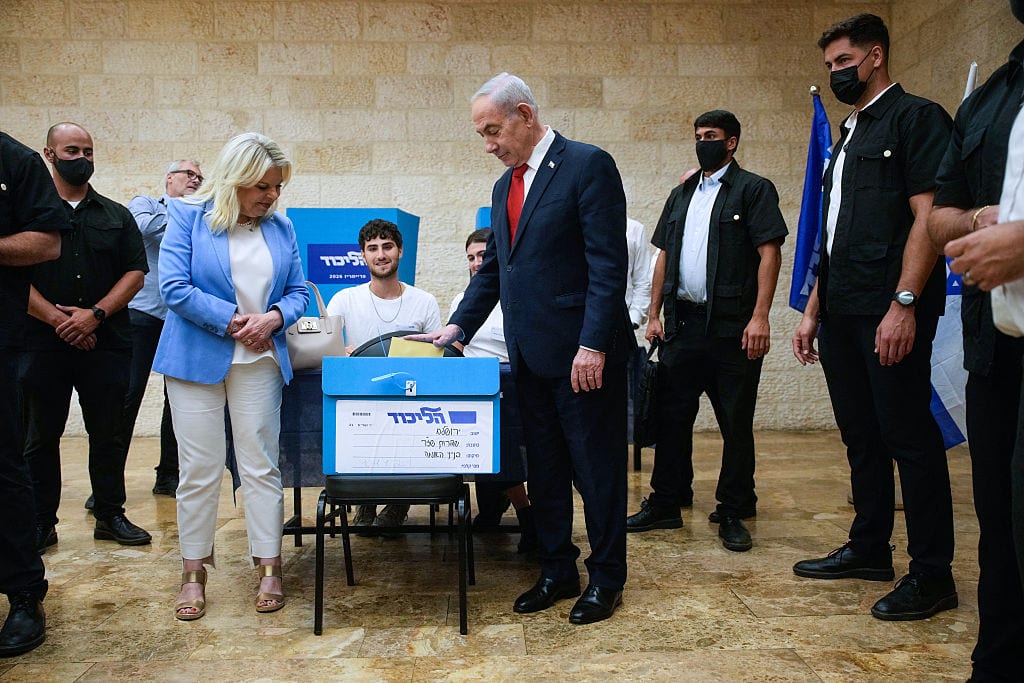
Photo: Israeli Prime Minister Benjamin Netanyahu, (C-R), and his wife, Sara, (C-L) cast their ballots at his party Likud’s main polling station during primary elections ahead of Israel’s general election in October in Jerusalem on Aug. 17, 2026. (Photo by Ohad Zwigenberg / POOL / AFP via Getty Images)