Implementation of the Women, Peace and Security Agenda: Lessons Learned from Ukraine
Scroll down to download the report in English or Ukrainian
Executive Summary
Ukraine represents a unique case in which a state is implementing the Women, Peace and Security (WPS) agenda under conditions of a large-scale, ongoing war. Since 2014, and particularly following Russia’s full-scale invasion in 2022, the unprecedented scope and intensity of Russian armed aggression have simultaneously accelerated institutional development and exposed structural gaps in gender-responsive governance. This has placed enormous pressure on national structures and services. Concurrently, the war has exposed the essential role of civil society and women’s organizations in the implementation of the WPS agenda in Ukraine, as well as the importance of localization and how women leaders shape this process.
Ukraine’s experience demonstrates that when the WPS agenda is effectively localized, integrated into national reforms, and supported by adaptable civil society actors, it can function as a framework that strengthens institutional capacity, enhances community resilience, and enables survivor-centered responses, even under extreme wartime constraints.
As Ukraine prepares to enter the new phase of implementation with the adoption of a new National Action Plan for 2026-2030 and potentially transitions from active hostilities toward a peace and recovery phase, the institutional gains achieved during previous years provide a resilient foundation. International partnerships and donor support have been critical in scaling and sustaining these efforts. However, further development will require ensuring the sustainability of WPS mechanisms in a context where international donor support may gradually decline. This will require a strategic shift toward stronger domestic institutional ownership, integration of WPS priorities into national budgeting and planning processes, and the consolidation of cross-sector coordination mechanisms.
Overall, Ukraine’s trajectory illustrates both the transformative potential and the structural limits of WPS implementation in active conflict settings. It highlights that progress is possible when driven by coordinated efforts among state institutions, civil society actors, and international partners. But it also underscores that long-term effectiveness depends on sustainability, inclusive participation, and a balanced approach that extends beyond immediate security concerns to comprehensively address broader dimensions of gender equality and recovery.
Strategic Recommendations from Ukraine’s Wartime Implementation of the WPS Agenda
Lessons Learned
Ukraine’s implementation of the WPS agenda during sustained Russian armed aggression offers a rare example of institutionalization, regionalization, and localization under conditions of ongoing war. Unlike postconflict adopters of UNSCR 1325, Ukraine operationalized WPS while simultaneously restructuring its security, justice, and governance systems under existential threat. This produced accelerated institutional change, uneven but meaningful localization, and structured state-civil society integration. It also revealed structural vulnerabilities relevant to other conflict-affected states. The Ukrainian example suggests several analytically significant lessons for governments, multilateral institutions, donors, and WPS implementing partners.
- Crisis can catalyze WPS institutionalization if political will exists
Ukraine’s initial engagement with WPS stemmed from emergency mobilization in 2014, driven by civil society, reform-oriented political actors, and supportive international partners after Russia’s invasion of Ukraine and illegal occupation and attempted annexation of parts of Ukrainian territory, including Crimea. Institutionalization accelerated only when these actors translated crisis urgency into structural reforms, including the gradual progression of NAPs. The key finding is that the presence of committed actors, not the existence of the war itself, enabled this rapid translation of crisis into policy change under duress.
Lessons Learned: International actors and states facing conflict should not treat conflict settings as unsuitable for WPS institutionalization. Instead, they should identify and support the change-driving actors, for instance through the coordinated government-civil society coalitions, to embed WPS within broader security and governance transformations. - Civil society, especially women-led local CSOs, can be structural implementers
A defining feature of Ukraine’s progress on WPS has been the central role of women-led civil society as both implementers and agenda-setters. Ukrainian women’s organizations have evolved from emergency responders to institutional partners influencing NAP design, CRSV-response mechanisms, and recovery planning. Their long-term engagement across phases created continuity between crisis response and governance reform. Women’s grassroots organizations are often the main drivers of the implementation of the WPS agenda at the local level. However, funding patterns remain misaligned with operational responsibility: Local women-led organizations continue to receive a disproportionately small share of humanitarian and security financing. This gap creates a structural contradiction between rhetoric and practice.
Lessons Learned: Donors should transition from project-based grants to sustained institutional support for local women’s organizations, increasing direct funding and formalizing civil society participation in monitoring and evaluation frameworks. Likewise, resilience in WPS implementation depends on institutionalized state-civil society partnership. Thus, states should develop the capacity of local and regional authorities to independently lead implementation of the WPS agenda. All parties should establish and sustain coordination platforms for the exchange of experience and the development of the regional Coalitions 1325. - CRSV response must be institutionalized across sectors
Ukraine’s response to CRSV evolved from documentation by civil society to partial institutionalization, and ultimately to multisectoral embedding during the full-scale invasion. The U.N.-Ukraine Framework of Cooperation on CRSV facilitated interagency coordination and the deployment of national experts across justice, health, and social systems. The key structural shift was the transition from a justice-only approach to an integrated, survivor-centered architecture. This model demonstrates that CRSV governance is most effective when prosecution, protection, and holistic support are institutionally linked.
Lessons Learned: States should establish cross-sector CRSV response mechanisms and link accountability efforts with comprehensive survivor support services. International partners should prioritize creating an institutionalized interagency system rather than funding standalone projects. - Operational inclusion of women in defense and security can catalyze structural reform
The dramatic rise in women’s voluntary enlistment in the Armed Forces of Ukraine during the full-scale invasion accelerated reforms that had begun in peacetime. These include legal and factual equality in service, introduction of anti-harassment policies, adaptation of equipment and infrastructure for women, and creation of gender adviser positions in the military. Operational necessity altered institutional incentives and reduced resistance to change. Meanwhile, women veterans have become visible in veteran affairs, post-conflict integration, and demining efforts. This suggests that women’s participation in security sectors reshapes institutional policy under mobilization conditions.
Lessons Learned: Security sector reform programs should treat gender integration as operational readiness reform, not just symbolic compliance. Post-conflict recovery and peacebuilding should deliberately include women veterans and leaders as agents of change and ensure women’s specific needs and priorities inform planning and policies. - International partnerships and women’s advocacy amplify domestic WPS implementation and shape global norms
In Ukraine, international partnerships (including with the U.N., EU, NATO, etc.) have been central to sustaining and reorienting Ukraine’s WPS agenda under wartime pressure. Technical and financial support helped Ukraine scale up gender-responsive systems, even during conflict. At the same time, Ukrainian women leaders have used international forums to influence global agendas. For example, their advocacy on assistance and reparations for CRSV survivors and gender inclusivity in the peace process has positioned Ukraine as a WPS norm-setter rather than just a recipient of aid.
Lessons Learned: External actors should foster partnerships that both empower national actors and allow local experiences to inform international standards. States can leverage global platforms (including CSW events, U.N. General Assembly meetings, Security Council debates, NATO summits, and other international conferences) to highlight domestic WPS innovations and ensure women’s voices help define the policies during and after the conflict, as well as ensuring just and sustainable peace. - The relevance and effectiveness of the National Action Plan can shift in the context of circumstances that have changed significantly
By 2022, the National Action Plan no longer adequately addressed the challenges and the current situation, which had changed significantly with the start of Russia’s full-scale invasion. At the end of 2022, the Ukrainian government adjusted the NAP, in particular, expanding the range of key target groups. As a result, many people in vulnerable situations who were not previously visible in the document (e.g., military families, former POWs, etc.) became the focus of activities.
Lessons Learned: The effectiveness of implementing the WPS agenda depends on the relevance of the adopted NAP. If circumstances change significantly, the document must be revised and reapproved at all levels: national (as a strategy), regional, and local (as operational activities). This will ensure that its implementation remains highly effective. - Women’s participation must be embedded in recovery and peacebuilding from the outset
Ukraine’s experience shows that women’s organizations and leaders are not only responders to wartime needs but also architects of recovery and peacebuilding. Their engagement links accountability, human security, community resilience, and gender equality, demonstrating that recovery cannot be reduced to physical reconstruction alone. Women veterans-turned-activists, having broken gender barriers in the armed forces, are now contributing to veteran reintegration and demining efforts. At the same time, Ukrainian women’s 10-Point Compact for Ukraine’s Just and Sustainable Peace is being cited in the highest international policy forums as a framework that safeguards human security, gender equality, accountability, and inclusive recovery. These initiatives illustrate that women are producing substantive policy agendas for what a just peace should contain.
Lesson learned: International partners and national authorities should formally embed women’s organizations, women veterans, survivor advocates, and local women leaders into recovery and peacebuilding processes. Their participation should be institutionalized in donor coordination, reconstruction planning, transitional justice mechanisms, veteran reintegration, and other related areas. Recovery frameworks that exclude women’s expertise risk reproducing insecurity and weakening the foundations of sustainable peace.
The views expressed in this article are those of the author and not an official policy or position of New Lines Institute.
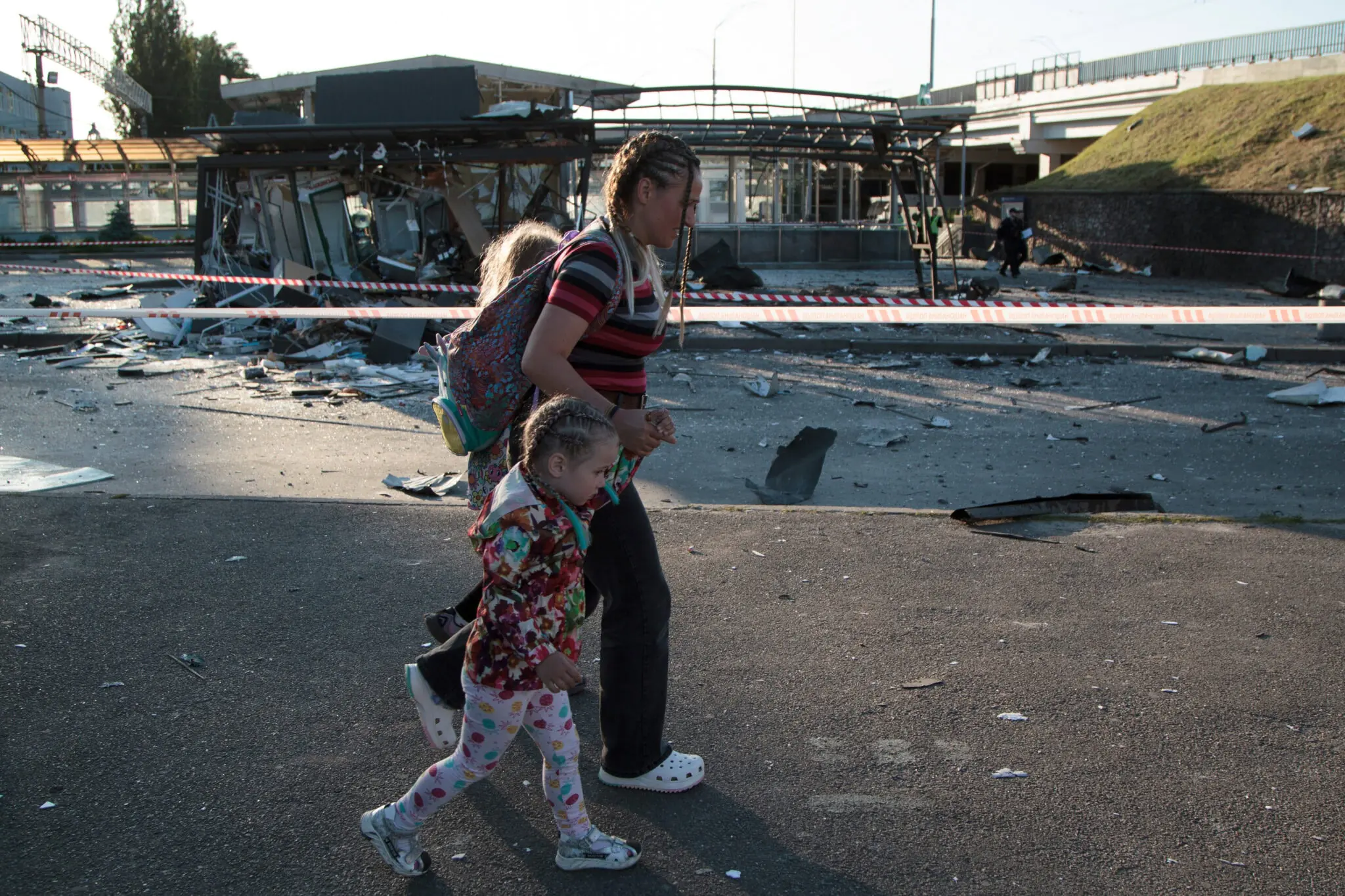
Photo: A woman with children walks past a damaged exit of the Sviatoshyn Metro Station following a Russian strike with ballistic missiles and drones in Kyiv, Ukraine, on June 23, 2025. (Kyrylo Chubotin / Ukrinform / NurPhoto via Getty Images)