Russia’s Coercive Occupation of Ukraine
Executive Summary
The report examines Russian occupation as a system, not merely a matter of shifting front lines or territorial control. It traces how coercive practices first tested in Crimea and parts of Donetsk and Luhansk after 2014 – including administrative absorption, population control, child militarization, information suppression, and the dismantling of local governance – have been systematically expanded and intensified across territories seized since 2022. Drawing on qualitative fieldwork, engagement with resistance networks operating under occupation, key informant interviews, open-source intelligence (OSINT), and detailed case studies such as Mariupol, the report centers the lived experience of civilians navigating repression, adaptation, and resistance.
By mapping the mechanisms through which Russia consolidates control – from filtration systems and forced passportization to economic integration and cultural erasure – the report assesses the implications for Ukraine’s long-term territorial recovery, demographic resilience, and state legitimacy. Finally, it considers the broader implications for the future of regional security in Europe, including the normalization of occupation as a strategy of warfare, the erosion of post-Cold War norms, and the risks posed to neighboring states if such models of control go unchallenged.
Recommendations
Policy responses must be built on the recognition that, beyond active combat, occupation itself is the primary engine of ongoing harm. Western governments and multilateral institutions should treat the dismantling of occupation structures, protection of civilians, and support for those under or escaping occupation as core security priorities rather than secondary humanitarian concerns. This requires aligning sanctions, legal accountability tools, security assistance, and reconstruction planning around the specific mechanisms through which occupation is sustained – schools, courts, registries, property systems, telecoms, and reconstruction finance – rather than focusing solely on frontline dynamics.
Taken together, these steps recognize that ending Russia’s occupation system is essential not only to restoring Ukraine’s territorial integrity but also to preventing a generation of Ukrainians from being permanently absorbed into an architecture of coercion that, if normalized, would weaken the entire international order’s ability to deter future wars of Russian imperialist conquest.
- Target the infrastructure and beneficiaries of occupation. States should expand and coordinate sanctions on Russian officials, regional authorities, state corporations, construction firms, banks, and intermediaries directly involved in administering occupied territories, financing reconstruction in places like Mariupol, running deportation and camp networks, or enforcing passportization and conscription. This should include secondary sanctions and procurement bans for unsanctioned entities demonstrably profiting from contracts or property in occupied Ukraine, coupled with legal frameworks to seize their overseas assets and earmark them for future Ukrainian-led restitution and reconstruction mechanisms.
- Create a dedicated accountability and documentation track focused on occupation crimes. Governments should support a standing international mechanism – or a reinforced mandate within existing bodies – to systematically document, preserve, and analyze evidence of occupation-related violations, including forced child transfers, civilian and child imprisonment, religious persecution, and coerced conscription, in close partnership with Ukrainian institutions and civil society. This should be linked to clear pathways for prosecution (domestic, hybrid, or international), long-term witness protection for people emerging from occupied areas, and coordinated use of universal jurisdiction for egregious occupation crimes, such as torture, enforced disappearance, and unlawful deportation.
- Protect and reconnect civilians under occupation. Protect and reconnect civilians under occupation. Western and partner governments should invest in resilient, secure channels – such as encrypted distance-learning platforms, offline materials, secure communications, and cross-border broadcasting – to keep occupied populations linked to Ukrainian education, information, and services. Parallel funding should support and scale Ukrainian and international networks that provide safe evacuation, legal aid, psychosocial care, and long-term reintegration for people, including children, leaving occupation, recognizing that reversing years of militarized schooling and propaganda will require sustained specialist support.
These efforts should be coordinated through official, secure, intelligence-led channels rather than NGOs, so as not to endanger resistance networks.
- Embed occupation dynamics into all security and reconstruction planning. Security assistance to Ukraine and discussions of post-war reconstruction should explicitly integrate the findings about child militarization, demographic engineering, and economic capture, recognizing that today’s school-age children in occupied territories are being channeled into tomorrow’s mobilization pool.
- Reinforce the norm against annexation and demographic engineering. Allies should use the Ukrainian case to strengthen global responses to annexation and settler-based demographic change, including by codifying clearer consequences for states that alter education systems, civil registries, religious institutions, or property regimes in occupied territory.
The views expressed in this article are those of the author and not an official policy or position of New Lines Institute.
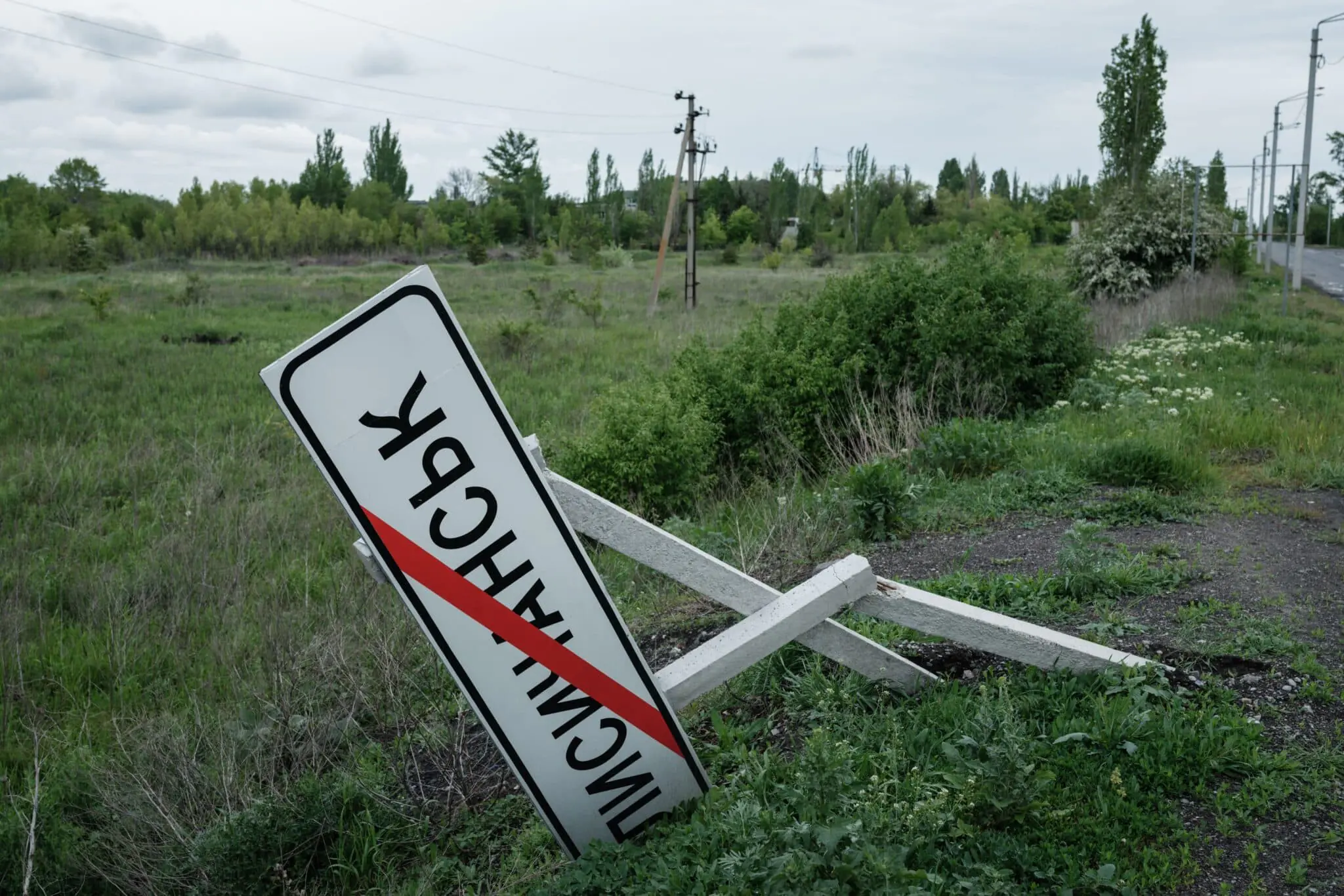
Photo: A road sign with the name of the city of Lysychansk is broken on the side of a road on the outskirts of Lysychansk, eastern Ukraine, on May 14, 2022, after fighting raged in eastern Ukraine’s Donbas region. (Yasuyoshi Chiba / AFP via Getty Images)