Trump’s Remarks Portend Waning U.S. Leadership on Transnational Repression
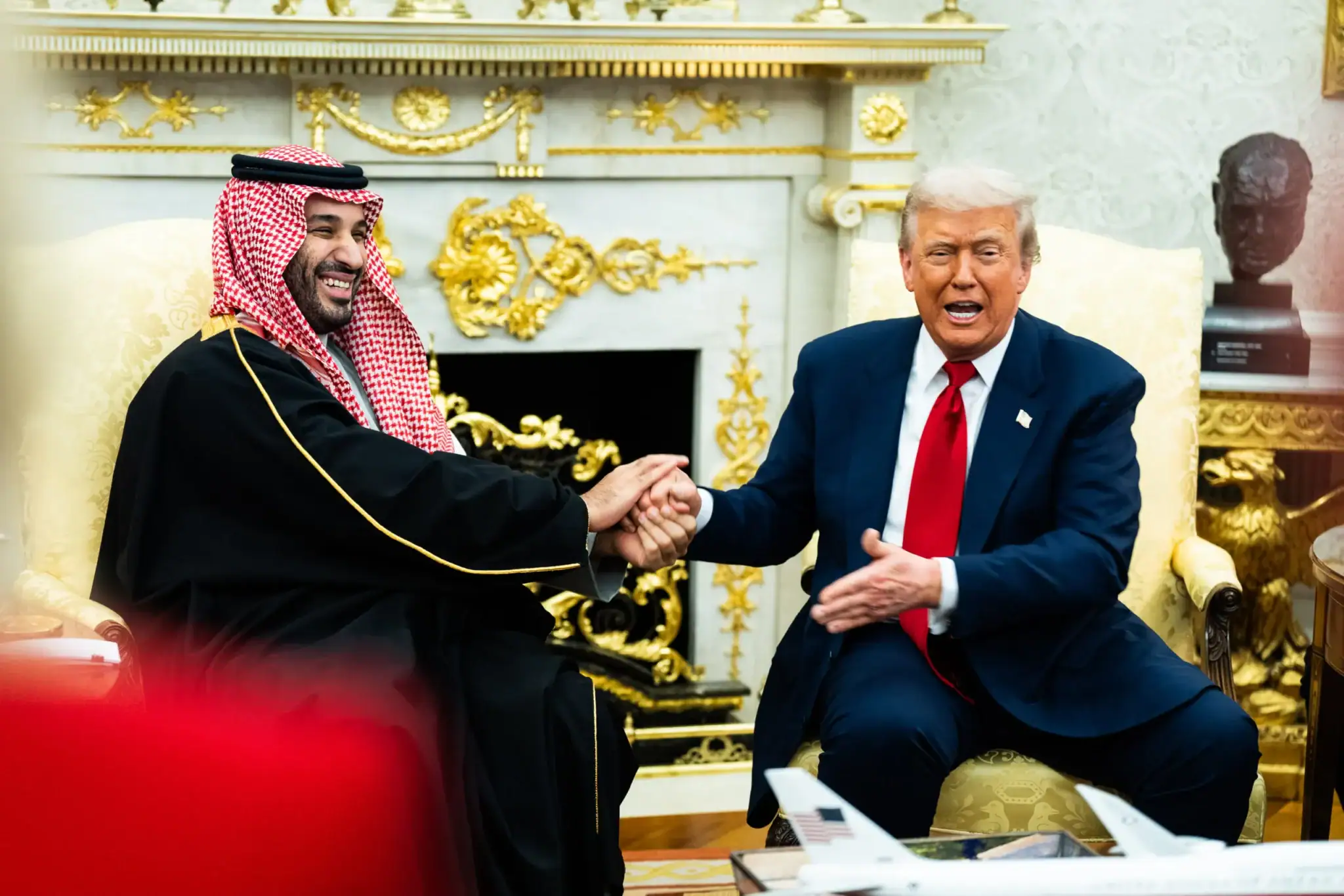
While the Nov. 18-19 White House visit by Saudi Arabian Crown Prince Mohammed bin Salman may have solidified the U.S. relationship with a key Middle East ally, President Donald Trump’s embrace of the Saudi leader dimmed U.S. progress in a growing movement to address transnational repression (TNR). Trump not only feted but also defended bin Salman in his first Washington visit since the brutal 2018 slaying of Saudi-American journalist Jamaal Khashoggi by agents of the Saudi government.
Trump defended bin Salman, claiming he “didn’t know” about the assassination – directly contradicting U.S. intelligence concluding that it had been ordered by bin Salman himself. His dismissal of the slain journalist, who was killed in a Saudi Consulate in Türkiye where he had gone to collect an official document, with the phrase “things happen” also flew in the face of calls from civil society organizations in the days leading up to the visit, which recommended that the White House put human rights on the agenda and hold the Saudi leadership accountable for its abuses.
With his comments, Trump dismissed one of the most egregious and disturbing cases of TNR to occur anywhere in the world in the past decade. Behind the collective shock and outrage that might keep this White House meeting in the news cycle for another few days, much is at stake.
Extraterritorial Assassinations and the TNR Toolkit
Khashoggi was an accomplished journalist, Saudi exile, and U.S. resident who was working at The Washington Post at the time of his murder. In his work, Khashoggi was critical of Saudi leadership, writing in defense of activists and calling for respect for the rights of minoritized and oppressed groups. On Oct. 2, 2018, investigations found, he entered the Saudi Consulate in Istanbul. Once inside, a team of Saudi agents whisked him away and killed him. His body was then sawed apart and disposed of in an operation that a U.S. intelligence assessment concluded had been ordered by MBS to silence his criticism.
While rare, extraterritorial assassinations like Khashoggi’s constitute one of the most extreme and disturbing tactics of transnational repression, or what New Lines has defined as “those actions or activities taken by representatives of a state and/or its proxies to repress nationals of that state living outside its borders.” Other, less extreme TNR tactics are lobbied against targets – dissidents, exiles, journalists, and even entire diaspora populations – with frequency: harassing phone calls and emails, bogus Interpol notices, third-country detentions, threats of extradition, refoulements.
Saudi Arabia is among the most notable perpetrators of TNR but doesn’t even rank in the top 10 as identified by Freedom House in 2023: China, Türkiye, Tajikistan, Egypt, Russia, Turkmenistan, Uzbekistan, Iran, Belarus, and Rwanda take those honors. TNR poses national security threats wherever it is perpetrated, and most devastatingly of all, it violates the fundamental rights and freedoms of people who left their home countries in search of those very things.
What Are the Stakes and What Should Be Done?
Trump’s dismissive stance strikes a major blow to U.S. government and civil-society leadership on the issue of transnational repression. In the past several years, transnational repression has become a major issue in U.S. foreign and domestic policy spaces. Civil society organizations, individual advocates, lawmakers in Congress, and officials across government agencies like the FBI, Department of Justice, and Department of State had begun to address the issue, elevating it with exposure, funding, and even diplomatic engagements meant to spur action by like-minded allies across North America, Europe, and Australia.
As Nate Schenkkan pointed out in a July 2025 analysis published by The Lawfare Institute, the movement to address TNR sustained a strong blow earlier this year following the immediate rolling out of new, disruptive policies under Trump 2.0: mass firings under the Department of Government Efficiency, the mass termination of foreign aid awards, and brutal anti-immigration policies. These were but a few early signals that rights-oriented concerns like TNR would not figure centrally in the administration’s agenda.
More recently, progress in the fight against TNR has sustained other blows: In late September, the administration announced its intent to deport hundreds of Iranians held in U.S. immigration detention to Iran beginning in early October, a move critics have pointed out would amount to refoulement in violation of international law given the likelihood that the deportees would face persecution in Iran. (As of this writing, it is unclear whether refoulement has occurred.) Earlier this month, Trump pardoned Michael McMahon, a U.S. citizen who had been convicted of acting as an unregistered foreign agent, interstate stalking, and conspiracy after assisting the Chinese party-state in tracking and intimidating Chinese dissidents in New Jersey.
Combined, Trump’s statements and actions undermine a bipartisan desire in the legislative branch to address, mitigate, and combat TNR at home and abroad. The Transnational Repression Policy Act introduced in the House and Senate over the summer, would among other things, lead to the formal adoption of a definition of TNR – a necessary step toward ensuring continuity across the U.S. government when talking about TNR and training law enforcement to recognize and address the issue with needed consistency and sensitivity. The bill would also allocate resources for U.S. collaboration with allies and multilaterals, necessary to address a global issue without borders. As Ted Bromund, Sandra Grossman, and Bradley Jardine point out in a New Lines report assessing the U.S. response to TNR, cooperation between the executive and legislative branches on TNR was low even under the Biden administration.
In December 2018, the Senate issued a unanimous – and thus bipartisan — condemnation of bin Salman. In 2025, only Democratic members have called out the hypocrisies on display in Trump’s meeting with MBS. The cosponsors of the Transnational Repression Policy Act of 2025, along with other those of other legislation proposing to target TNR perpetrated in the U.S., must vocally defend their bills and continue pushing for action with their peers in Congress.
Can we come back from this? The president could apologize for his remarks. But his well-recognized transactional style of politics and focus on business deals at the exclusion of human rights considerations make that unlikely.
Trump’s comments from the Oval Office not only undermine the first-rate research and advocacy done to address TNR to date but also signal to other authoritarian and repressive leaders that they, too, would likely face few to no consequences for perpetrating transnational repression and violating the fundamental rights of those who disagree with them. Saddest of all, dissidents, diasporas, and exiles who came to the United States in search of a place to freely express dissent and work toward a better future for their home countries – will continue to suffer at the hands of illiberal and despotic leaders.
The views expressed in this article are those of the author and not an official policy or position of New Lines Institute.
555