Uzbekistan Views its Future in Trade and Investment Diversity
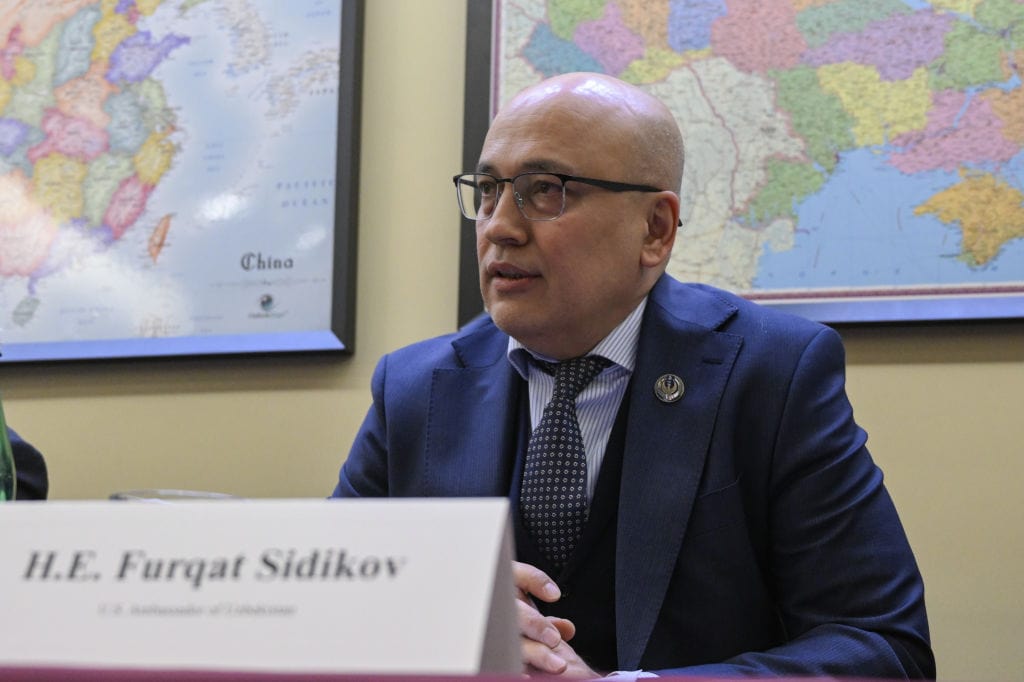
Thirty-five years since independence, Uzbekistan is looking forward when it comes to regional trade networks and relations with the United States. On Aug. 27, the Embassy of Uzbekistan in Washington, D.C., brought together a group of regional experts and journalists for a round table with Ambassador Furqat Sidikov, where they discussed ways to improve the U.S.-Uzbekistan relationship, regional developments in Central Asia, and other issues of mutual interest. What emerged from the discussions was that the Uzbek government views private-sector engagement and trade as the main drivers of sustained relations with the U.S. and that developing more diversified trade networks to global markets, particularly through South Asia, is key to expanding the country’s economic development.
How to Sustain Uzbek-American Relations
The second administration of President Donald Trump has emphasized relations with Central Asia more than any prior American administration since the end of the Cold War. The groundbreaking 2025 C5+1 summit, held in November 2025 at the White House, was the first time a U.S. president had met all the Central Asian presidents together in that format – a turning point in U.S. engagement with the region. Countries like Uzbekistan have been taking advantage of U.S. interest, most recently with the signing of a memorandum of understanding to boost U.S. private sector investment in Uzbekistan.
While it is too early to gauge the success of current initiatives, the Uzbek government is signaling that building private sector ties is key to sustained U.S. engagement. When asked directly about this during the roundtable, Sidikov stated as much with his comment that engagement with “private businesses will be the durable connection through administrations.”
The big hurdle for this is convincing American businesses to invest in Uzbekistan. The government has so far sought to encourage this by administrative means: the launch of the American-Uzbek Business and Investment Council, establishing Free/Special Economic Zones, and the recent creation of the Tashkent International Financial Center, whose appeal to western investors is strengthened by its usage of English Common Law and separate commercial court. There has been some success in engaging investors. Sidikov highlighted a multibillion-dollar agreement with U.S. corporation BlackRock, which joined over 300 other U.S. companies operating in Uzbekistan. Uzbekistan is also working with New York-based investment firm Franklin Templeton to manage the country’s National Investment Fund.
However, Uzbekistan still needs to improve its image among foreign investors, especially when it comes to ensuring fair arbitration processes for disputes and curbing corruption. Like many post-Soviet states, Uzbekistan has a history of corruption and transparency issues, and its economy is dominated by state-owned entities and banks. Recent cases like that of Solfy CA, a Russia-based fintech firm whose local branch director is allegedly subject to arbitrary detention over a dispute between the company and the National Bank of Uzbekistan, are the type to turn off foreign investors from engaging with Uzbekistan over concerns that their business interests will not face fair treatment from local authorities. Efforts to increase transparency and provide familiar investing environments for foreign investors, such as with Free/Special Economic Zones and the Tashkent International Financial Center, are a good start, but a persistent strategy of minimizing negative incidents while maximizing incentives for investors through mechanisms like easy access to authorities, investment schemes, and improving government transparency and even accountability will help develop the perception of Uzbekistan as a strong investment environment.
On bilaterial relations, Uzbekistan is right to think that successful private-sector engagement is the best way to support a sustainable relationship with the United States. A future Democratic administration could see human rights issues regain salience in foreign affairs, and a future president might also look negatively upon perceived politicized actions, such as Central Asian engagement with Trump’s Board of Peace.
The private sector will play a big role in setting the tone for U.S.-Uzbek relations. Private-sector engagement and trade is a major factor in enduring bilateral relations between states and with Central Asia’s critical mineral reserves only set to increase in importance to the global economy attracting investment now is key to securing the future of bilateral ties. The economic development support U.S. investment brings to Uzbekistan in its own development goals in the AI and tech industries will also be important. A significant U.S. business footprint in Uzbekistan, and Central Asia more generally, will make it harder for a future administration to disengage from the region or return to a policy of benign neglect, especially when compounded with other factors like the increasing need for critical minerals.
Afghanistan’s Role in Regional Trade Dynamics
Improving relations with the United States is just one aspect of a more expansive effort by the Uzbek government to integrate itself into the wider global economy. For years, Uzbekistan has invested heavily in east-west connectivity, with ambitious infrastructure projects linking the country with both China and the Middle Corridor. At the round table event in Washington, Sidikov made repeated note of the government’s interest in looking south and integrating neighboring Afghanistan into the region’s wider trade network.
Since the reestablishment of Taliban rule in 2021, Uzbekistan has consistently been at the forefront of engaging with Kabul, including on economic development and trade. During discussions, the ambassador highlighted the 2024 creation of a Free Economic Zone in Termez, along the Uzbek-Afghan border, which is meant as a space for fostering Uzbek-Afghan business opportunities and regional trade and points to the Uzbek government’s desire to engage and support the Afghan economy. So far, Uzbekistan is one of only a few countries to engage meaningfully with the globally unrecognized Taliban government and has taken the lead when it comes to Central Asia’s engagement with Afghanistan.
More ambitiously, the ambassador spoke about Afghanistan connecting Central and South Asia, facilitating trade along a north-south route. As New Lines Institute’s Silk Seven+ project outlines, Afghanistan is the lynchpin needed to build and expand a new trade route between Central and South Asia. Such a route would be shorter, potentially faster, and would provide easy access for goods coming in and out of Central Asia via Pakistan’s Arabian Sea ports, allowing both diversity and flexibility to Central Asian states looking to build their presence in global trade.
There are real, though surmountable, challenges. Afghanistan’s internal stability is a major concern, with recent reports of clashes in northern Afghanistan being the most recent example of instability. Permanently settling disputes with Pakistan would also be required for the viability of any cross-regional trade given the significant drop in trade between Central Asia and Pakistan since clashes between the South Asian state and Afghanistan began in February, 2026. However, given these challenges, Sidikov seemed bullish about the prospects for deeper economic cooperation between Afghanistan and Uzbekistan, even alluding to the desire for Afghanistan to become an “air-hub” for the region, boosting connectivity along with other infrastructure projects like the Trans-Afghan Railway project.
By betting on diversified trade networks and private-sector engagement with the West, Uzbekistan is hoping that it can retain the ability to hedge its international partnerships, remaining an independent actor while benefitting from the experience and capital U.S. businesses have in emerging markets like FinTech and AI. For a country in a region where U.S. attention has often been fickle, this is a smart strategy. All Uzbekistan needs now is to make itself more attractive to foreign businesses to secure reliable new pathways to global markets.
The views expressed in this article are those of the author and not an official policy or position of New Lines Institute.
Photo: Uzbekistan’s ambassador to Washington Furqat Sidikov speaks at a conference in Washington, D.C., on Nov. 2, 2023. (Photo by Celal Gunes/Anadolu via Getty Images)