Central Asia Roundup: August 2026
Kazakhstan
Kazakhstan’s election for its new unicameral parliament took place Aug. 23, with the Central Election Commission confirming final results Aug. 25, showing that five parties cleared the 5% threshold for representation in the Kurultai. The newly formed Adilet party, chiefly comprising members of the former ruling party, Amanat, received 71.17% of the vote to secure 110 of 145 seats, while the second-place Auyl Party won 6.26%. About 9.35 million voters cast ballots, a turnout of 74.1% of eligible voters. This compares with a 54.2% turnout for the 2023 parliamentary elections and 73.1% for the referendum approving the country’s new constitution. Policy experts argued that the results represent the continuation of a single political sequence that began with the constitutional referendum.
The results should be assessed in terms of Kazakhstan’s broader efforts to modernize its political and institutional structure as it gradually transforms its economy and the relationship between the state and society. One of the main challenges left in this political transformation is the country’s limited pluralism as concerns about media freedom increase. Related challenges include securing state stability while expanding political participation, institutional accountability, and social pluralism.
Uzbekistan
Azerbaijani President Ilham Aliyev visited with Uzbek President Shavkat Mirziyoyev during his visit to Tashkent on Aug. 23-24. The leaders signed the Treaty on Eternal Friendship aimed at strengthening bilateral ties alongside agreements with the goal of increasing trade volume to $1 billion by 2030; establish partnerships in areas like tourism, culture, justice, customs-related cooperation, and interregional ties; and coordinate foreign ministry programs. Both leaders said they are committed to avoiding alliances hostile to each other’s sovereignty. Uzbekistan also marked its independence anniversary in late August. Mirziyoyev said that while Uzbekistan had initially aimed to raise its annual gross domestic product to $160 billion by 2030, it now expects to exceed that level by year’s end. He also noted that the share of people living at or below the poverty level had fallen from 35% in 2017 to 4% this year. Separately, Mirziyoyev told a gathering of business leaders in the Khorezm region that entrepreneurs were moving from the stage of “starting a business” to the stage of “increasing capital,” with business investment in fixed capital having tripled over five years to about $30.6 billion.
Uzbekistan is gradually reforming its economy by empowering local small businesses and reducing the dominance of state-owned enterprises, though the state still accounts for a significant share of GDP. However, the country faces serious challenges: Many small businesses lack the skills, expertise, and standards required to compete effectively in international markets, putting them at a competitive disadvantage as Uzbekistan integrates further into the global economy. A recent report by the World Bank’s International Finance Corporation noted three sectors that could generate high revenue success for private investment and ultimately the economy: logistics, tourism, and pharmaceuticals.
According to the report, Uzbekistan faces an 88% shortage of modern warehousing. Regulatory changes to facilitate its development could result in $1 billion in private investment and 41,000 new jobs. For tourism, addressing land ownership rules, addressing a sector skills shortage, and improving management of tourist sites could add $3.1 billion to $4.2 billion in investment and create up to 180,000 jobs, the report noted. In the pharmaceuticals sector, the report assessed that reforms are needed, particularly to streamline drug registration and set up domestic bioequivalence labs. Those changes could unlock $188 million in investment and create over 20,000 skilled jobs.
Kyrgyzstan
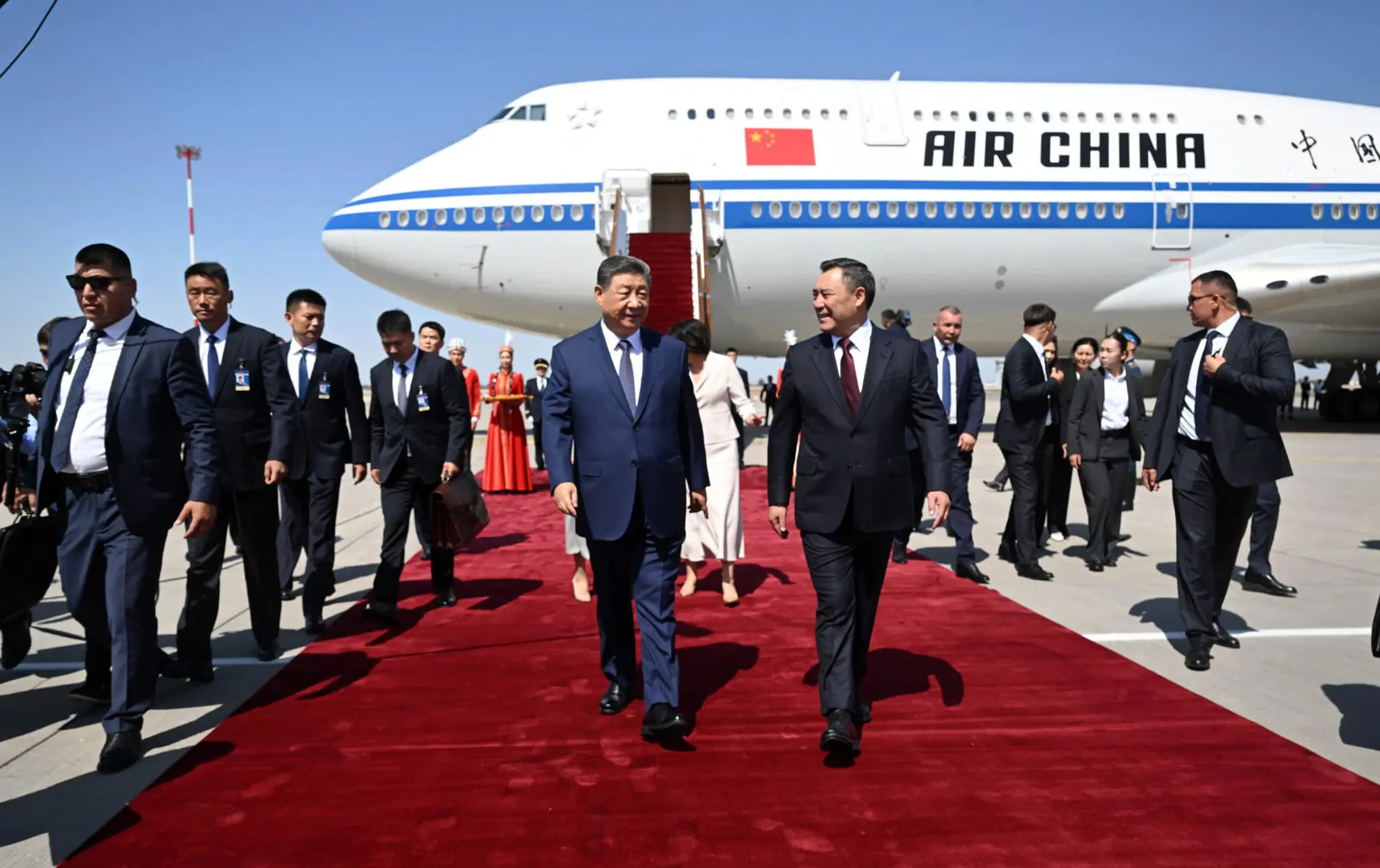
Kyrgyzstan completed its rotating SCO chairmanship by hosting the bloc’s 26th heads-of-state summit from Aug. 31-Sept. 1. Kyrgyz President Sadyr Japarov led the event titled “25 Years of the SCO: Together for Sustainable Peace, Development and Prosperity.” The meeting produced a “Bishkek Declaration” marking the SCO’s 25th anniversary, alongside thematic statements and other decisions such as regulations for two new security bodies and cooperation measures covering transportation, digitization, energy policy, and climate cooperation. The summit featured all 10 leaders of the core SCO countries, with an expanded “SCO Plus” format drawing the participation of another seven. The summit coincided with Kyrgyzstan’s Independence Day and the Aug. 31 opening of the World Nomad Games.
On the monetary front, pressure on the som persisted. The National Bank of Kyrgyzstan conducted its 10th currency intervention of the year, selling $196.2 million-worth of currency reserves to push the total volume of such operations to $1.669 billion, compared with eight interventions totaling $853 million in 2025.
Bishkek’s soft-power strategy to project Kyrgyzstan as a confident regional convener during its rotating chairmanship comes amid currency pressure driven by the costs of imports, remittance volatility, and capital outflow dynamics, suggesting the central bank is prioritizing the stability of the exchange rate. The disparity indicates Kyrgyzstan’s diplomatic prestige has outpaced its capacity to manage the fragility of its economy. This reality will likely inform any SCO-related investment and trade commitments.
Tajikistan
During an awards ceremony on Aug. 25, just ahead of the 35th anniversary of Tajikistan’s independence from the Soviet Union, President Emomali Rahmon lauded 165 of his compatriots for achievements in science, culture, medicine, and other fields. Rahmon directed particular praise toward workers building the Rogun Hydroelectric Power Station. During a visit to the project a few days earlier, Rahmon decreed that its dam height will be raised by another 30 meters within a year. S&P Global Ratings reported that Tajikistan will need roughly $5.8 billion more to complete construction.
Also during August, a Tajik delegation held talks with senior officials in Tehran, where the two sides proposed a “Union of Persian-Speaking Countries and Regions” for the purposes of developing stronger cultural ties between the two Persian-speaking countries. The Tajik and Turkmen foreign ministers, meanwhile, agreed on a two-year cooperation program during a meeting in Ashgabat. Rahmon met with Armenian Prime Minister Nikol Pashinyan on the sidelines of the SCO summit in Bishkek to highlight the importance of developing bilateral ties.
The decision to change the timeline and its funding shortfall point to a structural pattern of committing to physical milestones faster than its capacity to secure the capital to pay for them. Demands such as these typically result in one of three outcomes. The first is turning to external lenders, raising questions about which partners will gain leverage: Russia, China, or multilateral development banks. The second is diverting funds from other budget priorities. The third is quietly changing the timeline while maintaining the public narrative of progress in the reconstruction. At the same time, the Rogun project represents an important test for the ability and capacity of the European Union, which is helping support the dam’s construction, to fund and influence strategic projects in the Central Asia at a time Russia is losing ground and influence in Central Asia while China’s presence grows.
Turkmenistan
In August, Turkmenistan advanced energy and transit ties with Afghanistan. On Aug. 10 in Afghanistan’s Herat province, Afghan Gas and Turkmenistan’s state gas company, Türkmengaz, signed a memorandum of understanding on gas purchases under the Turkmenistan-Afghanistan-Pakistan-India (TAPI) pipeline project. The agreement followed a working visit by Paramount Leader Gurbanguly Berdimuhamedov to the Islam-Cheshme border zone, where he held talks with Afghan Deputy Prime Minister for Economic Affairs Abdul Ghani Baradar on cooperation in the fuel and energy, transport and logistics, and electricity sectors. Delegations from both countries met in Ashgabat on Aug. 30 to sign further cooperation deals, including an agreement between the TAPI Pipeline Company Ltd. and the Afghan government and a memorandum on the Turkmenistan-Afghanistan-Pakistan power transmission line project.
Turkmenistan’s decision to bolster diplomatic and economic relationships with Afghanistan is driven in part by its foreign policy of neutrality and cooperation with neighboring states. It also has an economic motive in reviving the TAPI pipeline in that building a new route to export its natural gas to South Asia would reduce its reliance on China. Beyond energy, deeper transportation and power links with Afghanistan would help position Turkmenistan as a connector between Central and South Asia. There’s also a security dimension in building economic ties that helps keep their shared border stable.
Regional Implications
For much of Central Asia, August was a month of political symbolism as well as economic coordination and partnership. Both Uzbekistan and Kyrgyzstan marked 35 years of post-Soviet independence. With its inaugural Kurultai elections, Kazakhstan completed a political change that solidified presidential power, albeit one that, at least on the surface, opened the possibility for reform. One undercurrent was the desire of the region’s governments to show movement when it comes to infrastructure and trade. While Kyrgyzstan’s currency issues show instability, Uzbek efforts to strengthen its connection to Azerbaijan – and thus the Middle Corridor, along with positive news from Turkmenistan regarding the TAPI pipeline project, shows that Central Asian leadership is serious about building regional connectivity and developing their economies. Rahmon and Pashinyan’s meeting symbolizes the desire to look beyond existing projects and partners to develop stronger economic connections with actors farther afield.
Regional Integration
Cooperation among Central Asian states showed some progress in August.
While trade among the five Central Asian states continues to grow, it accounts for only a small share of overall trade in the region, according to data for the first half of 2026 released by regional governments. Also, while Pakistan is stepping up diplomatic and economic engagement with Central Asian states, its total trade with the region decreased significantly in the first half of the year. Meanwhile, data shows that regional commerce with Afghanistan has experienced a significant uptick.
In a strong sign of regional cooperation, Azerbaijan and Kazakhstan completed laying a trans-Caspian submarine fiber-optic cable that now connects them. While some infrastructure remains to be completed, the project is expected to be operational by the end of the year. The next stage is establishing cable connections with neighboring Central Asian states, including Uzbekistan and Turkmenistan.
As part of another major regional initiative, Kazakhstan is lobbying the European Union to include the Caspian Green Energy Corridor on the list of Projects of Mutual Interest. The corridor is part of a green energy plan developed by Azerbaijan, Kazakhstan, and Uzbekistan to link their power grids with an eye toward exporting electricity to the European Union.
In another sign of expanding regional cooperation, Kazakhstan offered Uzbekistan significant discounts on transit via its Caspian port of Kuryk, a major Middle Corridor hub.
Meanwhile, Berdymukhamedov made a trip to Afghanistan for talks aimed at building momentum for the TAPI natural gas pipeline and expanding broader trade contacts. The most notable development during the visit was the signing of what amounted to a letter of intent reportedly outlining basic terms for the shipment of Turkmen gas to the Herat region. The document also mentions the possibility of Turkmen involvement in the creation of a regional gas distribution network in Herat.
But’s not all smooth sailing for relations among regional states. With Central Asia struggling to cope with drought conditions, Kazakhstan resorted in recent months to weather modification in an attempt to enhance precipitation, and some in Kyrgyzstan have accused Kazakhstan of literally stealing clouds to produce rain.
Also, in a move potentially counter to the growing integration trends in Central Asia, Kazakhstan is rolling out a system where citizens of the countries with which it has a visa-free regime will now have to seek entry authorization prior to their visit, thus creating new travel barriers.
In a potential sign that in Central Asia growing partnership coexists with intensifying competition, Kazakh authorities took a visiting Uzbek professor into custody on charges of espionage. Prof. Ikboljon Qoraboev, who was teaching at Narikbayev University in Astana, focused his research on critical minerals in Central Asia.
U.S.-Central Asian relations
It was a busy August for U.S. engagement with Central Asia.
U.S. President Donald Trump had separate phone conversations with Uzbek President Shavkat Mirziyoyev and Azerbaijani President Ilham Aliyev to discuss strengthening and expanding cooperation.
Meanwhile, the White House released a report titled The Great Transshipment Scam accusing over 40 countries, including Kazakhstan, Uzbekistan, Georgia, and Azerbaijan, of helping China engage in tariff evasion schemes designed to maintain the country’s U.S.-bound exports.
U.S. Assistant Secretary of State for South and Central Asian Affairs Samir Paul Kapur visited Kazakhstan, Kyrgyzstan, and Uzbekistan, where he met with the nations’ ministers of foreign affairs to discuss a wide range of bilateral and multilateral matters, such as critical minerals, energy, technologies, transport, and investment.
In the meantime, U.S. Under Secretary of State for Political Affairs Allison Hooker met with the five Central Asian ambassadors in Washington, D.C., to “discuss investment opportunities, critical minerals, and emerging technology,” adding that “the Trump administration looks forward to working with the C5 to advance our ambitious agenda.”
U.S. Ambassador to India and Special Envoy to South and Central Asia Sergio Gor and U.S. Sen. Steve Daines visited Kyrgyzstan amid the SCO leadership summit. The two held separate meetings with the presidents of Kyrgyzstan, Tajikistan, and Uzbekistan to discuss bilateral matters, as well as cooperation in the C5+1 format, thus shaking up the summit’s anti-American narrative and disrupting any appearance of unity among the gathering’s attendees.
A U.S. House of Representatives delegation visited Central Asia, where the congressmen met with the presidents of Kazakhstan and Uzbekistan, as well as other officials. The tour was followed by a hearing in the U.S. House Committee on Ways and Means on strategic partnerships to secure critical resources and supply chains, where Central Asia featured prominently.
The U.S. Department of State drafted a note stating that any nation interested in widening access to advanced U.S. know-how and technology in the AI sector under a program known as Pax Silica must refrain from participating in a rival Chinese initiative known as the World Artificial Intelligence Cooperation Organization (WAICO), according to Reuters. However, actions and statements by Kazakh and Uzbek officials since news of the draft State Department note began circulating indicate that both states are disinclined to adhere to what amounts to a U.S. demand.
Also, the State Department made permanent its pilot visa bond program, under which citizens of 50 countries – including Kyrgyzstan, Tajikistan, and Turkmenistan – seeking to obtain B-1 or B-2 visas may be required to pay a bond. The maximum amount of the bond was increased from $15,000 to $20,000.
Meanwhile, the department’s travel advisories listed Kazakhstan, Uzbekistan, and Turkmenistan among the safest places in the world for Americans to visit, ranking them higher than most other countries, including many in Western Europe.
On the business side, Cove Kaz Capital Group, whose project in Kazakhstan represents the first major American foray into the Central Asian critical minerals sector, has appointed a group of international engineering companies to carry out a definitive feasibility study for the Northern Katpar tungsten project.
Also, U.S. natural gas producer Comstock Resources announced plans to sell stakes in its Haynesville shale assets and related midstream business to Azerbaijan’s SOCAR for $1.65 billion.
Photo: Chinese President Xi Jinping and his wife Peng Liyuan are welcomed by Kyrgyz President Sadyr Japarov and First Lady Aigul Japarova upon their arrival at Manas International Airport in Bishkek, Kyrgyzstan, on August 30, 2026. President Xi arrived for an official state visit and to participate in the upcoming Shanghai Cooperation Organisation (SCO) Summit on September 1. (Photo by Kyrgyz Presidency/Anadolu via Getty Images