Central Asia Roundup, September-October 2026
This Central Asia Center briefing reviews the most important political and security developments across the region during September and October.
U.S.–Central Asian relations
September and October were busy months for U.S. diplomacy in Central Asia.
On Sept. 9, Turkmenistan hosted U.S. officials for a meeting of the C5+1 Secretariat. Participants discussed trade, transport, and critical minerals and prepared upcoming projects to be implemented within the C5+1 format.
On Sept. 29, Mark Cameron, the U.S. deputy assistant secretary for Central Asia, told a C5+1 conference on artificial intelligence in Astana that a stronger cybersecurity framework and trusted digital infrastructure would encourage more U.S. investment. He said Washington has committed $5 million via CRDF Global for cybersecurity and digital-sector assistance to the region.
U.S. Secretary of State Marco Rubio, along with an almost 300-strong U.S. business delegation, visited Samarkand, Uzbekistan in mid-October where Rubio held talks with foreign ministers from all five Central Asian states. According to a joint statement issued after the meeting, Washington pledged to help Central Asian states expand exports “by developing innovative ways to increase value-added products within the region and [create] pathways to introduce these products to the international market.” Central Asian foreign ministers were happy to hear a message from Rubio that the United States will not be pursuing a zero-sum economic policy that would force regional states to choose between U.S. and Chinese models of development in key areas, especially digital technologies and artificial intelligence. In August, the State Department had reportedly threatened that any Central Asian nation participating in a China-led AI development framework called WAICO would be prevented from participating in a U.S. initiative to share advanced technologies critical for the development of advanced AI models.
An accompanying trade forum in Samarkand yielded at least 54 U.S.-Uzbek business deals worth potentially $12 billion. Uzbek President Shavkat Mirziyoyev said his country would work to become more investor friendly. “Investors coming to Uzbekistan should be able to start doing business immediately, without wasting time on administrative procedures,” he stated.
Kazakhstan
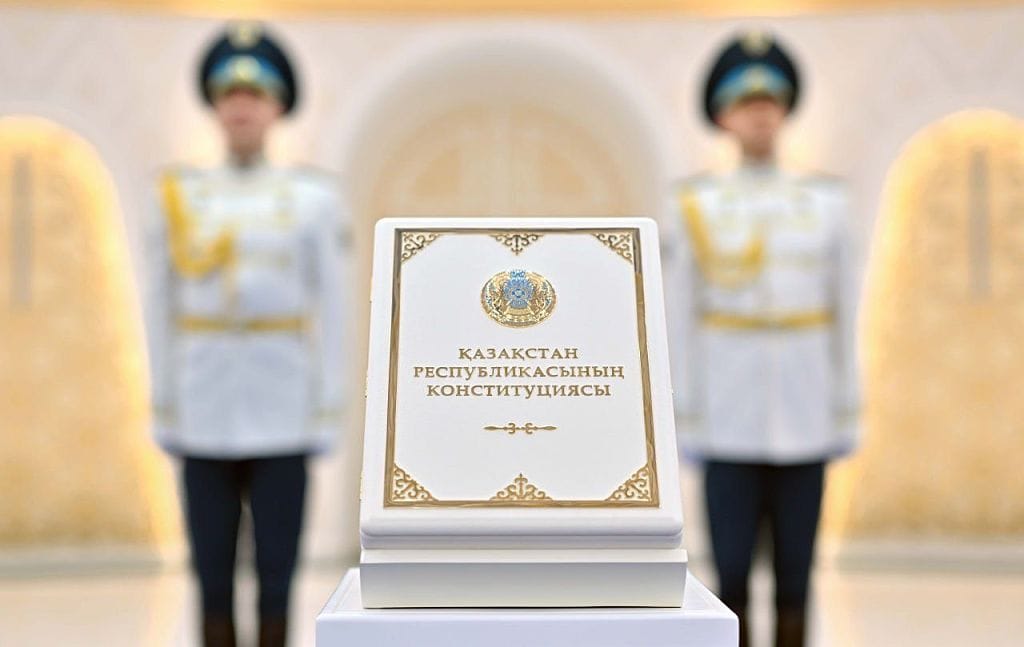
President Kassym-Jomart Tokayev announced Sept. 24 that municipal elections would be held ahead of schedule. He characterized the vote as the “final stage” of a political transformation initiated in March with the adoption of the new constitution.
In mid-September, Tokayev attended the first South Korea–Central Asia summit in Seoul, where Kazakhstan announced deals worth $19 billion and agreed to host the next C5+1 summit involving South Korea in two years. He then traveled to Berlin on Sept. 28, where he met President Frank-Walter Steinmeier and Chancellor Friedrich Merz and cited bilateral trade of $4.5 billion last year. In Germany, Tokayev caused a stir by calling Russian leader Vladimir Putin “an outstanding statesman.” Merz restated Germany’s full support for Ukraine. Closer to home, Almaty hosted a Kazakhstan–China investment forum on Sept. 25, which produced agreements covering vehicle manufacturing, green energy, information technology/artificial intelligence, and fertilizers, and Tokayev proposed making it an annual event.
The country experienced a tragedy when a naval exercise on the Caspian Sea went awry, leaving 14 sailors dead. Several senior officers were arrested amid an investigation.
Oil production fell 8.4% short of its target during the first eight months of 2026, reaching 61.7 million tons. Scheduled maintenance at the Karachaganak oil and gas field, one of the country’s largest, slowed production. Officials in September lowered the annual production forecast to 96 million tons from 100 million tons. Production hit 99.6 million tons in 2025. Amid the production troubles, Astana is indicating growing interest in diversifying energy export routes, in particular reviving the idea of a trans-Caspian pipeline.
Astana’s relations with Russia grew strained over auto exports. During the first half of 2026, Kazakhstan imported Russian autos worth $9.8 million, but Kazakh officials report that in recent months imports have gone to near zero. Kazakh authorities complained that Russia is charging excessive fees for recycling autos, and in September they followed through on a pledge to introduce retaliatory measures, leading to import-export gridlock.
Jensen Huang, CEO of Nvidia, appeared in Kazakhstan on Oct. 23, proclaiming the Central Asian state a potential “global hub for Physical AI.” In conjunction with Huang’s visit, Kazakh officials announced that an Armenian-U.S. AI infrastructure firm, Firebird.ai, was teaming with Kazakhtelecom to build a large-scale data center using Nvidia Grace Blackwell GPUs. The first phase of the project is under construction with a launch date set for the third quarter of 2027.
Tokayev, in his state–of–the–nation address on Oct. 28, emphasized a need to accelerate development of the country’s nuclear energy capacity, saying it was “of fundamental importance.”
Speaking at the Organization of Turkic States summit in Ankara on Oct. 30, Tokayev proposed that Russia be invited to become an observer, according to the state news agency Kazinform.
Uzbekistan
On Sept. 10, President Shavkat Mirziyoyev appointed his daughter Saida Mirziyoyeva, who already heads the presidential administration, to lead the Tashkent International Financial Center, a special economic zone designed to attract foreign direct investment. Mirziyoyeva also represented Uzbekistan at the U.N. General Assembly and met U.N. Secretary-General António Guterres on Sept. 21. Her growing portfolio raises speculation that she is being groomed to succeed her father at the helm of Uzbekistan’s political system.
In Seoul, Mirziyoyev explored deals worth up to $12 billion and proposed an $8 billion financing mechanism with Korea’s Ex-Im Bank. The value of signed agreements seemed far lower than the announced targets.
Azerbaijan and Uzbekistan signed a roadmap on Sept. 17 to expand energy cooperation through 2028, an agreement to help advance regional connectivity as envisioned by the New Lines Institute’s S7+ concept.
In the energy sector, Uzbek and U.S. regulators signed a nuclear safety memorandum on the sidelines of the IAEA General Conference in Vienna. Earlier, Mirziyoyev announced that an international consortium would oversee construction of the country’s first nuclear power plant, amid questions about the Russian nuclear entity Rosatom’s financial condition.
Uzbekistan’s top team won the FIDE Chess Olympiad in Samarkand in late September.
Domestic natural gas output fell to 18.3 billion cubic meters in the first half of 2026, down from 21.9 bcm during the same period last year, according to official statistics.
In mid-October, the International Monetary Fund raised Uzbekistan’s economic growth forecast for 2026 to 7.8%t, up from 6.8%. Growth is projected at 6.5% for 2027.
On Oct. 12, Mirziyoyev presided over the groundbreaking of 10 projects worth an estimated $2 billion at the New Tashkent development.
The Russian e-commerce giant Wildberries is seeking to expand its footprint in Central Asia to help overcome disruption to its operations caused by Ukrainian drone attacks in Russia. The company sealed a deal Oct. 6 to build a distribution complex on a 67-hectare parcel of land on the outskirts of Tashkent. The project is expected to cost $140 million and create up to 7,500 jobs. In late July, Wildberries brokered deals for warehouses in Kazakhstan.
Kyrgyzstan
In his Sept. 22 address to the U.N. General Assembly, President Sadyr Japarov endorsed China’s position on Security Council reform and described Western sanctions against Kyrgyzstan as a tool of interference. At the same time, Japarov thanked U.S. President Donald Trump for ending U.S. funding for local nongovernmental organizations via the elimination of the U.S. Agency for International Development. Kyrgyzstan will begin a two-year term as a member of the U.N. Security Council starting in 2027.
In New York, Japarov also presided over the signing of a purchase agreement for 10 Wabtec locomotives, financed with U.S. Ex-Im Bank support, and a memorandum with Citibank under which the U.S. banking giant could potentially open a branch in Bishkek.
During the C5+1 meeting in Seoul, Kyrgyzstan signed 18 agreements with South Korea, including a sister-city deal between Bishkek and Seoul.
Investigative reports published by both the Financial Times and the New York Times focused attention on Kyrgyzstan’s role in a money laundering scheme run by a Russian financial entity, A7, that helps Moscow evade Western sanctions.
On the monetary front, pressure on the Kyrgyz som is continuing. The National Bank sold $202.7 million on the foreign exchange market on Sept. 4, and by early October its interventions in 2026 had exceeded $2 billion across 12 operations, all of them dollar sales.
The government introduced a tracking system to enforce migration rules for foreigners amid an inflow of Russians fleeing rumors that the Russian government might launch a military mobilization.
Kyrgyzstan’s State Committee for Statistics reported that industrial output for the first nine months of 2026 reached about $7.8 billion, up 7% over the same period the previous year.
Central Asia’s power grid is set to be tested this winter. One study shows that the grid in recent winters was routinely overloaded. Acknowledging Kyrgyzstan’s troubles with providing sufficient electricity supplies in winter, Japarov announced in an Oct. 28 interview that authorities will not grant new licenses for power-intensive crypto mining operations for the foreseeable future.
Tajikistan
On the sidelines of the SCO summit, Tajik leader Emomali Rahmon met with Putin, who noted that bilateral trade grew 25% last year and another 25% during the first half of 2026. At the C5+1 summit in Seoul, the Tajik delegation signed 15 documents, mostly nonbinding memoranda.
Back in Tajikistan, Rahmon attended the launch of the country’s first major solar electricity generation farm in the Sughd region, built with the help of Chinese specialists.
Construction on the Rogun Dam is moving ahead, thanks to new financial commitments from the World Bank, the Abu Dhabi Fund for Development, and Italy’s Cassa Depositi e Prestiti. The finance minister of Tajikistan said the country has secured $1.5 billion in international commitments and spent $400 million of its own revenue on the project during the first half of 2026. However, officials will have to find an estimated $5.8 billion to finish the project. The dam was the site of an industrial accident in late October. The Asia-Plus news agency reported that an industrial reservoir ruptured, causing water to “gush” into a tunnel where an unspecified number of workers were located. Official sources claimed no one was hurt in the accident. But RFE/RL said at least five workers were injured.
Iranian First Vice President Mohammad Reza Aref met with Rahmon on Oct. 19 to talk trade. No specific deals were announced as a result of the discussions.
The European Bank for Reconstruction and Development announced Oct. 27 that it was allocating over 54 million euros for infrastructure projects in Tajikistan, including road improvements in the southern Khatlon region, which borders Afghanistan, and for ongoing work in the city of Kulob to improve water supply and wastewater treatment.
Turkmenistan
Turkmenistan and Iran set a target of $3 billion in trade for the current Iranian fiscal year, while Afghanistan and Turkmenistan agreed to establish a joint commission on road transport to ease visa and customs rules for truck cargo.
The Asian Development Bank kept its growth forecast for Turkmenistan at 6.3% for 2026.
During the C5+1 meeting in Seoul, Turkmenistan signed a deal to set up a joint venture with a South Korean firm to manufacture high-tech equipment, including servers, for the domestic Turkmen market. The countries also signed dozens of memoranda.
Early October saw Central Asian leaders, along with Azerbaijani President Ilham Aliyev, gather in Turkmenistan for a “C6” summit, the 8th Consultative Meeting of the Heads of State of Central Asia and Azerbaijan. Participants agreed on a need for closer coordination in such areas as trade, transport and regional security, according to a joint statement. Perhaps the most significant outcome was Ashgabat’s affirmation to end its historic isolationism and integrate into emerging trade networks.
Turkmenistan also hosted the annual Commonwealth of Independent States summit. The gathering yielded little of substance.
Ashgabat was the scene of two well-attended events in October, an investment forum and an oil & gas expo. The gatherings yielded only relatively minor investment deals. Turkmen officials indicated that they want to complete a section of the TAPI pipeline that connects the Turkmen border to the western Afghan city of Herat by the end of the year.
Regional Implications
South Korea has now joined the United States, China, Russia, the European Union and Japan in convening a meeting with all five Central Asian leaders under a C5+1 format over the past 18 months. The activity indicates that foreign powers will have to compete vigorously for access to the region’s minerals, energy, transit routes, and digital markets. Central Asian governments are using that competition to diversify their partners and gain negotiating leverage.
Meanwhile, there were signs of potential instability on Central Asia’s southern border. The United Nations issued an alert on Oct. 15 that malnutrition is reaching record levels in Afghanistan with over one-third of the country’s population experiencing severe hunger. According to U.N. estimates, 15.9 million Afghans are facing acute food insecurity, with 3.4 million confronting famine conditions. A deterioration of conditions could prompt a wave of migration.
A World Bank update in early October estimated economic growth in Central Asia rising by 5.6% in 2026. Meanwhile, a Eurasian Development Bank report published toward the end of the month projected that demand for electricity in Central Asia would rise 27% by 2030.
Regional Integration
A joint statement issued after the C6 summit between Central Asian states and Azerbaijan made clear that construction of a long-contemplated trans-Caspian pipeline is back on the regional agenda. Turkmenistan, the host nation, has traditionally been circumspect about the project but during the meeting signaled it is fully on board. Turkmen President Serdar Berdymukhamedov called for “maximum substance to be given to negotiations and actions to create transport and logistics connectivity,” adding that “the Central Asia-Caspian Sea-South Caucasus-Europe corridor is expected to play a key role here.” Any firm movement towards the construction of a trans-Caspian pipeline would mark a major step forward for the S7+ concept.
In a sign of growing security cooperation, the border services of Kazakhstan, Kyrgyzstan, and Tajikistan met in Kyrgyzstan’s Issyk–Kul region on Sept. 23-24, with OSCE support, and agreed to build a more efficient information-sharing system, hold more joint training exercises, and develop joint emergency-response procedures. Their main shared concern was threats from Afghanistan. Uzbek officials did not attend the meeting.
On connectivity, Kazakhstan, Uzbekistan, and Turkmenistan facilitated the passage from China to Iran of a sealed freight train consisting of 55 container cars. Uzbek officials presented the shipment as proof that the corridor between China and Iran running through Central Asia can function. Uzbekistan also outlined plans to establish logistics facilities at Caspian ports in Kazakhstan, Turkmenistan, and Azerbaijan, as well as at Georgia’s Black Sea port of Poti, to strengthen its role in Middle Corridor trade. As part of a push in October to expand its engagement with Central Asian states, Iranian Transport Minister Farzaneh Sadegh met with officials from Kazakhstan and Uzbekistan, promoting the Iranian port of Chabahar as a hub for north-south trade.
Key Eurasianet articles:
China driving down price of Russian gas
Rubio’s visit to Central Asia boosts trade ties
Iran ups trade engagement with Central Asian states as conflict with U.S. simmers
UAE joins effort to build trans-Afghan railwayUzbekistan outlines grand Middle Corridor plans
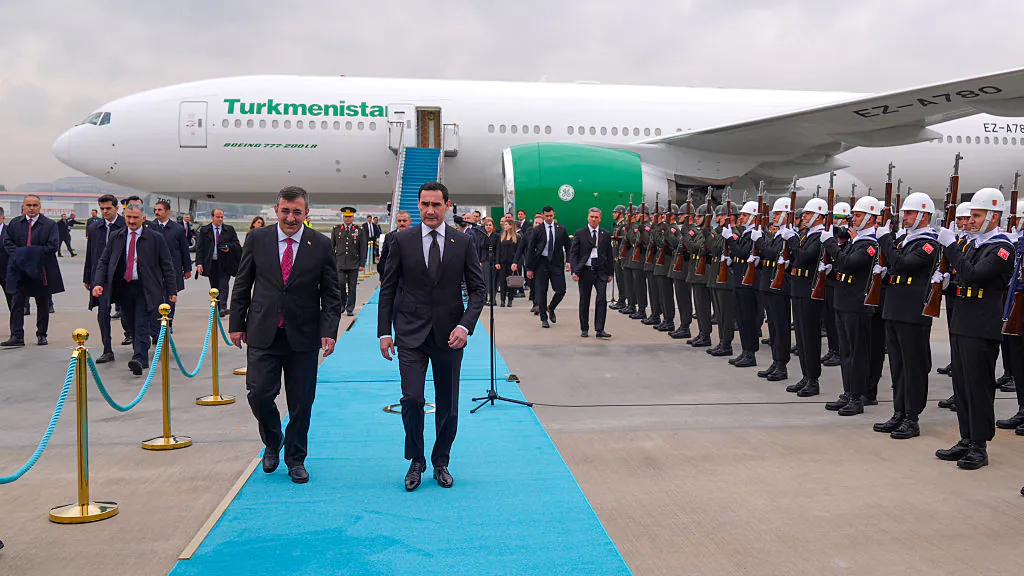
Photo: Turkish Vice President Cevdet Yilmaz welcomes Turkmenistan’s President Serdar Berdimuhamedov upon his arrival at Ankara Airport ahead of the 13th Summit of the Organization of Turkic States in Ankara, Türkiye, on Oct. 29, 2026. (Photo by Yasin Baturhan Ergin/Anadolu via Getty Images)