Egypt and the Eastern Mediterranean’s Exposed Momentum
On July 28, 2026, Eni and TotalEnergies committed to develop the Cronos gas field off Cyprus, the first Eastern Mediterranean discovery to send gas to European markets. The next day, a drone struck two vessels at Egypt’s Damietta port, the coastal site that will liquefy the Cronos gas for the voyage to Europe, setting them ablaze. No party claimed responsibility for the attack, and Egyptian investigators are still working to identify its origin. Five days later, a magnitude 5.6 earthquake struck near Suez, rattling buildings from Cairo to Port Said.
These three separate events hitting one stretch of coast in a single week is relevant because so much now depends on the region. Europe, the Gulf states, and the world’s largest energy firms are all rushing to build out a transit and energy corridor in the Eastern Mediterranean, concentrating enormous value on its narrow, exposed geography. The corridor’s new centrality and its exposure are linked: The infrastructure that makes the basin indispensable to global energy flows is exactly what makes it worth striking.
Investment Raises the Stakes
The scope of investment in that area, and how quickly it has been implemented demonstrates its growing importance. In little more than a year, the corridor has drawn commitments from a 690-million-euro ($768.8 million) electricity grid package to multibillion-dollar field and pipeline deals. That financial inflow and geopolitical events inspired Cyprus’s energy minister to call the Eastern Mediterranean a fast-emerging alternative source for a Europe still weaning itself off Russian natural gas. The output of the Cronos field will feed a pipeline to Egypt’s existing Zohr infrastructure, then travel on to the Damietta plant, a route costing roughly $2 billion, about half of what standalone infrastructure in Cypriot waters would. In August, Egypt, ExxonMobil, and QatarEnergy began implementing a separate deal to connect two more Cypriot fields, Glaucus and Pegasus, to the same Egyptian plants. A Chevron-led group expects to sanction the Aphrodite field in 2027 to supply Egypt’s own demand. Each deal makes the next one cheaper and more logical, which is how a set of transactions becomes a wave.
The investment also covers electricity transmission and generation infrastructure. In June, the European Union and its investment bank committed 690 million euros to Egypt’s power grid under a new trans-Mediterranean clean energy initiative. The loans will be used to develop substations and high-voltage lines to carry 22 gigawatts (GW) of new solar- and wind-generated energy onto the national network by 2030. The European funds cover 44% of the program while Egypt’s transmission company pays the rest. The package leaves out the project that has drawn the most attention, the GREGY interconnector, a planned 3,000-megawatt (MW) undersea power cable that would carry Egyptian electricity to the Greek mainland and onward to Europe, at a budgeted 3.569 billion euros. The sequencing tells the story: Egypt is building the domestic network that any export cable would need before the cable itself exists.
The Gulf sees the same opportunity and has helped fund it. QatarEnergy holds a stake in the Cypriot fields that Egypt will process. An Emirati consortium put roughly $391 million into a 500-kilovolt line linking Egypt’s Gulf of Suez renewables. And Egypt’s most advanced interconnection plan reaches east, to a 3,000-MW link with Saudi Arabia. Gulf capital building Egypt’s switchboard is the Gulf buying a stake in its own western route to Europe.
A Fragile Corridor
That concentration adds risk of disruption along several fronts. The drone that struck Damietta damaged a ship used in LNG regassification, a crucial part of the Egyptian energy picture. Once, Egypt exported natural gas, but declining domestic output has turned it into a net importer that leans on floating regasification units. The strike hit one of those units during peak summer demand. Cairo covered the gap by pulling on other units, including one it shares with Jordan at Aqaba, and the port kept running.
The earthquake near Suez underlined the same fragility, a reminder of how much sits on one coastline in a seismically active basin. And beneath both runs a major vulnerability: The Suez Canal corridor itself, where shipping squeezes through a single channel. As Iran disrupts Hormuz and the Houthis press their embargo on Saudi shipping in the Bab el-Mandeb, more traffic crowds toward the Red Sea and Suez, and the same narrow waters carry more of the world’s energy and more of its risk. The economics are stark. A relatively inexpensive drone threatened a multibillion-dollar gateway and forced a national scramble.
For a century, oil and gas produced elsewhere crossed the Mediterranean to reach Europe. Now the basin makes value of its own. Egypt processes gas drilled in Cypriot waters on its coast, and cables will carry Egyptian power to Greece and Italy. As the eastern chokepoints strain, it doubles as Europe’s fallback route that remains clear when others close.
The North African Clean Energy Gateway
Egypt’s EU-backed grid exists to move solar and wind power from the Red Sea and Gulf of Suez regions, and Egypt’s electricity minister now lists planned links to Sudan and Libya alongside those to Greece and Italy. GREGY, in its developers’ own framing, would carry North African renewable power into the European market. Egypt is positioning itself as the gateway between a North African clean-energy base and European demand, with today’s natural gas hub serving as proof that the goal of exporting clean power can work. While that gateway is not yet a fact, the gas will flow soon, while the green power exports links have yet to be built. Still, the direction is unmistakable.
This returns us to the drone strike at Damietta. Infrastructure becomes a target once it becomes essential, and Damietta, now the gateway for Cypriot gas bound for Europe, has crossed that threshold. Egypt needs it, Europe needs it, the Gulf and Europe has paid to build it, and the world’s largest energy firms have sunk capital into the water. Their shared stake, not any single government’s strength, protects the corridor’s momentum. Indispensability has become its own imperfect shield.
Imperfect is the operative word. The shared interest that guards the route cannot secure it. The coastline stays exposed to the next cheap drone, the next tremor, or the next squeeze on Suez, and the money knows it. So the wave and the risk advance together, and neither cancels the other. Whether broad, well-funded momentum can absorb concentrated, low-cost vulnerability is the question the Eastern Mediterranean will answer for the rest of the world because the same logic now governs every route the old order no longer guarantees.
Yet the shield need not stay imperfect. Today the corridor’s protection is almost accidental, a byproduct of universal demand, and no single party owns the work of securing it. Formalizing that shared stake would not diminish Egypt’s position. It would entrench it.
Policy Recommendations
1. Parties with financial stakes in the energy corridor should establish a joint financing and insurance facility.
European buyers, Gulf investors, and the firms already drilling and building around Egypt’s coast should spread the cost of a strike or an outage with a pooled risk and financing mechanism. The United States, which has underwritten the security of these sea lanes for decades, is the natural convener, less as paymaster than as the guarantor that lends it the political and security weight that makes it credible.
2. Egypt should establish a second coastal LNG processing facility.
The drone strike on Damietta demonstrated a vulnerability in having a single port function as Egypt’s import hub. A second Egyptian processing and landing point with the storage and interconnection to carry the load if one site goes down would mean no single event would take the corridor offline. This would deepen Cairo’s indispensability rather than hedging against it.
Conclusion
Egypt sits at the center of a dense web of energy partnerships with the European Union and the Gulf, the same parties that would carry the route’s risk and are financing its buildout. Folding the corridor’s security into that architecture, rather than standing up something new, would turn a set of separate commercial deals into a shared obligation organized around Egypt. The alternative is the current arrangement: a corridor everyone needs, no one secures, and anyone can put at risk for the price of a drone.
The views expressed in this article are those of the author and not an official policy or position of New Lines Institute.
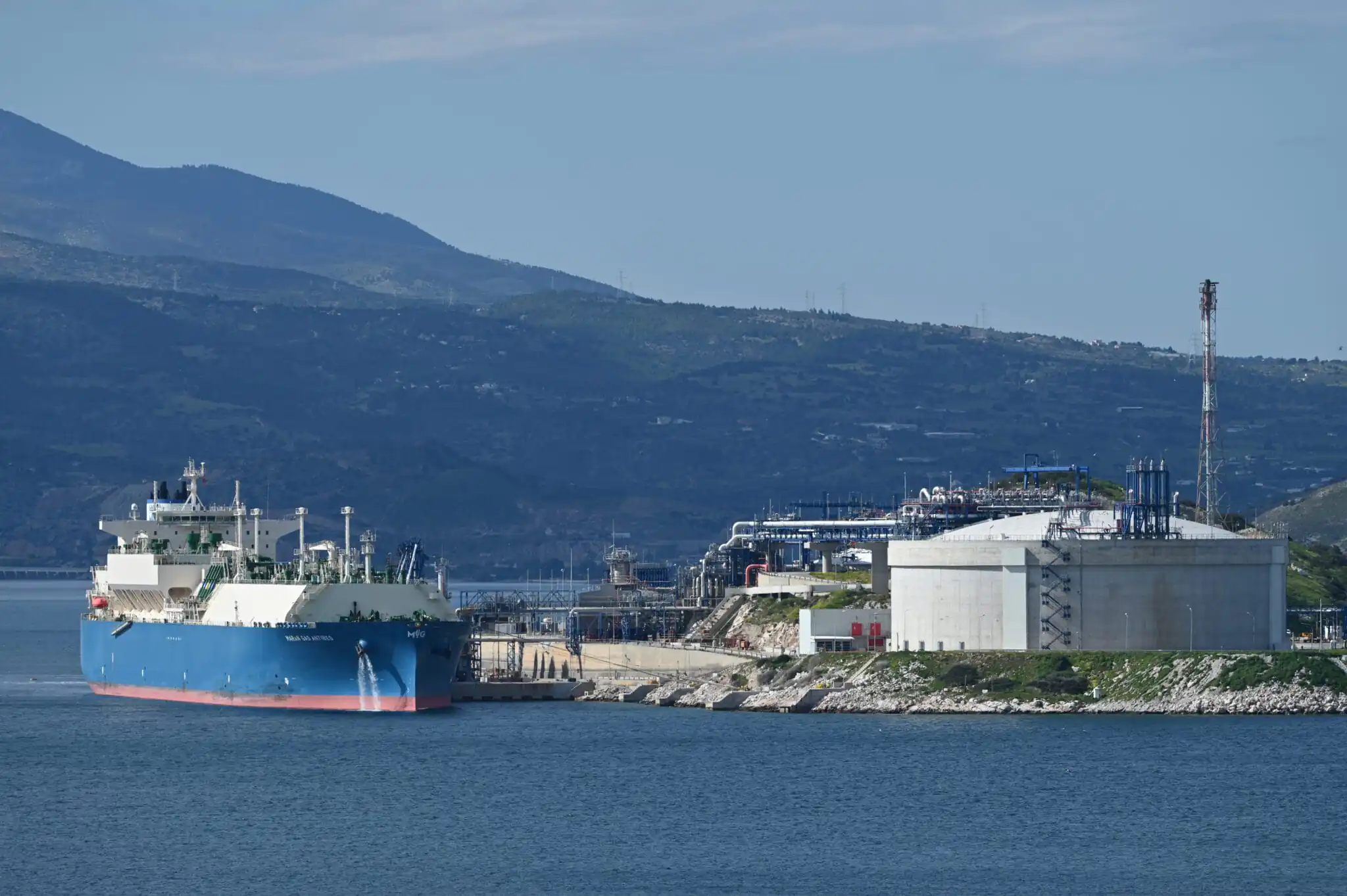
Photo: The Greek-flagged LNG tanker Maran Gas Antibes unloads Egyptian LNG at the Revithoussa terminal near Athens, Greece, on Feb. 25, 2026. Cargoes from Egypt contribute to the diversification of European gas supplies and strengthen energy security in the post-Russian gas market. (Photo by Nicolas Koutsokostas/NurPhoto via Getty Images)