Solving Central Asia’s Energy Challenge
Editor’s note: This document, originally published in April 2026, was updated in September 2026, including a revised executive summary and additions to Part II and recommendations.
Executive Summary
Central Asia is grappling with a power generation challenge. Four of the region’s five states have adopted economic growth programs requiring considerably more electricity than they currently produce. States are even contending with electricity deficits right now. Thus, a pivotal challenge facing regional leaders is whether they can develop enough new power sources – including hydro-driven, solar, wind, and nuclear – fast enough to fulfill their economic ambitions. The chances of success would be greatly enhanced by the operation of a more effective regional entity to coordinate the efficient generation and distribution of electricity. A unified regional electricity grid existed prior to the collapse of the Soviet Union and could be fully reestablished relatively quickly, given sufficient political will. This report illuminates the flaws in the current system and existing plans to add generating capacity, while evaluating the capacity for regional cooperation. Ultimately, a well-coordinated management system is needed to unlock the region’s economic potential. The effective functioning of such a system can also build trust that catalyzes the formation of a Central Asian economic union, a cornerstone of the S7+ concept developed by New Lines Institute for Strategy and Policy. Under the S7+ framework, Kazakhstan, Kyrgyzstan, Tajikistan, Turkmenistan and Uzbekistan would come together to form a cohesive economic bloc that is uninfluenced by outside powers, including Russia, China, the United States and European Union. The bloc would ultimately incorporate Azerbaijan, Afghanistan, and, eventually, Pakistan. Such a grouping can accelerate efforts to create a reliable and sustainable regional system to generate and distribute the electricity needed to fuel regional economic growth while meeting household needs.
Recommendations
For Central Asian States:
- Expand a Central Asian Power System (CAPS) connecting the grids of all five Central Asian states.
- Empower an interstate power commission or executive body, comprising representatives of all five Central Asian states, with the ability to enforce its decisions.
- Explore joint projects to develop renewables, maximize available financial and natural resources, and promote efficiencies in the generation and distribution of electricity.
- Reduce hydropower’s share of electricity production and implement measures to reduce reservoir evaporation.
- Bring tariff rates for electricity usage by both businesses and households into closer alignment with the actual cost of power production.
- Develop public awareness campaigns aimed at conserving electricity.
- Expand small-scale renewable initiatives.
For the International Community:
- The United States, European Union, United Kingdom, multilateral development banks, and other interested parties can provide assistance to refurbish antiquated infrastructure, digitalize distribution systems, and finance new projects that help expand CAPS.
- Assist Central Asian states in the development of strategies for IT/AI/data center development that keep demand for electricity and water to a minimum, ensuring adequate supplies for household needs.
- The United States, EU, U.K., and multilateral development banks should encourage the modification of Central Asian states’ nuclear strategies to better meet nearer-term needs.
- U.S. should increase access to Central Asia’s minerals and increase cooperation in nuclear and AI sectors.
The views expressed in this article are those of the author and not an official policy or position of New Lines Institute.
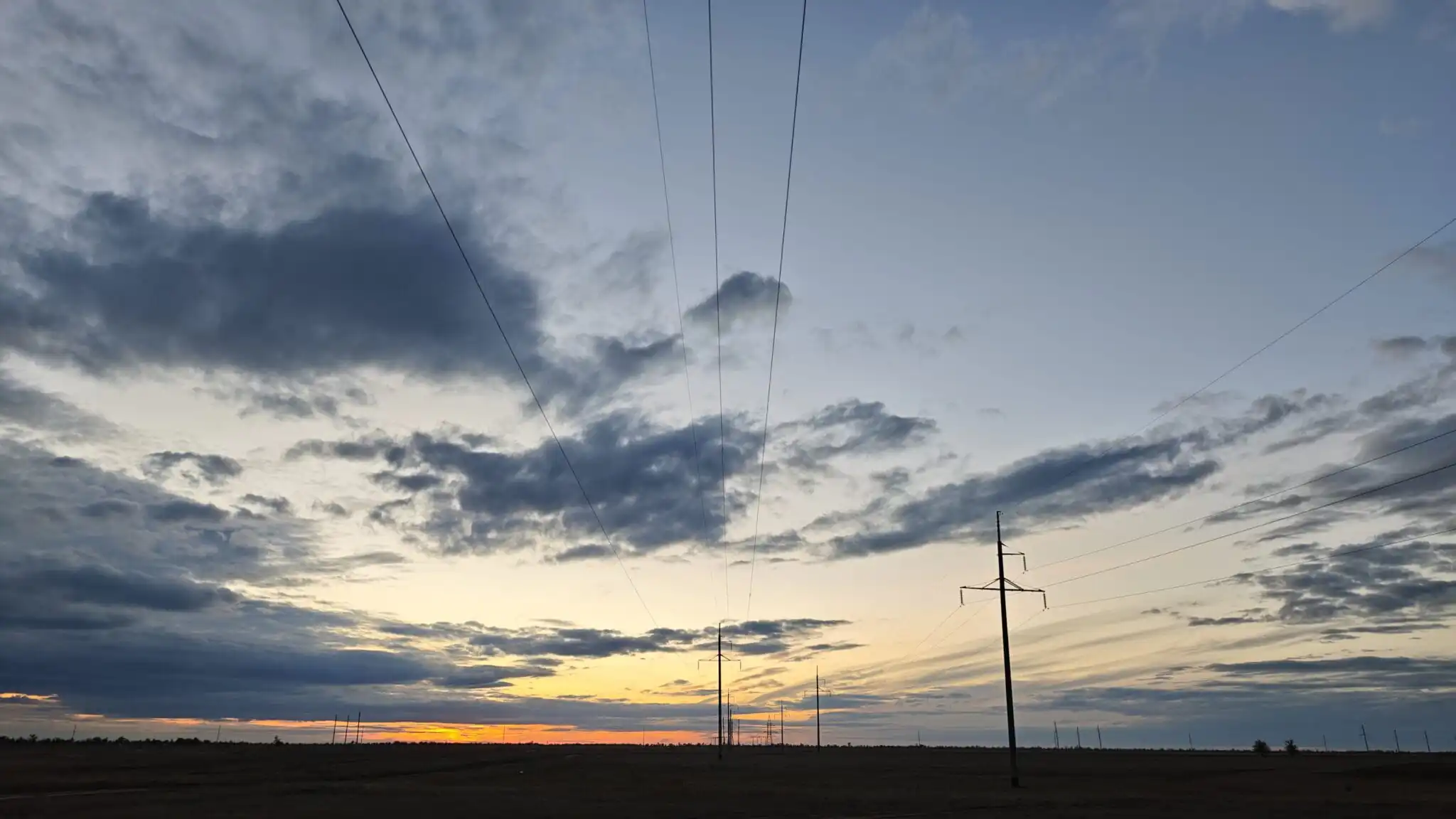
Photo: Power lines point toward a sunset in Kazakhstan. (Murat Kuzhakhmetov / Getty Images)