When Water Becomes Glue: Solving Central Asia’s Water Dilemma Through Collaboration
Editor’s note: This document, originally published in February 2026, was updated in September 2026, including a revised introduction and Part II.
Executive Summary
Central Asian leaders have ambitious modernization plans. To realize these growth goals, however, they must solve a water-management conundrum: Many of the planned projects require an abundant amount of water, but the region is facing a mounting water deficit. It’s too tall an order for any one state in Central Asia to tackle alone. Regional leaders acknowledge they lack the resources and know-how to implement desired reforms. Ultimately, success will depend on their ability to cooperate and establish an efficient organization that balances competing demands for water, ensuring adequate supplies for irrigating agricultural lands, generating electricity, and accommodating economic growth. This report takes an in-depth look at the water-management challenges facing Central Asia, as well as the region’s economic development agenda. It also highlights ways the international community can help, enabling technology transfers that produce immediate improvements in water-use efficiency and extending financing for improvements that reduce waste.
Introduction
Water represents the fundamental building block of Central Asia’s economic future, needed to sustain agriculture, produce electricity, and fuel ambitions of turning the region into a manufacturing and high-tech hub. Yet as demand for water explodes, the region’s supplies are dwindling at an alarming rate. Climate change is melting glaciers, and existing water distribution systems are antiquated and inefficient, wasting resources. Multilateral water-management arrangements have likewise proved mostly ineffective, as the divergent interests of upstream and downstream states have hindered joint responses to shared challenges.
The pressure on Central Asia’s water resources will only intensify in the coming years. The region’s population is growing rapidly, and governments are implementing modernization plans centered on water-intensive sectors, including the expansion of the mining sector, along with the development of nuclear energy and artificial intelligence capabilities.
The region’s governments are awake ning to the threat of a widening water deficit and have adopted plans to make irrigation systems more efficient and introduce water-saving technologies. They have also shown increasing willingness to cooperate on transboundary water issues. So far, however, there has been much more talk than action, due in part to a lack of financial resources and a shortage of human capital.
Given their growing desire to secure a large share of Central Asia’s critical minerals, the United States and European Union have a vested interest in helping Central Asian governments solve water-supply dilemmas. When it comes to water, Central Asia will have to do more with less if development goals are to be reached and social stability maintained. The way forward offering the highest chances of success is through unity via the creation of a comprehensive water-management framework, built and run by the Central Asian states themselves.
The development of a sustainable water-management system can serve as the cornerstone for the creation of a comprehensive regional economic organization that leverages natural resources and human capital in ways that can transform Central Asia into a major player in global trade.
Policy Recommendations
For Central Asian states:
- Negotiate a comprehensive water-management treaty;
- Create a unified entity responsible for implementing treaty provisions;
- Develop effective enforcement mechanisms to ensure treaty compliance;
- Mount coordinated public awareness campaigns to promote conservation;
- Gradually eliminate heavy subsidization of water use for individuals and corporations.
For the international community:
- Provide expertise, equipment and financial assistance to help Central Asian states upgrade irrigation and water-management systems;
- Fund research on the impact of climate change on Central Asia, including trends concerning water resources, glacier melt and the Caspian Sea’s decline;
- Work with Central Asian governments to prospect for aquifers, potentially identifying new sources of water;
- Assist Central Asian states in developing sustainable water-supply systems for the AI, IT and crypto sectors without diminishing amounts for household use;
- Support Central Asian efforts to engage Afghanistan in joining a shared water-use framework;
- Expand IFI support for infrastructure initiatives to improve access to clean drinking water for citizens living in rural areas of Central Asia.
The views expressed in this article are those of the author and not an official policy or position of New Lines Institute.
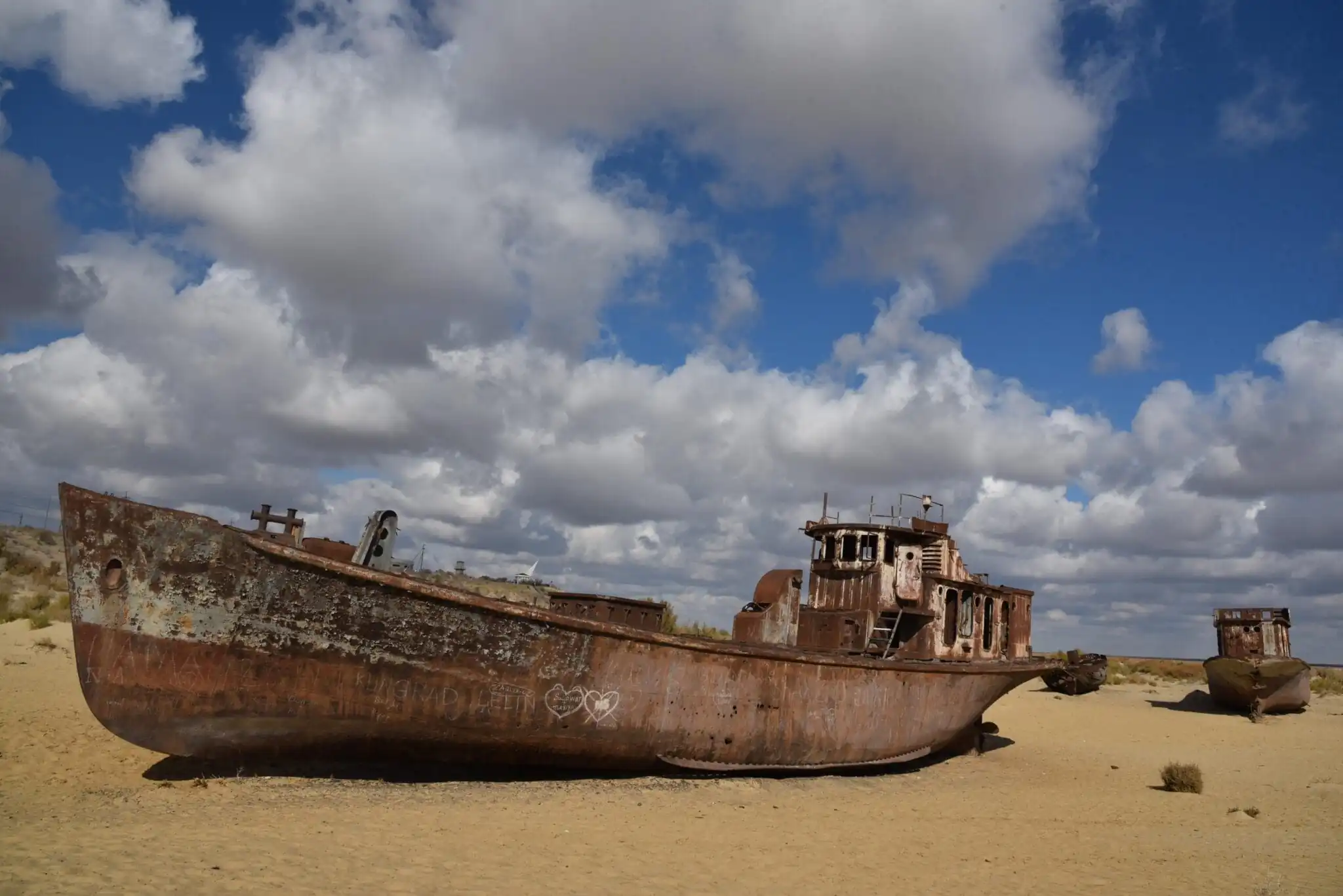
Photo: Oct 21, 2021, Uzbekistan, Mujnak: Rusty ships lie in the sand of the former port city, from which the water retreated decades ago. The salt and sand desert of Aralkum continues to grow. (Ulf Mauder/picture alliance via Getty Images)