How Higher Education Can Expand U.S. Influence in Central Asia
In the competition between the United States and China to gain influence in Central Asia, Washington has an opportunity to use its soft power advantage by encouraging international student exchanges. However, current U.S. immigration policy creates a barrier to the most effective use of this tool.
Encouraging legal student exchange between the United States and Central Asian nations can increase understanding of U.S. culture and spread the use of the English language in the region while encouraging alignment with the West. But even though student exchange visas continue to be issued, the White House’s pause on immigrant visas is creating uncertainty that can discourage prospective students from Central Asia. Also, the cuts in funding from the State Department for exchange programs has dampened the demand and participation of Central Asian international students in programs in educational programs in the U.S.
Geographic proximity and development deals under its Belt and Road Initiative have helped China build influence in Central Asia. Nevertheless, some Central Asian economies are pursuing closer ties with Western ones, including the United States. Kazakhstan joined the Abraham Accords in 2025, strengthening its ties with the U.S. The U.S. State Department launched the C5+1 diplomatic platform to enhance cooperation with Central Asian states. Those states could look to further enhance ties through the U.S Strategic Critical Minerals Reserve, established as part of Project Vault in February 2026 to secure mineral and metal supply chains. The U.S. can leverage the increasing interest from Central Asia in diversifying away from China to expand its soft power in the region through education.
Why Use Educational Soft Power?
The United States has long used soft power in its foreign policy strategy, whether through cultural channels like its film industry or educational exchanges, to spread its global interests. While the current administration has prioritized border security enforcement and immigration laws, international student exchanges in higher education remains one of the most effective policy tools to advance U.S. national security through noncoercive, nonmilitary means. However, the use of that mechanism is waning. According to the Institute of International Education (IIE), in the fall of 2025, new enrollment of international students in U.S. universities declined by 17%. At the same time, less money is being made available for research and scholarship funding.
In particular, the State Department has cut around $100 million in funding for fiscal year 2026 for 22 educational exchange programs, affecting around 10,000 foreign exchange students. Others had their studies interrupted during 2024-25 by the funding freeze that affected operations of the Institute of International Education, which administers Fulbright and Humphery fellowships for international students. These policy decisions have come even though educational exchange programs are distinct from broader immigration concerns and have proved to serve strategic national interests for several reasons.
For one, study abroad differs from other policy tools in that international students intentionally choose to come to the United States to earn professional and/or academic experience and skills. During that process, these students become immersed in the U.S. system, institutions, and social structure. They are exposed to U.S. values and norms, inspiring some to share their experiences back home, thus promoting the U.S. way of life in other parts of the world. These endorsements come at little cost to taxpayers. Additionally, students who experience life in the U.S., whether in classrooms or daily life, often return home with more positive views about the United States. The result is a network of people who better understand and align with the United States and may be more predisposed to cooperation rather than confrontation with the U.S., particularly in the long term.
In addition, the scholarly contributions of international students to institutions of higher education in the United States increase the U.S. capacity for innovation, research, and economic competitiveness. Many visiting students possess the skills and the experience that can drive technological advancement and fill critical gaps in STEM fields that fuel economic growth. For example, Alexander Yakovlev, a key figure behind the Soviet Union’s perestroika reformist program launched in the 1980s and a driving force behind the end of the Cold War, studied at Columbia University as a Fulbright Scholar. He later acknowledged that his studies there contributed to the intellectual foundations of his vision of perestroika. His example is one of many demonstrating how study abroad and exchange programs have the capacity to significantly reshape political outcomes.
Finally, international students in higher education further advance the U.S.’s reputation as a global research and academic leader. This contributes not only to the U.S. at large but also helps to build the public knowledge and skills base that transcends borders.
How Is China Building Soft Power in Central Asia
An analysis of Chinese influence in Central Asia underscores the importance to the United States of expanding its influence in the region.
China’s physical proximity facilitates Beijing’s ability to employ soft power tactics in Central Asia. Additionally, China has made significant investments in building and developing Central Asian capabilities, including through educational exchange programs at institutions such as the Confucius Institute and Luban Workshops. China’s education-focused strategy rests on two key elements: Inviting students from Central Asia to China while at the same time developing programs in Central Asia to disseminate Chinese cultural values and norms.
According to the Kazakhstan Ministry of Science and Higher Education, as of December. 2025, 9.6% of the total number of international students studying in Central Asia are from China. Additionally, the number of Central Asian students studying in China has ballooned. In 2010, China hosted approximately 11,930 students from Central Asia. Eight years later, that total had reached 30,000. Since then, the number of Central Asian international students in China has continued to rise with Beijing becoming known as a hub for Central Asian students who want to study abroad. On the institutional level, China has established technical training institutions in many Central Asian countries, including in Kazakhstan, Kyrgyzstan, Tajikistan, and Uzbekistan.
The Implications for National Security
With the decline in international student enrollment, the United States is losing opportunities to spread its values and norms to the rest of the world and thus increase its influence and leverage. Furthermore, the drop in enrollment can weaken U.S. diplomatic and geopolitical relationships with leaders accustomed to benefiting from its research institutions to build their countries’ knowledge base. This vacuum opens the door for China to expand its influence through soft diplomacy by offering financial scholarships to attract international students, while also increasing partnerships with neighbors such as Kazakhstan.
The result is that the United States is losing its status as a core hub for scientific research and education, and China is filling this gap, further expanding its influence and leverage beyond direct economic policy tactics through soft diplomacy tools.
Rebuilding U.S. Soft Power in Central Asia?
While U.S. soft power has diminished in Central Asia, Washington still has the potential and the power to expand its influence there.
First, many young people in the region speak English and very few speak Chinese and Russian. As several Central Asian countries have focused on national languages in education, fluency in Russian has declined, especially among younger generations. The complexity of the Chinese language also gives English an advantage, particularly among young individuals. Moreover, Central Asian countries encourage their citizens to learn and use English in their day-to-day activities through initiatives such as the C5+O.N.E (Opening Networks through English) program.
Second, despite Chinese efforts to build educational institutions and reshape public attitudes toward its policies, Central Asians remain skeptical about Chinese attempts to expand its influence there. Specifically, public attitudes toward China among Central Asians is not uniformly positive. For example, according to a report published by Central Asia Barometer, Uzbekistan is one of the economies with mixed views toward China’s position in the region.
Policy Recommendations
To regain its reputation as a hub for scholarly scientific research, the United States must facilitate the entry of international students and encourage collaboration between U.S. scholars and those in Central Asia. International student programs help protect U.S. interests by maintaining diplomatic relationships with allies, attracting global talent that drives innovation, and creating networks of future leaders that promote and align with U.S. values. To do so, the United States should:
- Restore exchange programs such as Fulbright and Humphrey fellowships.
- Encourage academic collaboration and cooperation between U.S. scholars and those in Central Asia to enable the exchange of ideas and further build mutual knowledge that transcends borders through academic and research exchange programs between the U.S. and Central Asia.
These exchange programs between the U.S. and countries in the region can spread American values and democratic norms, directly challenging the narratives promoted by state-controlled media and educational institutions. The impact of facilitating international student exchanges and scholarly collaboration extends beyond soft power. It reflects the country’s capacity to compete strategically with China, strengthen alliances, and ensure U.S. leadership in science and technology.
The views expressed in this article are those of the author and not an official policy or position of New Lines Institute.
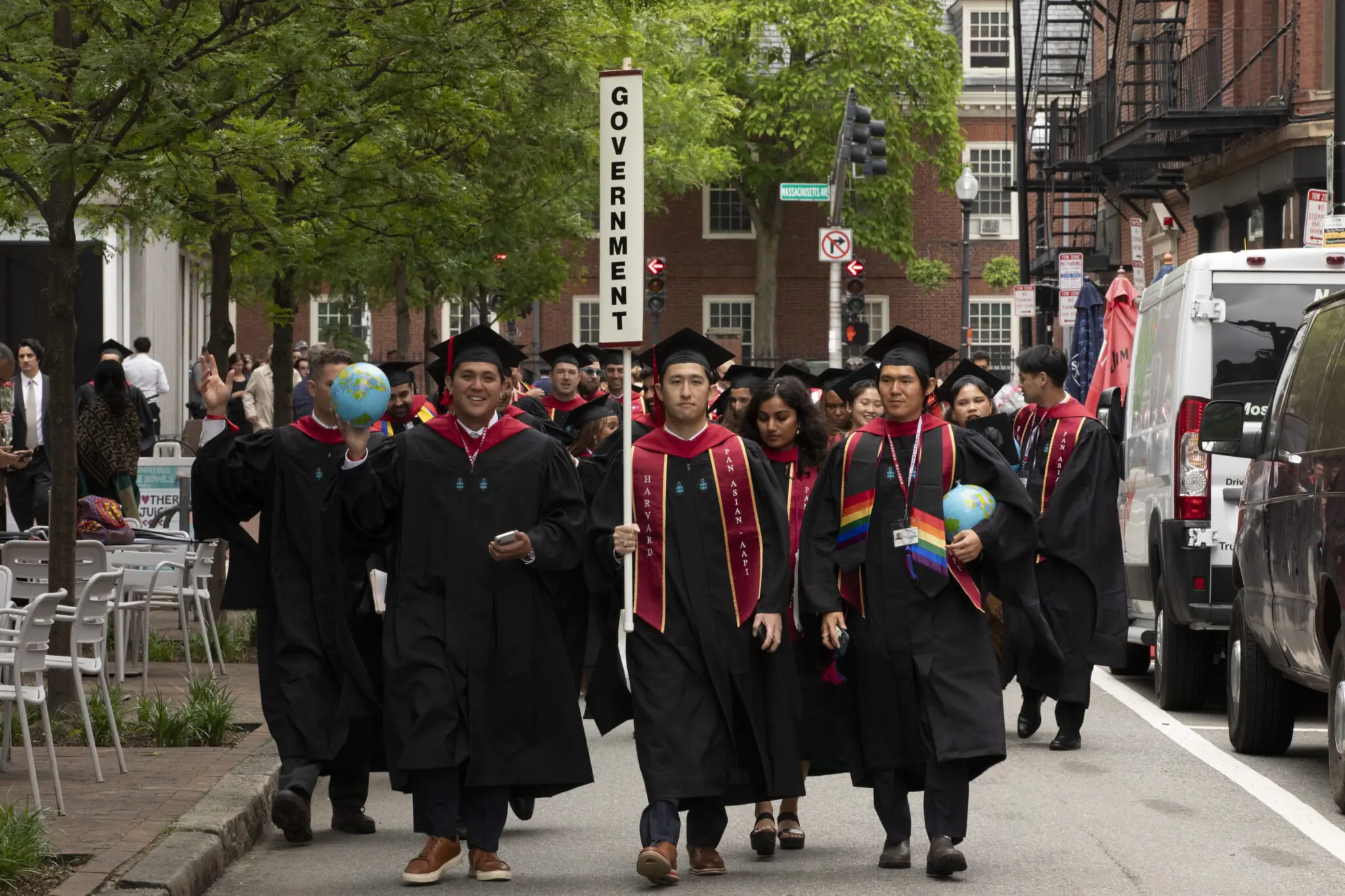
Photo: Graduates exit Harvard University’s 374th commencement ceremony in Cambridge, Mass., on April 29, 2025. (Photo by Sydney Roth/Anadolu via Getty Images)