Protecting Civilians in Real Time: The Case for Unarmed Civilian Protection in Contemporary Conflict
As civilians increasingly bear the brunt of contemporary warfare, civilian harm* has become not only normalized but, in many contexts, central to how conflict is conducted. In contexts where international accountability mechanisms are delayed, ineffective, or politically constrained, locally led, community-based protection strategies, particularly unarmed civilian protection (UCP), provide practical mechanisms for reducing civilian harm in real time by strengthening community resilience, deterring violence, and enabling civilian self-protection during armed conflict. Effective civilian protection requires a fundamental shift toward locally led approaches supported by flexible, long-term funding, sustained investment in local capacity, gender-sensitive and inclusive programming, stronger integration into formal humanitarian and security architectures, and community-linked coordination and information-sharing systems.
Existing accountability mechanisms such as international tribunals and legal proceedings are slow, often occurring after atrocities have been committed, and are incapable of providing immediate protection to civilians under threat, especially in cases where major powers are the perpetrators and it is unlikely that other nations will intervene. As a result, civilians facing immediate threats are often left without meaningful safeguards.
* Civilian Harm: Negative effects on civilian personal or community well-being caused by use of force in hostilities. Effects can occur directly (death, physical or mental trauma, property damage) or indirectly through the destruction of critical infrastructure, disruption of access to basic needs and services, or the loss of livelihood.
Civilian infrastructure is increasingly framed as a legitimate target, and the strategic use of collective punishment, siege warfare, and displacement have become defining features of many contemporary conflicts. These trends make the need for protection mechanisms capable of operating in real time increasingly urgent. Closing this gap requires policymakers to recognize local communities as active agents of protection and equip them with the resources, capacity, and institutional support necessary to respond to threats in real time.
The Normalization of Civilian Harm
Modern conflict is increasingly characterized by civilian harm. The gap between international commitments to protect civilians and the realities civilians face on the ground continues to widen as they not only suffer from the unintended consequences of hostilities such as incidental death, injury or destruction of critical infrastructure but also increasingly face deliberate targeting. As the number of armed conflicts continues to climb, the targeting of humanitarian workers and journalists, the destruction of civilian infrastructure, and the forced displacement of populations increase with it. The changing nature of warfare is also contributing to heightened risks for civilians. The growing use of advanced technologies and artificial intelligence, combined with the increasing prevalence of urban warfare, has blurred the distinction between combatant and civilian spaces, increasing both direct and indiscriminate harm to noncombatants. Additionally, the practice of treating civilian populations as associated with or indistinguishable from nonstate armed groups increases the risk of incidental civilian harm and complicates compliance with the principles of distinction and proportionality under international humanitarian law (IHL).
In Iran, for example, U.S. and Israeli airstrikes killed at least 1,443 civilians between Feb. 28 and March 23, 2026. Civilian harm during these operations was linked to documented instances of targeting errors and misidentification, inadequate precautionary and evacuation warnings for civilians, the use of explosive weapons in densely populated urban areas, and attacks on civilian and “dual-use” infrastructure. Taken together, these incidents reflect the broader spectrum of civilian harm in contemporary warfare, encompassing both incidents of alleged unlawful targeting and cases of incidental civilian casualties that come from operations conducted under contested assessments of proportionality and military necessity under IHL.
When civilian harm becomes a structural feature rather than the unintended consequence, the normative foundations of civilian protection begin to erode, making alternative civilian protection infrastructures increasingly essential. Community-based, locally led protection strategies that leverage existing community networks, local knowledge, and nonviolent methods offer a particularly effective means of creating protective environments for civilians and to mitigate harm in real time.
Unarmed Civilian Protection as an Immediate Protection Mechanism
Community-based protection puts the agency and rights of conflict-affected communities at the center of civilian protection programming by building the capacity of local organizations to deploy the knowledge and resources within their own communities. As documented by the U.N. High Commissioner for Refugees, affected communities are already typically the first responders to a crisis and are in the best position to understand the needs of their communities and the threats they face, as protection concerns often predate crises. Humanitarian actors can be a vital lifeline, but in many cases, cause lasting harm to the communities they work by undermining the agency of community members, disrupting communal structures, exploiting the communities they work in, or leaving them without resources for future emergency response. By empowering communities to build their existing capacities, communities can become real-time evaluators and implementers in their own protection.
UCP is a community-based framework for providing direct protection of civilians by trained individuals and organizations using nonviolent practices before, during, and after violent conflict. UCP employs a number of methods of protection such as protective accompaniment, protective presence, early warning, early response mechanisms, women and youth protection teams, mutual aid networks, civilian-led ceasefire monitoring and documentation, mobile crisis response, and mental health and psychosocial support programming. UCP operates on the core principles of nonviolence, nonpartisanship, primacy of local actors, independence, and civilian-to-civilian action. It is grounded in the commitments to civilian protection and noncombatant immunity under IHL and cannot be practiced with entities directly associated with military personnel. Many of the protective activities embodied in UCP methodology are organic and have been practiced informally for centuries, but formalized UCP dates back to the 1980s when activists traveled to Nicaragua to provide protective presence for civilians facing Contra attacks and found that involving communities in their own protection was more effective.
UCP is especially effective when applied in early stages of conflict or in transitional settings where there is an absence of traditional humanitarian personnel, U.N. missions, and U.N. peacekeepers. The adaptability of UCP methods is a significant strength. Rather than providing prescriptive solutions, interventions are designed on a case-by-case basis depending on the needs of the local population, context of the conflict, and capacity of both local and implementing organizations. Because UCP methodology operates by embedding operations into communities, it is sustainable and effective in areas that are inaccessible to traditional humanitarian actors or where civilian infrastructure is routinely impacted by armed conflict.
Case Study: Frontlines in Ukraine
Nearly five years into the full-scale Russian invasion of Ukraine, civilians face daily aerial bombardment, infrastructure destruction, and drone attacks. This has resulted in increased protection needs. With increased military conscription and large losses in civilian populations, including government workers, healthcare professionals, essential services workers, and local businesspeople, gaps in the ability to respond to civilian needs and evacuate those at risk widened.
Nonviolent Peaceforce, the world’s largest UCP organization, has worked to establish organizational networks consisting of local and international NGOs to respond to protection gaps and frontline needs in Ukraine. One of these networks is the Safe Transport for Emergency Evacuations and Logistics (STEEL) Consortium. Co-implemented by Nonviolent Peaceforce and the Relief Coordination Centre and supported by Ukraine Humanitarian Fund, the STEEL project worked to train and equip local organizations to act as first responders within their own communities. Training often involves learning how to administer first aid, provide initial psychological support, and establish evacuation protocols before professional help arrives. Each training is tailored to fit the needs of each local organization and is constantly updated to respond to new and emerging threats.
One example of this training in action occurred in March 2026 when four Russian guided aerial bombs struck a residential neighborhood in the city of Slovyansk in the Donetsk region, killing four people and injuring 17 others. A team from a STEEL partner organization based in Kharkiv, which was already conducting a civilian evacuation near where the attack occurred, quickly changed course, administered first aid, and safely transported the injured to a nearby medical facility. This is just one instance where a local group was prepared to act immediately in the face of civilian harm rather than having to wait for traditional first responders to arrive. Since February 2024, STEEL has conducted 181 evacuation missions, assisting a total of 922 civilians
STEEL also illustrates the adaptability of UCP in response to the unique conditions of contemporary warfare in Ukraine. Rather than relying primarily on more traditional UCP approaches such as protective presence and patrols or Women’s Protection Teams, Nonviolent Peaceforce and its partners have adapted UCP principles to strengthen locally led emergency response and civilian evacuation capacities, reflecting the flexibility of UCP methodology in responding to context-specific protection needs.
UCP mechanisms also involve strengthening civil society networks and creating spaces of community-based dialogue and peer support. The consortium has established volunteer hubs in key cities like Kherson and Kramatorsk that have become neutral safe zones where locals can access psycho-social services, engage in community dialogues, and receive protective accompaniment, all while bolstering social cohesion. These kinds of civilian-centered spaces illustrate how UCP mechanisms can serve as both a form of immediate protection and as a space to begin long-term peacebuilding efforts.
The case of Ukraine highlights one particularly innovative adaptation of UCP. Its effectiveness across contexts stems from its ability to leverage local legitimacy, existing social networks, and community-based protection mechanisms. Unlike many protection interventions, UCP practitioners and local protection actors are often already embedded within communities and can respond rapidly to emerging threats through continuous monitoring, early warning dissemination, evacuation coordination, and conflict de-escalation efforts.
The impact of UCP initiatives in Ukraine demonstrate that civilian protection does not depend solely on international intervention or postconflict accountability. Rather, investments in local protection capacity can generate immediate and sustainable mechanisms for reducing civilian vulnerability during active conflict. As civilian harm becomes an increasingly normalized feature of contemporary warfare, policymakers should view community-based protection not as a supplementary humanitarian activity but as a core component of civilian protection architecture.
Policy Recommendations
Donor governments and multilateral institutions should expand access to localized, flexible, and unrestricted funding for local civil society organizations operating in conflict-affected areas.
Current humanitarian funding structures remain overly centralized and rigid, often with layers of bureaucracy that delay response time and limit local agency. Especially now, in the wake of the dismantling of the U.S. Agency for International Development and decreased funding for humanitarian work globally, it is appropriate to rethink funding mechanisms. The Inter-Agency Standing Committee (IASC) has brought together a consortium of major humanitarian organizations and donors to push a localization agenda, but implementation continues fall short of policy commitments and fails to address the colonial nature of the financing scheme. Localized funding of civilian protection efforts should be flexible, unrestricted, multiyear support that is allocated by local organizations based on their most pressing needs. Locally governed pooled mechanisms and reverse calls for proposals have proved effective in the past and can be used as a basis for local funding structures.
International actors should invest in long-term training and capacity-building in local civil society organizations for community-based protection mechanisms such as UCP.
This includes early response mechanisms, civilian evacuation planning, armed-actor engagement/negotiation, infrastructure resilience, andmental health and psychosocial support services. These efforts must be inclusive, context-specific, and gender-sensitive. Evidence from humanitarian and resilience programming suggests that locally embedded actors are often best positioned to operationalize protection outcomes when supported with adequate technical and financial resources. Capacity building should be accompanied by sustained financial and technical support to local organizations allowing them to institutionalize these skills, adapt them to changing conflict dynamics, and maintain protection activities long-term.
Mainstream gender-sensitive and inclusive design across community-based protection programming.
Protection programming should recognize the unique protection risks faced by women, girls, and gender-diverse individuals and tailor protection strategies accordingly. A recent report from the Center for Civilians in Conflict as well as the IASC Gender Handbook further underscore that effective protection systems must integrate gender-sensitive design and recognize the differentiated risks faced by women and girls in conflict settings. Without the active participation of women and gender-diverse individuals in protection response, the response risks overlooking critical threats to the community and leads to non-comprehensive protection outcomes.
Integrate locally led protection strategies into formal humanitarian and security architectures, rather than treating them as secondary or informal approaches.
Despite repeated policy commitments, localization is still frequently treated as supplementary rather than structural. Yet data from the Global Protection Cluster’s Locally-led Protection Analysis Survey shows that locally grounded prevention and protection systems are more sustainable and effective in reducing violence over time. Therefore, strengthening institutional pathways for local participation in protection and peacebuilding programming design and implementation is operationally necessary for effective conflict response. This includes formally recognizing communities as active agents of protection rather than passive beneficiaries of assistance. Across conflict settings, communities routinely organize mutual aid networks, women and youth protection groups, and local peace committees in the absence of or alongside international intervention. For years, the central role of these self-protection strategies in sustaining survival and resilience during crises has been documented. Reframing humanitarian architectures to center local agency is not only a normative shift; it reflects what protection looks like on the ground.
Build coordinated, community-linked protection and information-sharing systems.
International actors should strengthen coordination mechanisms that connect local protection networks with humanitarian agencies and relevant state actors through real-time information-sharing systems. Such structures would improve situational awareness, amplify grassroots efforts, and ensure protection responses are informed by locally generated data and frontline knowledge. Investing in coordination infrastructure that centers community inputs would enhance both the speed and effectiveness of protection interventions in active conflict environments.
The views expressed in this article are those of the author and not an official policy or position of New Lines Institute.
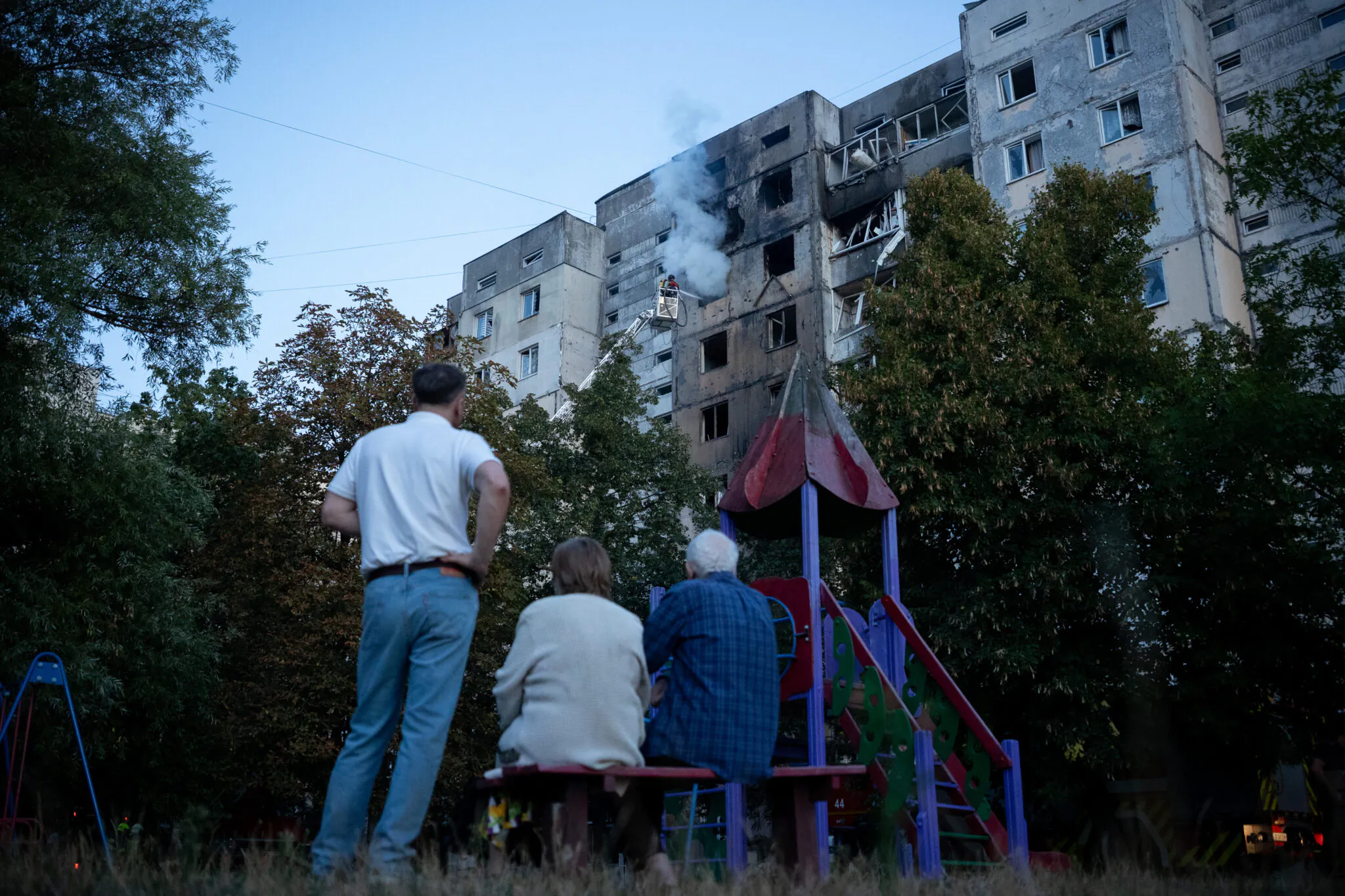
Photo: People watch as firefighters extinguish a fire in an apartment building damaged by a Russian drone strike on Sept. 3, 2026, in Kyiv, Ukraine. The targeting of civilian infrastructure has become a more regular feature of war, local protection of the population becomes increasingly important. (Photo by Oleksandr Magula/Suspilne Ukraine/JSC “UA:PBC”/Global Images Ukraine via Getty Images)