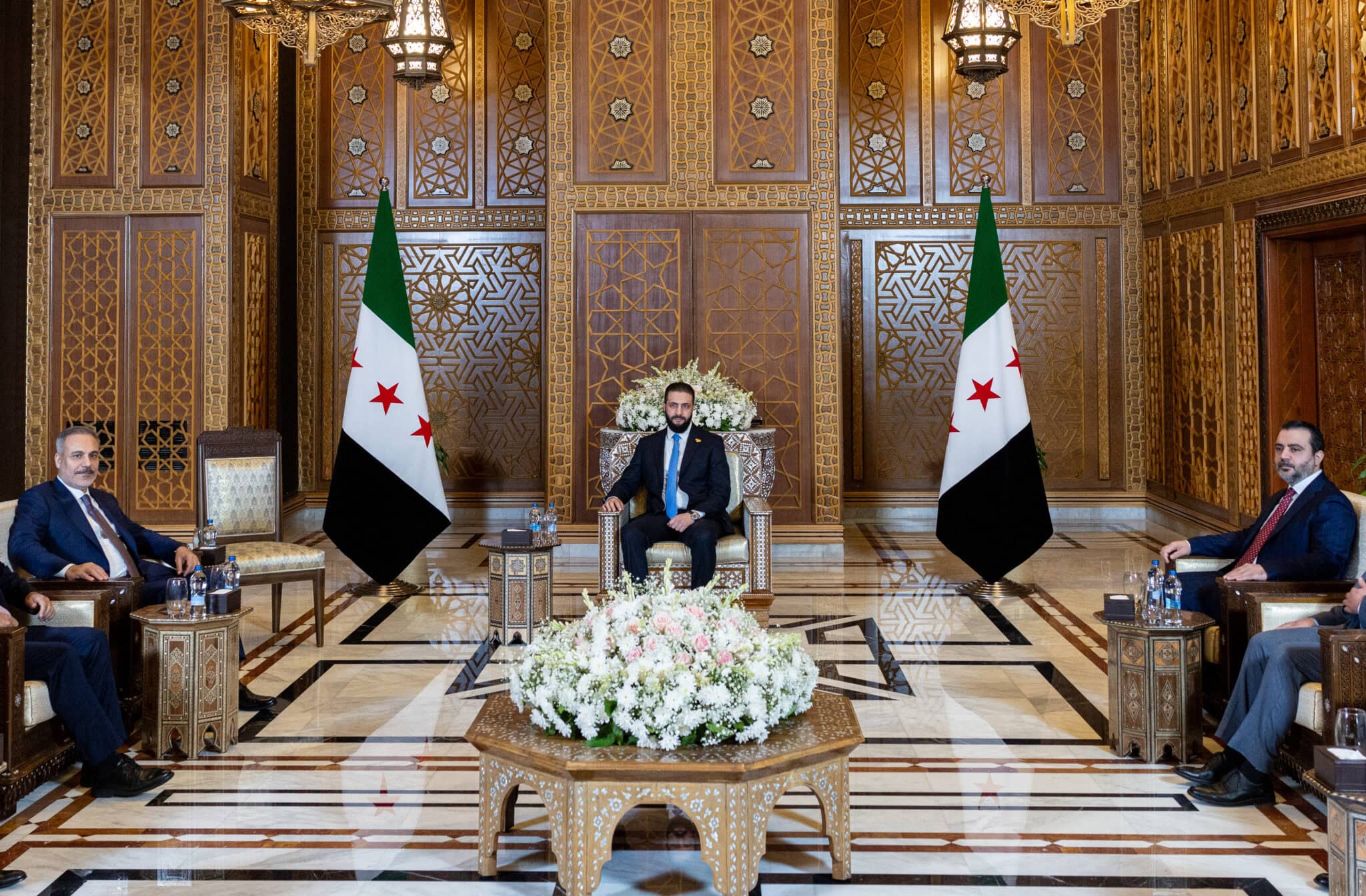
The New Syrian Government: Turning a Page or Rewriting the Script?
Syria’s new leadership is rapidly reestablishing the country’s global ties, but this appearance of diplomatic normalization belies an emerging domestic political order marked by Islamist ideological consolidation and centralization of power around the person of interim president Ahmad al-Sharaa.
Since the fall of former President Bashar al-Assad in December 2024, Syria has been undergoing a geopolitical makeover during which al- Sharaa has repositioned the country on the world stage. The lifting of U.S. economic sanctions on Syria in May was the epitome of the return of international engagement with Syria.
There is no doubt that this economic and diplomatic revival serves as a domestic stabilizer. History suggests that the collapse of state services, sustained poverty, and prolonged exclusion from global systems create fertile ground for violence and extremist movements and recruiting. Yet, even as the government projects a modern, technocratic face abroad, its internal governance choices suggest a different trajectory – one in which ideological alignment and power concentration increasingly define the emerging state.
Al-Sharaa, once an Islamist fighter, signaled his governing philosophy early on with the declaration, “he who liberates will decide.” That principle appears to guide his leadership: Key ministries and decision-making posts are held by ideologically aligned figures, mainly men who held similar leadership positions in the autonomous province of Idlib during the last years of the civil war. Moreover, the president continues to expand his personal authority across multiple domains, overreaching on both executive and legislative branches of the government.
The Many Powers of Ahmad al-Sharaa
While not committing to a future date for general elections, al-Sharaa emphasized the transitional nature of his government, when he announced its formation during a ceremony at the presidential palace on March 29. He has nevertheless gradually concentrated power across all branches of the state. His official titles include president of the republic, holding executive authority over both civil and military institutions; commander-in-chief of the armed forces; and head of government – as he appointed no prime minister. He chairs the National Reconstruction Authority, which manages foreign investment flows and oversees the entire public sector. In addition, he has appointed himself head of the Constitution Drafting Committee, giving himself de facto control over the language of the document currently being developed, including the integration of Islamic law as a source of legislation. He also leads the parliamentary committee responsible for selecting provincial representatives and reserves the right to appoint one-third of parliament directly.
All major decisions made since al-Sharaa appointed himself president were issued by unilateral presidential decrees.
Unofficially, al-Sharaa has cultivated the image of a “custodian of Islamic identity and national morality” — a role not enshrined in law but consistently amplified through state media. He is often referred to as a “Sheikh-President”, blending political authority with religious symbolism. This positioning allows him to project spiritual and moral legitimacy, reinforcing his leadership beyond institutional structures and enabling the enforcement of religious norms through ministries like Interior and Tourism.
This consolidation of power may indeed bring short-term stability and the appearance of order after years of conflict. But so far, al-Sharaa has offered no timeline for national elections. The more plausible scenario, at least for the foreseeable future, is a continuation of one-man rule under the veneer of a transitional mandate.
Technocrats Abroad, Theocrats at Home
In their quotidian life since the fall of Assad, Syrians are witnessing an increasing tendency of al-Sharaa’s government to institutionalize a modern form of authoritarianism, presenting itself to the world as pragmatic and market-oriented, while enforcing ideological conformity and religious orthodoxy at home. While this model may succeed in restoring short-term stability and attracting international investments, it threatens to re-create the very conditions – exclusion, repression, and sectarian tension – that ignited the civil war in the first place.
On the international front, Syria has been rapidly reactivating its economic and diplomatic channels. It has signed a flurry of trade and infrastructure agreements with European, Gulf, and Asian partners. In June, the country’s Central Bank governor announced that Syria had completed its first international transaction via the SWIFT banking transfer system, Türkiye sent a trade delegation in March ; the United Arab Emirates reopened its consulate in Damascus in April; and Washington reinstated a small diplomatic mission to Syria in June.
Al-Sharaa has cast these moves as a return to global respectability, building his narrative around anti-corruption, economic pragmatism, and institutional revival. This narrative is also reflected in the forming of his transitional cabinet, particularly the ministries of Education, Health, and Digital Infrastructure, where ministers have introduced notable spaces for public feedback and policy discussion. Their staff now publish regular updates of their activities, they accept public feedback online, and they hold press briefings: a clear departure from the opacity of governance of the Assad era.
At the societal level, Assad’s fall has led to a cautious reopening of civic space. Independent podcasters and YouTube commentators are gaining traction, especially in urban centers. Civil society groups focused on mental health, urban planning, and women’s empowerment have started to reemerge, though tentatively. Criticism of inefficiency and corruption is voiced, small street protests erupt from time to time, and discontent is tolerated. In July, for instance, hundreds of long-established merchants protested a new law to evict them from their shops. The government responded by pausing the law’s implementation and naming several merchant representatives to a consultative committee. Similarly, protests by families of those who disappeared under Assad, calling for investigation and accountability, prompted the government in May to establish a National Commission for the Missing, tasked with engaging victims’ families and clarifying their relatives’ fate.
These developments suggest a degree of political relaxation not seen under Assad: Ordinary Syrians are finally allowed to participate in public life – at least on the surface, since the government doesn’t meet the protests with violent crackdown, as it did under Assad.
However, the government’s response is not consistent, and it doesn’t always take the demands seriously into consideration. For example, when public outrage erupted over changes to the school curriculum, such as the removal of scientific and historical content in favor of religious doctrine, the government simply ignored the backlash and allowed the controversy to fade. The government’s contrasting responses to the merchants’ protest and the curriculum protests reveal its priorities: it will make concessions necessary when it comes to the economy, while it ensures that its Islamist ideology takes root in the most consequential arena – school education.
This selective responsiveness reveals the deeper structure of al-Sharaa’s rule: consultation on the outside, hardline ideology underneath.
Nowhere is this more evident than in the formation of ministries that wield real power. Interior, Defense, and Religious Affairs are dominated by individuals ideologically aligned with Hay’at Tahrir al-Sham (HTS), many of them former members. Although the other appointed ministers are technocrats, their decisions are overseen by a parallel structure of ‘sheikhs,’ whose authority rests not on civil law but on discretionary interpretations of Islamic law.
Since February, the Interior and Tourism ministries have ramped up enforcement of moral codes by security agents. These codes are not grounded in clearly defined laws but instead rely on the personal judgment of the agents, many of whom interpret “decency” through the lens of strict religious doctrine. For example, several bars and restaurants serving alcohol have been attacked and shut down. Men have been detained for wearing shorts. Unmarried couples have been questioned for appearing in public together. Even swimming attire is now regulated by morality police affiliated with the tourism sector.
This expansion of religious policing can be traced back to how the security apparatus was restructured after Assad’s fall. When HTS, under al-Sharaa’s leadership, assumed power, it dismissed the vast majority of the old regime’s police and security forces. To fill the vacuum, HTS retrained its own fighters, many of whom had operated in the ideologically rigid terrain of Idlib, and redeployed them as police in Damascus and other major cities. The result has been a profound cultural mismatch: combatants trained in Islamist militant discipline now tasked with managing the social dynamics of a diverse, urban population. Unsurprisingly, clashes have become routine, not over criminal acts, but over behavior these new officers perceive as morally deviant.
What was once a security vacuum is now being filled by arbitrary enforcement.
These attacks on personal liberties are increasing; if they become systemic, they risk deepening fear in an already divided society and fostering greater intolerance.
Al-Sharaa’s Legitimacy is Fragile
While al-Sharaa is leveraging counterterrorism narratives to gain international legitimacy, he is failing to contain the escalating sectarian violence at home. The government repeatedly distances itself from the violence yet implicitly enables it through inaction, impunity, and the absence of transitional justice.
Sectarian discourse in Syria is today widespread, fueled by social media and by the absence of a long-awaited transitional justice process that has yet to start. The communities most affected by the 14-year war are frustrated that the old regime’s criminals have not been brought to justice; they are impatient and prone to take revenge.
In March, violence broke out in several coastal cities between Alawites, mostly armed loyalists of the old regime, and Sunni Jihadist militias, mainly Islamist militants who had not been brought under central control. The clashes soon transformed into revenge killing by these latter of entire Alawite families in Tartus neighborhoods.
On June 22, during Sunday mass at a Greek Orthodox church near Damascus, a terrorist opened fire on the congregation before detonating a suicide bomb, killing 20 and injuring dozens. The government’s response was swift but bland: a few muted condemnations, followed almost immediately by an announcement blaming the Islamic State. Just as quickly, authorities said they’d dismantled the terrorist cell behind the attack. The operation was widely publicized, reinforcing the new government’s narrative of a robust counterterrorism strategy, part of its broader pitch to the international community to justify lifting the crippling economic sanctions.
A similar wave of sectarian violence also occurred in Druze communities in the outskirts of Damascus after a fake video of blasphemous content circulated and triggered a security crackdown on the neighborhood. The clashes left dozens dead and the minority community in fear.
On July 15, another, even more brutal conflict erupted between Druze in Suwayda and Arab tribes. Government forces interfered to halt the violence, but videos and images from the scene showed men wearing government security attire committing criminal acts targeting the Druze. Israeli intervention escalated the violence targeting the ministry of defense in the middle of Damascus with airstrikes, sending a clear message for al-Sharaa to retreat from the area bordering Israel.
In each of these instances of sectarian violence, the government attributed the acts to “uncontrolled factions” or “individual transgressions,” distancing itself from responsibility. Moreover, after each event, the government promises to pursue the perpetrators and bring them to justice but has yet to deliver on any of those promises. As a result, these assurances have now lost their credibility, hurting the very fragile trust that al-Sharaa strives to establish between his government and citizens.
Policy Recommendations
- Allow the prompt flow of investment to the country, especially to fund the reconstruction of critical infrastructure and reestablishing basic services. Financing job creation would help restore hope for the mostly young Syrian population deeply scarred by the war and can be the guarantee of a peaceful transition. Furthermore, this will accelerate the return of refugees from neighboring countries.
- In the short term, tie recognition and investment to clear benchmarks. These must include the disarmament and demobilization of militias, particularly those with sectarian affiliations or histories of abuse; the protection of minority rights across religious, ethnic, and regional lines; the meaningful inclusion of women in governance, not only through appointments but also through structural representation in decision-making bodies; and legal guarantees of civil liberties, including freedom of speech, assembly, and association.
- Follow-up on the creation of credible transitional justice mechanisms and monitor their practices. Mechanisms such as truth commissions, community-led reconciliation initiatives, and compensation schemes for victims must be locally grounded yet internationally supported.
- Monitor the evolving institutional landscape, especially the drafting of the new constitution and the distribution of power within key government bodies. The absence of checks and balances, the concentration of power in the person of al-Sharaa and the sidelining of representative institutions are early warning signs of a system drifting toward authoritarian rule under the guise of transition.
The views expressed in this article are those of the author and not an official policy or position of New Lines Institute.