Punishing Vulnerability: Iran’s Minority Crackdown After the 12-Day War
In the wake of the 12-day war pitting Iran against Israel and the United States, Tehran has intensified a crackdown against minorities in the country, targeting particular ethnic and religious groups. The Iranian government has justified its most recent actions as a matter of national security. However, its pattern of systemic exclusion and targeted persecutions has played out over decades, drawing widespread condemnation from human rights organizations and key international powers.
Since June 13, 2025, when the Israeli and U.S. missile campaign targeting Iranian military and nuclear sites began, Iranian authorities have arrested over 21,000 people, including dissidents, journalists, human rights activists, and social media users as well as people from the Kurdish, Balochi, Azerbaijani Turk, Ahwazi Arab, Baha’i, and Jewish communities, among others. Iranian women and journalists regardless of ethnicity are also subject to distinct, systemic patterns of state repression that mirror the mechanisms used against ethnic and religious minorities, raising similar issues of governance, accountability, and protection. In the wake of the conflict, Tehran ramped up state surveillance as well as enforcement of repressive laws. Additionally, in October, Tehran passed a new law mandating harsher consequences for those suspected of spying for Israel and the U.S., making espionage automatically punishable by death and asset confiscation.
This elevated targeting of minorities follows a documented pattern of state-sponsored violence against civilians in Iran. Since the 12-day war, Tehran’s crackdown on ethnic and religious minorities suggests that the Islamic Republic regards its vast minority population as both disposable and a danger to the regime’s survival. Minority rights and inclusion are key indicators of stability and government behavior. The aftermath of the Arab Spring demonstrated how regional governments respond to opposition and dissent. In the wake of the 12-day war, the Iranian regime responded by tightening its authoritarian grip on its population, with many remaining neither unable to exercise their constitutional right to free speech, nor the capability to communicate their grievances with the outside world due to a widespread telecommunications shutdown.
The war exposed critical fractures in Tehran’s regime. Iran’s diverse population of nearly 93 million has long lived under an imposed centralized national identity that rejects ethno-religious pluralism, leading to systemic discrimination against minorities. In December 2025, merchants working in Tehran’s Grand Bazaar ignited antigovernment protests over deteriorating living standards and hyperinflation. The unrest soon spread to the city of Malekshahi and to the poverty-stricken city of Daradrezh, garnering traction among other minority communities also protesting economic deprivation and repressive laws. While Supreme Leader Ali Khamenei publicly acknowledged that the protests had been triggered by Tehran’s merchants, only the Kurdish demonstrators faced major crackdowns. This was the start of the largest round of protests to take place since those in 2022-2023 that were sparked by the death of Mahsa “Jina” Amini in police custody after her detention for refusing to comply with the country’s hijab laws. For the Iranian regime to operate as a tightly controlled theocracy, as it has for the last 37 years, would require minorities to undergo strict state monitoring to silence dissent.
Building pressure on the regime brought about by the war and economic decline has led many analysts to forecast its downfall. Tehran’s response to the demonstrations marks one of the most turbulent and severe periods of repression in its history. After the state cut access to the internet and suppressed media outlets as the January protests grew, millions were left without the means to communicate with the outside world. The information blackout also left Iranian human rights groups without support from outside Iran. Nongovernmental organizations dedicated to supporting Iranians have highlighted the threat faced by human rights defenders, journalists, activists, and newly arrested detainees. Although the restricted access has limited the evaluation of the true scope of casualties during the latest rounds of protest, international media outlets have verified that over 2,500 have been killed, with thousands more injured and over 18,000 people classified as dissidents confirmed arrested.
Minorities in Iran
Kurds
Iran’s 7 million to 14 million Kurds inhabit the country’s northwestern regions for the most part, making up its third-largest ethnic group after Persians and Azeris. Iranian Kurds have borne the brunt of the Islamic Republic’s brutality and have historically been disproportionately targeted by the government. The cross-border nature of the Kurdish issue and the group’s widely known aspirations of self-governance has led to the Kurdish identity being securitized through accusations of foreign alliances and separatism, resulting in systemic persecution and cultural suppression for over four decades.
The western Kurdish-majority provinces of Iran, West Azerbaijan, Kurdistan, Kermanshah, and Ilam, lie along the border with Iraq. They are widely treated as political and economic peripheries and remain among Iran’s poorest and most underdeveloped regions, despite an abundance of natural resources. The nongovernmental organization Genocide Watch argues that discriminatory state practices in the region such as prohibitions on Kurdish-language schooling, repeated shutdowns of Kurdish cultural organizations, and the criminalization of journalists, teachers, and activists, constitute cultural genocide. The Iranian regime has demonstrated a recurring pattern of heightened repression against its Kurdish minority during periods of regional power transition, particularly when it perceives its authority to be under threat. Following the 12-day war, it increased its military presence in Kurdish regions with expanded checkpoints and security deployments. According to the Hengaw Organization for Human Rights, Kurds accounted for 14% of the total number of state executions and 47% of detainees in Iran in 2025, figures disproportionate to their 8% to 17% of the total population.
Aspirations of self-rule have placed the community at the top of the regime’s foreign collaborators list, as the state fears that its Kurdish citizens are seeking outside support to advance separatist goals. The government’s suspicions have led to harsh consequences for some Iranian Kurds. On June 25, 2025, three Kurdish prisoners, including an Iraqi, were executed in Orumiyeh prison on charges of “enmity against God” and “spreading corruption on earth” through “espionage for Israel.” All three were reportedly denied access to legal representation and tortured into making false confessions.
Many Kurds in Iran have turned to kolbari, a form of cross-border portering in which people carry heavy loads of goods on foot across mountainous terrain to earn a subsistence income. The Hengaw Organization recorded a surge in state violence toward kolbars after the 12-day war with Israel. This coincided with a wave of public threats made by government officials, accusing the porters of “espionage for Israel” and “smuggling military equipment.” Over the course of a month in 2025, government forces shot and killed seven kolbars.
In addition, Iranian security forces detained 25 Kurdish children in 2025, accounting for 52% of all child detentions nationwide.
Azerbaijani Turks
According to some estimates, Azerbaijani Turks, the largest non-Farsi ethnic group in Iran, make up 16 to 24% of the country’s population, while others estimate the figure could be 30% or higher. This disparity reflects the absence of transparent demographic census data due to politically driven sensitivities around Iran’s diverse ethnic and religious demographic composition. Unlike other minorities, Tehran’s complex relationship with its native Azerbaijani minority stems from the fear of potential irredentist ambitions toward neighboring Azerbaijan, especially after the 12-day war with Israel. Since the exchange of missiles, the Islamic Revolutionary Guard Corps (IRGC) accused Baku of “intelligence support to Israel,” triggering further surveillance and targeting of Azerbaijani Turks as Tehran shifted its focus toward perceived “close enemies.”
The Iranian regime has traditionally relied on repressive tactics to control opposition, with zero tolerance for budding separatist ambitions among ethnic minorities. As the largest ethnic minority, Azerbaijani Turks have long faced forms of cultural repression, particularly limitations on speaking or learning in their native language. The United Nations Office of the High Commissioner for Human Rights identifies linguistic exclusion as a key driver of social exclusion.
The Ardabil province, bordering Azerbaijan further illustrates how cultural repression functions as a barrier to inclusion. In Ardabil, 45.3% of the population lives in poverty, and the province has an unemployment rate of 10.1%, highlighting poverty and unemployment as two key drivers of sustained social exclusion. Nationally in 2025, unemployment stood at 7.6% for men, 15% for women and 19% among youths, while approximately 36% of the population is classified as impoverished.
Since the 12-day war, state authorities have arrested around 2,000 individuals on the charge of “collaboration” with Israel, resulting in expedited trials and executions and an increased scrutiny on its native Azerbaijani population. The Iran Human Rights Society reported in November 2025 that arrests of Azerbaijani Turks had surged in recent months and noted a pattern used by the regime to quash dissent after significant security threats. On Nov. 2, 2025, IHRS reported the transfer of seven Azerbaijani Turks to solitary confinement due to charges of propaganda against the regime, illustrating that Azerbaijani Turks are not random victims of post-conflict crackdowns, but are part of a recurring pattern in which Tehran uses security-based repression to limit minority rights.
Baloch
The Baloch ethnic group makes up an estimated 2% of the Iranian population, most of whom inhabit the eastern province of Sistan and Balochistan, which shares a 565-mile border with the Balochistan province of Pakistan. Sistan and Balochistan holds significant untapped gold reserves, yet it was officially categorized as the “most deprived region by a significant margin” by the Iranian Parliament’s Research Center in 2024. Its population lacks access to basic necessities like health care, education, and sanitation, and the Islamic Republic has violently repressed dissent there.
The Baloch, who are neither Persian nor Shia, have been suppressed in almost every aspect of life. As Sunnis, the state doesn’t allow them to hold most political office, leaving them underrepresented on both the local and national levels. Publications in the Baloch language are outlawed, and their mosques have long been targets of state violence. According to the Hengaw Organization, at least 142 Baloch were executed in Iranian prisons in 2025, and 256 more were detained, among them 18 children, more than a third of the total child detainees in Iran. Bias against the Baloch in the justice system remains deep, with most Baloch defendants being tried in Revolutionary Courts without due process.
While the IRGC, the Basij militia, and Quds Force all have maintained a constant presence in Balochistan for decades, during periods of unrest their activities and numbers increase. The state’s official reasoning is that the forces are there to combat the threat posed by the Baloch anti-Shia Islamist militant group Jaish al-Adl, which has claimed responsibility for deadly attacks against Iranian state institutions and security personnel. On July 26, an attack by the group on an Iranian courthouse left nine dead. The group’s commander later claimed that more than 52 people had been hanged in a month by the order of judges who worked there.
Following the 12-day war, Genocide Watch reported an increase in militarization and oppressive measures as more checkpoints were set up in the province. Their ostensive purpose was to identify foreign spies, yet they led to a spike in civilian deaths as security forces opened fire on civilians. Hengaw’s statistics showed 44 Baloch civilians were killed by direct government gunfire in 2025, about 60% of all such deaths. In addition to new checkpoints, the state has also utilized surveillance technology – drones and military helicopters – to monitor the province. Baloch civilians remain vulnerable to state violence which continues to brutally oppress them in the name of national security and battling Jaish al-Adl.
Baha’i
Baha’is are the largest unrecognized non-Muslim religious group in Iran, with an estimated population of 300,000. In 1963, Ayatollah Ruhollah Khomeini declared Baha’is agents of Israel, a characterization that later served as ideological justification for the long-term persecution of the community under the rule of the Islamic Republic. Since 1979, Baha’i individuals have been denied recognition under the Iranian Constitution and subject to systematic deprivation of fundamental rights. In a 1991 memorandum signed by Khamenei, the regime effectively laid out a plan for dealing with Baha’is in such a way that their “progress and development are blocked.” Regime policies have translated into consistent persecution, including arbitrary arrests, executions, asset seizures, and economic discrimination.
The spiritual and administrative headquarters of the Baha’i faith are in Haifa, Israel – a location designated by the Baha’i prophet 57 years before the creation of the modern Jewish state. Nevertheless, the Iranian regime accuses the Baha’i of collaboration with Israel, making the community subject of direct consequences in periods of regional conflict. Hundreds of Baha’is were subjected to arbitrary arrests, property confiscation, and unjust convictions as government crackdowns intensified after the 12-day war, according to Human Rights Watch. The Baha’i International Community documented more than 750 persecutory acts across Iran between June and November 2025 – three times more than the number recorded in the same period in 2024.
A number of Baha’i individuals who were charged with “participation in deviant propagation and educational activities contrary to the Sharia,” “membership in the Baha’i sect,” “forming a group to disrupt national security,” and “collaboration with citizens of the Israeli government” were sentenced. In some cases, the government has invoked Article 49 of the Iranian Constitution, which allows for the seizure of “illegal” assets, to confiscate property from Baha’i individuals.
Ahwazi Arabs
Between 5 million and 7 million Ahwazi Arabs in Iran reside in Khuzestan chiefly but also occupy parts of Elam, Bushehr and Hormozegan provinces. While most identify as Shia, a smaller population in the farther south are Sunni Muslims and suffer from religious repression. The Ahwaz have historically been subject to cultural, political, and economic discrimination. Standardized Arabic is confined to religious study, but education in the native Ahwazi dialect is prohibited. As a result, the literacy rate among Ahwazi Arabs is four times lower than the national average, with 80% of rural Arab women illiterate.
While Khuzestan generates about 90% of Iran’s oil revenue, the Ahwaz suffer from socioeconomic marginalization and a lack of adequate social services. Local Arabs are constantly denied employment in the oil and petrochemical industries, jobs mostly allocated to Persians. A history of land confiscation and ethnic engineering has forced thousands into slums on the periphery of Ahwaz city. Simultaneously, economic incentives not available to Arabs have attracted non-Arab populations to resettle on Ahwazi farmlands. While the Ahwaz region is home to 35% of Iran’s freshwater resources, river diversions directed by Tehran, mainly to provide water for nuclear reactors, have led to public outcry over chronic water shortages.
The Ahwaz region holds tremendous significance for the Iranian regime, which has placed a priority on suppression of its local population. The region’s massive natural wealth has been systematically exploited to build and sustain the modern Iranian state. Its strategic location along the entire Arabian Gulf coast, as well as its vast natural and water resources, make it indispensable to Tehran’s power. The Islamic Republic recognizes that any loss of control over Ahwaz would collapse its ability to fund and sustain its nuclear program, support regional militias, and maintain its geopolitical influence; therefore, it continues to brutally suppress dissent.
Following the 12-day war, authorities intensified their crackdowns on the Ahwazi Arab minority. On June 23, IranWire reported that 54 Arab citizens were arrested on charges of “espionage” and “cyberspace activities,” with the prosecutor describing the detainees as “hostile elements and supporters of Israel.” Similarly, the Center for Human Rights in Iran reported that multiple Arab individuals received death sentences on national security charges throughout July.
Afghan Nationals
For over four decades, Iran has maintained space to host and offer asylum to refugees from one of the most protracted refugee crises in the world, stemming from Iraq and Taliban-controlled Afghanistan. In 2024, the UNHCR reported that around 3.7 million forcibly displaced refugees of various legal statuses resided in Iran, including undocumented Afghans and Afghan passport holders, the world’s largest refugee population.
By June 2025, the Afghan community living in Iran experienced the largest mass deportation campaign in its history. Around 1 million Afghan nationals have been deported, 70% forcibly so, with a quarter of those being children. Unlike prior waves of forced deportation that focused largely on young, single men, entire families were targeted. According to a report by the International Organization for Migration (IOM), the return of Afghan nationals began accelerating in April and May 2025, and peaked in June. On June 25, one day after a ceasefire in the 12-day war, the IOM recorded over 28,000 people crossing back into Afghanistan. A survey conducted by UNHRCR found that 82% of the returnees were in debt due to displacement, unemployment, and loans finance their basic needs upon their arrival to Afghanistan.
Ultimately, Tehran’s aversion to civil disobedience must not be perceived as a show of might, but rather a fear response triggered by unexpected foreign interference.
Ethnic Groups
Comprehensive and fully reliable demographic data on Iran’s ethnic composition is not available. Many academic and policy sources had relied on figures from the now-discontinued CIA World Factbook, even though it had ceased reporting ethnic data on Iran a decade ago. While these estimates provided a generally consistent picture of the relative size of Iran’s largest ethnic communities, they did not account for several smaller indigenous groups, including the Gilakis, Mazandaranis, Talysh,, and Tats. . As a result, percentage-based representations are more defensible for major groups than for smaller and less documented communities, whose exclusion distorts assessments of Iran’s patterns of repression.
Existing estimates consistently identify Persians, Azerbaijani Turks, and Kurds as Iran’s three largest ethnic communities, with Persians making up roughly 61% of the population, Azerbaijani Turks about 16%, and Kurds about 10%. Lurs are generally estimated at close to 6%, while Arabs, Baloch, and Turkmen are each roughly 2%. Although the proportions remain uncertain for smaller ethnic groups, and several others are unaccounted for, these figures can still provide a useful baseline for understanding the scale of state repression when interpreted alongside security practices.
Religious Groups
Around 90% to 95% of Iran’s population are categorized as Shia Muslim; 5% to 10% as Sunni Muslim; and less than 1% identify as non-Muslim, including adherents of the Baha’i Faith, Zoroastrianism, Judaism, and Christianity. Under the Iranian Constitution, Zoroastrians, Jews, and Christians, with the exception of converts from Islam, are permitted to form religious societies “within the limits of the law.” Smaller religions like Bahaism lack any recognition under the law.
Women
According to Iran Human Rights Monitor, at least 61 women were executed between January and December 2025, representing a nearly 70% increase compared with the previous year. At least 35 of these executions were carried out between late July and mid-December. This spike in executions can in part be attributed to the regime’s heightened sensitivity to the growing role of women in recent uprisings and political movements since 2022.
Press Freedom
For authoritarian regimes, the loss of control over the media equates to an existential threat, as it undermines state legitimacy and the ability to control public discourse. Tehran’s media organizations are forbidden from operating or reporting outside of state control. In the wake of the 12-day war, the Committee to Protect Journalists (CPJ) publicly demanded an explanation from Iranian authorities to justify the arrest of 98 “citizen-journalists” being charged with communicating with a London-based Persian-language television channel. State-owned news agency Mehr News justified the action by saying Tehran had arrested and summoned “affiliated operational agents,” not journalists.
Tehran’s reformist Ham-Mihan newspaper also reported that several of its journalists were summoned by the IRGC’s intelligence branch in the wake of the 12-day war. Ham-Mihan’s website was blocked by the state, and the newspaper was prohibited from posting on social media. The pattern of state control through forced detention, arrest, and execution intensified in September 2022 following Amini’s death in custody. Since the “Woman, Life, Freedom” movement, triggered by Amini’s passing, state pressure to quell future civilian uprisings and control press freedom has spiked, particularly after the outbreak of violence between Iran and Israel, culminating in the arrest of over 700 people on allegations of collaboration with Israel.
Conclusion
A telling indicator of democratic health and shifts in state behavior can be seen in how minority communities are treated. From the highly targeted Baha’i community to the Kurds in Iran, the Islamic state has long abandoned the principle of equal rights “for all people of Iran” as outlined in its constitution. The aftermath of the 12-day war revealed how Tehran manages dissent, prompting millions to push for basic rights.
Policy Recommendations
- Mandate Minority-Focused Reporting in U.S.
U.S. policymakers should use minority inclusion as a core benchmark of political transition rather than a secondary human rights consideration. Patterns of minority inclusion and exclusion offer valuable insight into state fragility, regime behavior, and impact on regional order and stability. To implement this approach, U.S. agencies should incorporate minority- and inclusion-related indicators into annual country assessments. Government agencies must also work alongside experts and minority-focused civil society organizations to enable cross-sector dialogue and well-informed analysis. Doing so would streamline the U.S.’s risk-assessment capabilities, enabling the United States to anticipate instability, supporting its interests to maintain stability in the region.
- Protect Journalists, Activists, and Minorities Who Have Fled
The United States should partner with allied states to expand global protections for journalists, dissidents, and activists who were forced into exile due to intense repression. Congress must work with regional experts and select committees to allocate resources that enhance their safety and legal protections. Targeted sanctions against officials responsible for abuses will reinforce accountability and signal that minority persecution carries international consequences.
- Improve Visibility and Recognition of Information Blind Spots in Iran
State-enforced internet and media blackouts triggered by civil unrest mean critical information about minority groups at high risk of persecution often does not reach the international community. This strategic blind spot distorts the U.S.’s ability to assess ongoing, but largely unknown political and humanitarian conditions. Thus, government agencies such as the State Department’s Bureau of Democracy, Human Rights, and Labor should consider expanding its analytical focus on information gaps and media censorship patterns in authoritarian states. This will boost Washington’s risk-assessment capabilities and reduce blind spots in policy analysis designed to protect minorities, proving that U.S. support is critical, and ensuring that western support is well-intentioned.
This analysis was published in collaboration with the Middle East Policy Council.
The views expressed in this article are those of the authors and not an official policy or position of New Lines Institute.
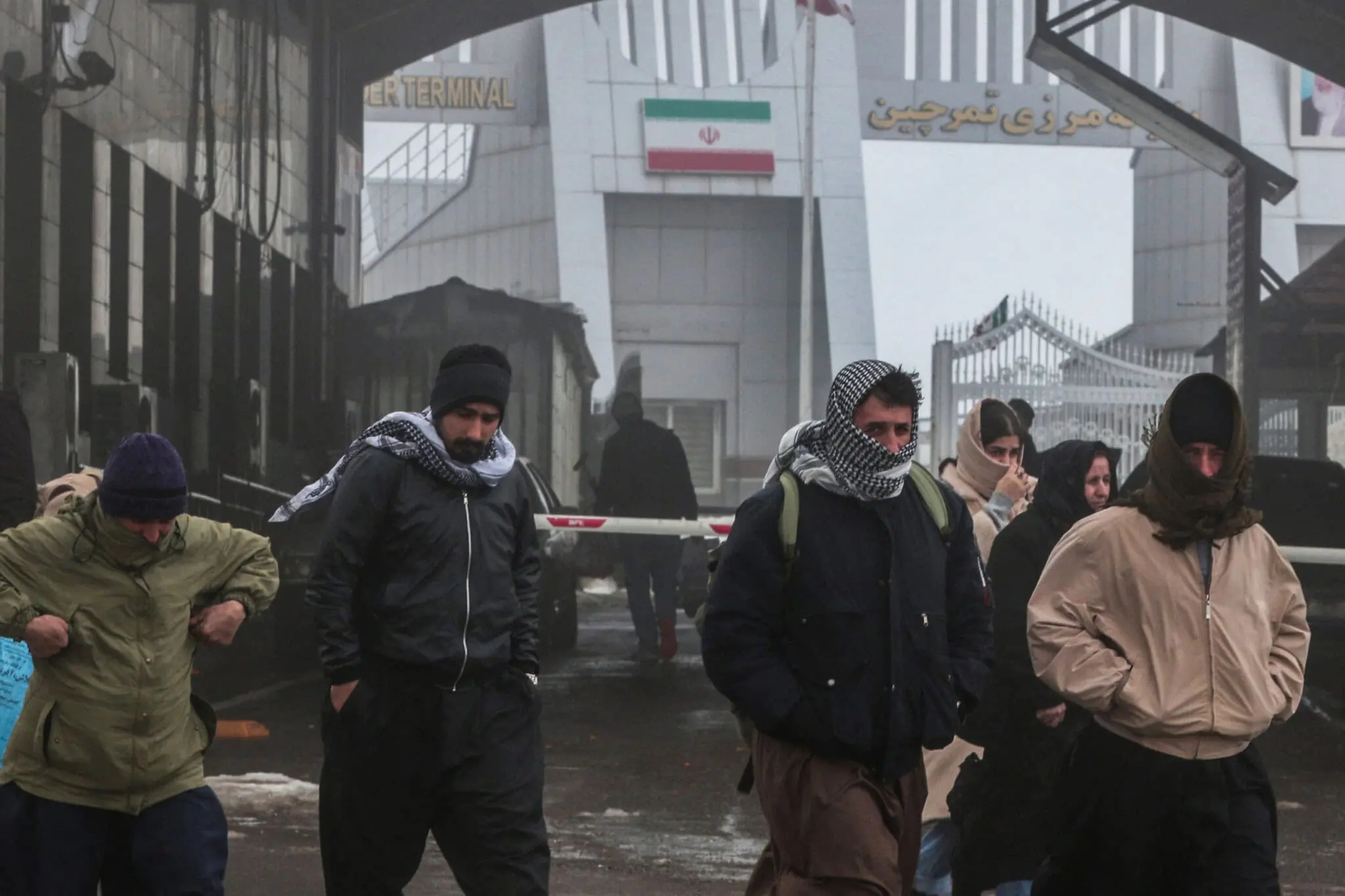
Travelers, mainly Iranian Kurds, arrive at the Haji Omran border crossing with Iran, in Iraq’s autonomous northern Kurdish region, on Feb.1, 2026, which is open to travelers and economic trade. (Photo by Safin HAMID / AFP via Getty Images)