Disunity and Absence of Strategic Vision Pose Serious Complications for the Iranian Opposition
This report is part of a series exploring the strengths and weaknesses of the Iranian opposition and what this implies for policymakers. This analysis looks at the weaknesses of the pro-royalist opposition, while the third section deals with the ethnic camp. Read the previous installment here.
The most glaring weakness of the Iranian opposition is its disunity. Of late, Reza Pahlavi, the leader of monarchist movement seeking to reclaim its place atop Iranian leadership, has made no meaningful attempts – even token ones – at unifying opposition factions. Coalition-building involves work among equals, after all, and according to some of his supporters, that would entail demotion of the lofty position of the king.
The monarchists’ earlier overtures to other political and ethnic opposition groups have been all but abandoned. Compare that with late Supreme Leader Ayatollah Ruhollah Khomeini’s leadership style during the Islamic Revolution that toppled Shah Mohammad Reza Pahlavi, Reza Pahlavi’s father. Khomeini managed to unite liberals, nationalists, leftists, former guerrillas, ethnic groups, middle classes, and religious conservatives in a united front during the 1979 uprising.
At a time when the success of anti-regime forces is contingent upon their unity, it appears that a radical monarchist faction – symbolized by groups such as the New Iran Party (formerly Farashgar) and National Union for Democracy in Iran – now have the upper hand among the royalist opposition, prevailing upon the crown prince to forego coalition-building altogether.
For instance, while Reza Pahlavi did once agree of the need for unity, he has now moved decisively to dispense with that imperative. During a press conference in Munich on Feb. 14, 2026, after a BBC Persian journalist pressed him regarding the absence of consensus in Iran on his leadership, he lashed out, saying: “We have brought everyone together. Those who are not with us are either terrorists, Mojahedin-e Khalgh, or separatists.”
Hardened Positions
Along with the ascendancy of the radical royalists in recent years has come a hardening of positions vis-a-vis the other rival groups, chiefly the “17 Signatories.” On Dec. 12, during a mass funeral held for a human rights lawyer who some believe to have been killed by Iran’s secret police, pro-Pahlavi activists pelted their rivals with stones. When Nobel Peace Prize recipient Nargess Mohammadi, a member of that movement, rose to speak, they also chanted a slogan implying death to their rivals.
Many similar incidents have flared up in recent months both in Iran and abroad. While pro-royalist forces have recently accosted their rivals, they also were the targets of similar tactics in the past. The conclusion can be made, however, that the rifts within the opposition have dramatically widened of late rather than narrowing.
The monarchist movement in exile once consisted of several schools of thought, but those have essentially consolidated into two major currents today: the Constitutionalist Monarchists, who believe in restoration of the pre-1979 monarchy albeit in a more democratic and less autocratic form, and the Radical Monarchists, who have little patience for strict constitutional trappings and restrictions, at least in the immediate aftermath of a liberation.
Among the first group can be found queen mother Farah Diba, journalist Amir Taheri, and Shahriar Ahi, a former close adviser to the prince before the ascendancy of the radicals. As for the latter group, many of its members harbor Great Persia irredentist tendencies and are generally ill-disposed toward Islam. Of late, with the rise of the radical right movements throughout the world, they are consciously crafting their message in a far-right idiom but so far are still frozen in a classical upper-class right-wing ultranationalist framework as opposed to a genuine radical-right nativist paradigm.
Compared with other groups, the members of this faction are relatively young, and the infusion of new blood from a radicalizing landscape inside Iran may reinforce this dynamic. Many of its leaders once belonged to an organization inside Iran called the Iranian Liberal Students and Graduates, which has been inactive for close to a decade. One was the regional representative of Green Movement leader Mehdi Karoubi in 2009, and the group as a whole officially endorsed Karoubi’s candidacy for presidency that same year before turning sharply to the right. Two of these up-and-coming politicians, Saeed Ghaseminejad and Amir Hossein Etemadi, have acted as chief advisers to the prince in his meetings with foreign officials. For example, in 2024, they accompanied him to Tel Aviv, for a series of meetings with midlevel Israeli officials.
Another weakness of the Pahlavi movement is its strong ethnocentrism. Iran is a multiethnic country composed of Azeris, Kurds, Baluchis, Arabs, and others that together make up nearly half of the population. Many members of these groups find Persian ultranationalism offensive. This explains why Kurdish and Azeri groups joined the protest movement in its later stages and in a somewhat limited form. Before the monarchist movement’s radical turn, relations with ethnic leaders had been progressing reasonably well. However, they have deteriorated recently.
A Strategic Gamble
Another potential problem for the monarchist movement is that it has effectively premised its entire roadmap for toppling the current regime on foreign intervention to the exclusion of most other strategies. There simply doesn’t appear to be a Plan B in case the administration of U.S. President Donald Trump decides to make a deal with the mullahs in Tehran. Until now, at least, Pahlavi has not said much about the imperatives of grassroots organizing or participatory decision-making from below. Nor has he articulated nonviolent direct action techniques like civil disobedience, legal strategies, petition campaigns, community-level mobilization, civic engagements, pamphleteering, targeted strikes and boycotts, etc., steps without which it would be virtually impossible to restrain or overpower a dictatorship.
He has, however, announced the formation of a group called the Immortal Guard of Iran (IGI). This was the name of an elite military unit under the shah that served as both his personal guard and a combat branch of the army. The name clearly harkens back to the glory of the old regime as well as its militarism. Pahlavi supporters insist the IGI’s chief remit is civilian. However, it is difficult to accept that proposition given its name. In addition, several videos have emerged recently showing men in military attire pledging allegiance to Pahlavi.
The impression that Pahlavi endorses armed resistance is reinforced by the fact that he has not officially distanced his movement from acts of violence committed in his name. This is a fraught strategy. During January’s protests scores of government buildings, mosques, banks, plus one religious shrine were destroyed, and around 100 members of the country’s security forces were killed, marking a first for an Iranian protest movement. This gave the regime the needed pretext to justify the subsequent bloody crackdown that has claimed thousands of lives.
A History Lesson Unheeded
A recent article by Karim Sajadpour, an Iran expert, and Jack Goldstone, a social scientist, published by The Atlantic compares the prince positively to the great revolutionary leaders of the last century: individuals like Vladimir Lenin and Ho Chi Minh. They studiously shunned any form of violence toward their foes – i.e. the Tsarist regime and the French colonialists – until the time was ripe for a mass uprising as opposed to endorsing individual acts of terrorism. Both men spent more than 20 years in political agitation and organizing before endorsing an armed uprising.
A comparison with the tactics employed by Khomeini during the Islamic Revolution is apt. The ayatollah successfully deployed both violent and nonviolent means to chip away at the old regime’s pillars. But there is a big difference between Reza Pahlavi and Khomeini. While Khomeini’s revolutionary supporters rampaged through major cities burning government buildings, cinemas, and liquor stores, he constantly harped on the peaceful nature of the protests and the inherent violence of the regime in power. He never stopped doing so even when he was manifestly distorting the truth.
A key reason why there have been no defections from the regime side so far and why all regime factions have banded together is precisely the perception by many of its loyalists that the opposition is a violent and dangerous force in cahoots with foreign enemies and bent on their extermination.
Hostility Toward Islam
The anti-Islamic messaging from the people around the prince is yet another major drawback for the royalists. Recently, a royalist with significant influence, threatened to burn a copy of Quran for each prisoner who is executed. While Islamophobia has proved to be a highly effective tool for radical right forces in the Western world, it could be a major liability in a Muslim-dominated country like Iran. For example, chehelom – special ceremonies on the 40th day after a person’s death – is an important mourning rite in the Irano-Shia culture. In fact the Islamic Revolution succeeded in part by commemoration of consecutive cycles of cheheloms for those who had been killed by the army.
While Pahlavi once called for commemoration of chehelom ceremonies well in advance of the events, this year, he did so in the middle of them and not with a lot of enthusiasm thus missing an important opportunity for mass mobilization.
Alienating the IRGC
Finally, Pahlavi may be making a major tactical error by urging global powers to put the Islamic Revolutionary Guards Corps (IRGC) on their terrorist lists. While the IRGC is responsible for atrocities inside Iran and for sowing mischief in the region, and while foreign states may be justified in adding it to lists of terrorist entities, for the opposition to call for that is an entirely different matter.
Pahlavi’s rhetoric signifies his rejection of the IRGC, thereby effectively closing doors for potential defections and reintegration under any new regime. This could be a recipe for civil war. After all, the experience of Iraq under U.S. occupation shows the risks that treating a security entity as a terrorist organization or completely disbanding its structures could easily lead to eruptions of civil war and terrorism on a mass scale.
Compare Pahlavi’s posture with Khomeini’s measured approach to the Iranian military during the revolution. The ayatollah never called for disbanding the force even under the threat of a coup d’état. After the revolution, he resisted pressure from all sides to disband the Artesh (the regular military) as well.
Shortly before the revolution succeeded, Khomeini made a direct appeal to the military, assuring it would not face retribution from the new regime: “We will not hold you responsible for past actions, nor will we seek revenge. It is time for us to unite in the spirit of Islam and work together to rebuild Iran for the future.”
Policy Recommendations
The royalist opposition has grown and thrived considerably since Jan. 8, 2026. It has attracted many new adherents who believe it is the chosen alternative to take power after a regime change initiative from abroad. In the event of an actual regime replacement operation, its support could be expected to further grow. This support is therefore wholly conditional on a U.S. decision to go ahead with military intervention.
If policymakers opt to attempt a forced overhaul of the governing system, the Pahlavi movement could be a reliable partner, along with elements of the armed forces, for a transition to a non-Islamist polity.
However, if the final decision is not to orchestrate a change of regime in Tehran, the royalist opposition would likely undergo contraction. How far it shrinks will depend on how well its leaders adapt to new conditions, its appetite for reorienting toward coalition-building, and its willingness to start engaging in the slow but vital task of grassroots organizing from below.
If the movement fails to rise to the occasion, it could become totally marginalized in the future once the Islamic state begins to reconsolidate itself once again.
Conclusion
While the replacement of older advisers from the Constitutionalist camp by younger and more radical individuals and groupings from inside the country has unquestionably brought a surge of vitality to Pahlavi’s royalist movement as well as providing him with a closer sense of what is happening on the ground in Iran, it has also fundamentally changed the character of his movement. Its aims have shifted from seeking a monarchy with guardrails to a more traditional one with sweeping powers, at least in the short term. This has been accompanied with a corresponding change in tactics and rhetoric.
Pahlavi is gambling that U.S. military intervention will lead to a regime change that elevates him to power. If that fails to materialize, his recently intensified support likely will ebb, and his real or imagined compact with Israel or the Trump administration could instantly change from a big asset to a major liability.
The views expressed in this article are those of the author and not an official policy or position of New Lines Institute.
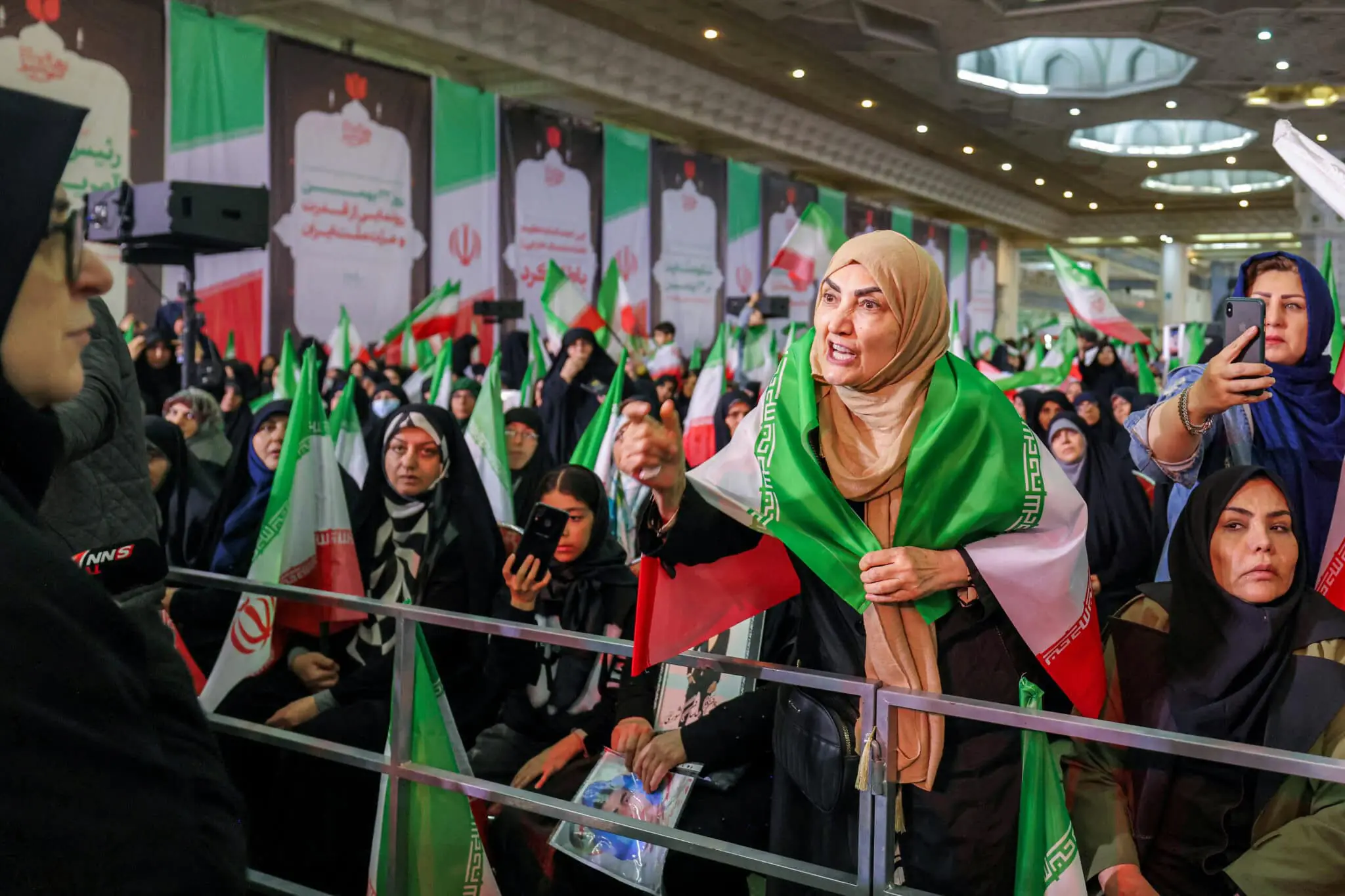
Photo: A woman draped in the Iranian flag confronts a government spokesperson during a memorial ceremony marking the 40th day of mourning for people killed in previous anti-government protests in Iran at the Tehran Musalla on Feb. 17, 2026.Photo by ATTA KENARE / AFP via Getty Images)