A U.S. Missile Strike Could Guarantee Regime Continuity in Iran
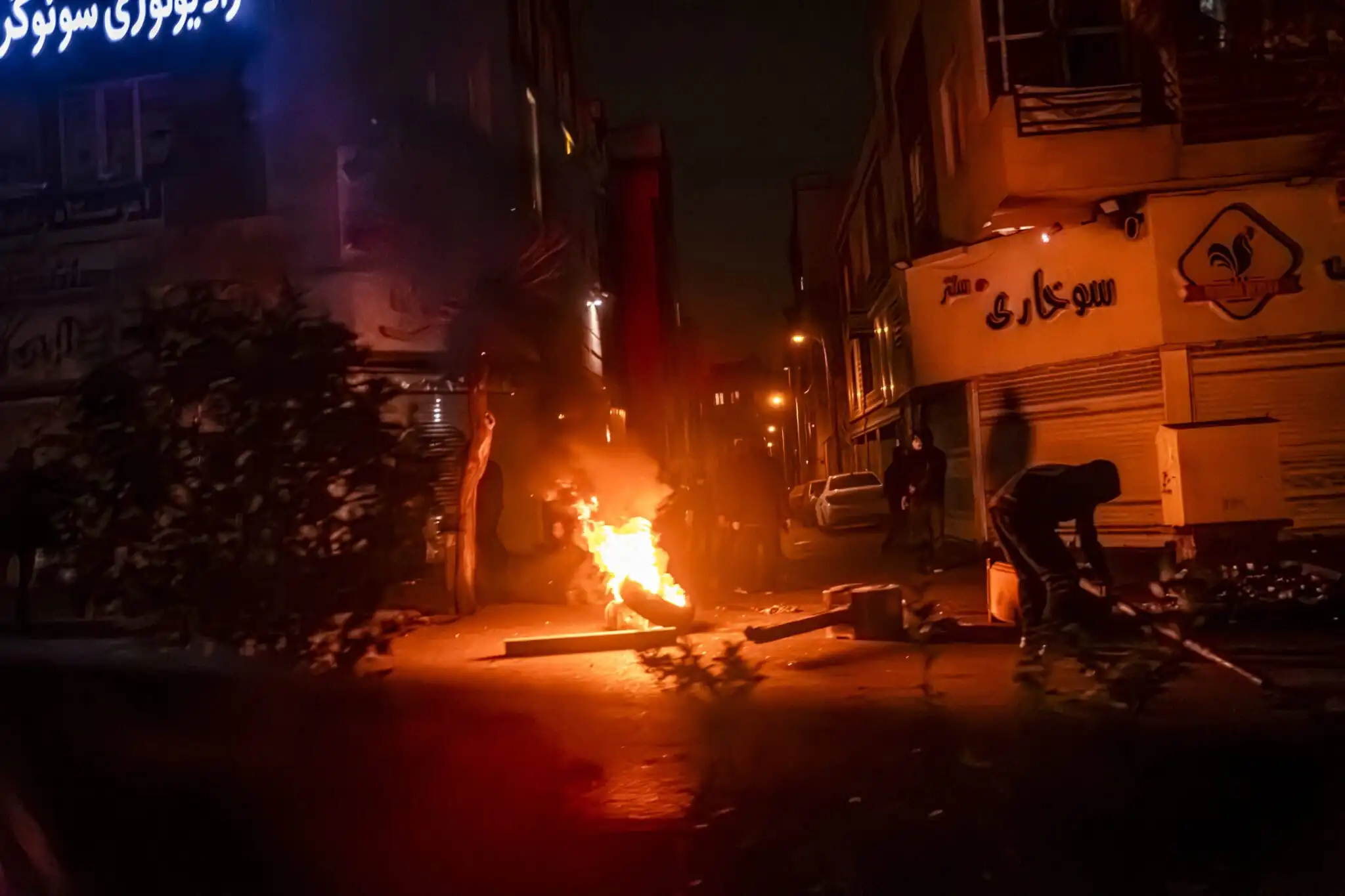
As its options for stability run out, the Iranian regime could be provoking the United States into military action in order to dissolve the current protest movement. On Jan. 9, speaker of the Iranian Parliament Mohammad Bagher Ghalibaf stated that after any U.S. missile strike, there would be a response and an escalation. This would lead to a hot, albeit brief, war. Under those circumstances, any government in power would immediately call a state of emergency. Iranians have a strong sense of nationalism. Many undoubtedly would go along with the state of emergency. In wartime conditions, fear often replaces any kind of rational thinking. Some may even regard those cheering such an attack as unpatriotic. Thus, a strike on Iran would be tantamount to U.S. President Donald Trump throwing a lifeline to the regime.
In an unprecedented move, on Jan. 11, Iranian state-owned television station IRIB broadcast part of a video that purportedly showed the dead bodies of several dozen protesters, with mourners congregated in a courtyard outside a morgue near Tehran. While the video’s authenticity is questionable, that is not as important as the fact that it was aired at all. The regime had never before shown a funeral or mourners related to fallen members of a protest movement.
Clearly, IRIB’s Islamist-leaning audience was not the video’s target audience; there were no chador-clad individuals among the relatives of the deceased. Nor was the video aimed at the protesters and their sympathizers, who were likely further angered by the images. Rather, the chief target audience seemed to be somewhere outside Iran. It was as if the Iranian government was goading Trump to make good on his promise to retaliate militarily for the loss of civilian lives.
Iran is in a state of suspended animation. All internet and mobile phone communications are stopped. Even land line telephones are not functioning, for the most part. Bazaars, universities, and some government offices have been temporarily closed. Communication with the outside world is halted, and the shutdown of much of the economic activity is worsening the economic crisis.
After Ghalibaf’s statement about retaliation, reports surfaced that units of the Iranian armed forces are on high alert, a status that would facilitate retaliation against a U.S. missile strike. Ghalibaf said that Iranian retaliation would target both U.S. and Israeli bases in the region.
Out of Good Options
Tehran has run out of options for addressing protests. As past major protest movements (the 2009 Green Movement, the 2017 protests over gasoline price hikes, the 2019 protest about cost of living issues, and the 2022 Woman, Life, Freedom protests) erupted, the government had significant room to maneuver, both financially and politically, to clamp down with relatively limited costs. It does not have that luxury now.
Iran’s economic deterioration is speeding up. For instance, workers and state employee are to receive only a 20% raise in wages, while the country’s inflation rate is officially close to 50%. Additionally, according to Iranian President Masoud Pezeshkian, government coffers are practically empty. Moreover, many Iranian economists believe that with the further devaluation of the local currency, a dollarization of the economy – like what occurred in other countries that experienced hyperinflation – is inevitable.
Meanwhile, the regime’s popularity is at its lowest ever. According to an official public opinion survey conducted last November and republished on a website believed to be close to Iran’s regular military (Artesh), 93% of the population expressed “dissatisfaction” with the state of the country.
Additionally, there are indications that the regime may be ready to make significant concessions to the United States in a forthcoming negotiation. If that’s the case, Tehran would negotiate with a stronger hand after the full suppression of the current protest movement than it would have if the movement were still alive.
Present vs. Past
None of this means the regime is on the verge of collapse, as many observers and opposition figures claim. The power of politicized religion in Iran has created an entirely new dimension to general political analysis that is absent from other similar cases. It simply means that the government cannot contain the protest movement as easily as it did before.
For example, during the 2019 protests, nearly 1,500 people – mostly young and of working-class origin – were killed. However, the number of casualties did not create a serious national scandal for two reasons. First, other sectors of society (bazaaris, the middle classes, and the urban poor) were generally unaffected. Second, according to government officials, 991 banks and close to 200 gasoline stations were torched in a series of mysterious arson attacks that the government quickly blamed on the protesters. (It later came to light that these attacks were partly or wholly perpetrated by government agents aiming to provide justification for a crackdown.) A former head of the Islamic Revolutionary Guards Corps (IRGC) revealed that battle-hardened military units under the command of Qassem Soleimani had directly participated in the shootings.
In the Green Movement, only the middle classes of Tehran were involved, and for a strictly political cause. The Woman, Life, Freedom movement of 2021 was exclusively driven by middle-class women and activists. By contrast, today’s protest movement spans several classes, with both economic and political components. The government simply does not have the wherewithal to meet the economic needs of all these different segments of society simultaneously. Nor is it politically strong enough to ride out the blowback that would occur after a massive and bloody crackdown. No one would believe that these protesters have burned down hundreds of gasoline stations or banks. In fact, most Iranians seem to think regime forces are behind the burning of the cars and mosques, although that does not seem to be the case so far.
Even an announcement of the formation of armed groups that could resort to assassinations and sabotage – as happened in the 1980s – won’t help the regime this time around. (Three such armed groups have just emerged in the last few days.) In addition, Iranian leaders have learned an important lesson from the 1979 revolution: Never yield to the protesters’ demands in any circumstance, because doing so would only embolden them to make further demands.
There have been two exceptions to this rule in the last 46 years. The first is the 2022 Woman, Life, Freedom movement, which began after Mahsa “Jina” Amini died in police custody during her detention for allegedly wearing an “improper hijab.” The government conceded on the issue of mandatory hijabs; the law remains on the books, but enforcement is spotty. The second occurred just two weeks ago. Pezeshkian’s government acceded to many of the demands of bazaar merchants to quell their protests. These included a concession that their taxes would not be raised, as had been announced earlier, and there be a grace period before penalties for unpaid taxes from the year before would be imposed.
A Time for Critical Decisions
The fact that the regime made those crucial concessions instead of suppressing the demonstrators swiftly, as is its custom, indicates that some significant developments we are not yet privy to might have been in the works.
Contrary to the opposition’s claims, repressive forces have yet to respond with great brutality as before. Up until communication with the outside world was abruptly stopped on Jan. 8, the information conveyed gave an impression that security forces displayed deliberate restraint. In some areas, members of the security forces can be seen waving to the crowds in a welcoming gesture as thousands of demonstrators marched peacefully, sometimes en famille, in several large and small cities.
Though opposition activists claim that thousands of lives have been lost, these same activists attribute the lack of overwhelming force to a loss of morale among the security forces. This is likely an illusion. There is no demoralization discernible either among these forces or the million-large Islamist population at large. They are just biding their time. If missiles start hitting IRGC bases in charge of internal security, such as the infamous Thar-Allah Headquarters in northern Tehran, we will see how demoralized these forces really are.
Leaving aside the conspiracy theory-tinged notion that a military strike may have been agreed upon as part of a grand bargain, any form of kinetic action against Iran would be a monumental mistake on the part of the United States. People around Trump and Israeli Prime Minister Benjamin Netanyahu seem to be making comments that support that error. For example, U.S. Sen. Lindsey Graham called for the U.S. to assassinate Iranian Supreme Leader Ali Khamenei. It is unclear whether Graham is aware that however despotic Khamenei’s rule has been, he is the revered spiritual leader of several million people.
A successful assassination might lead to state collapse in certain areas, like Iranian Kurdistan, or even to a violent transition to a secular state in the capital. But it also would almost certainly lead to a bloody civil war, mass refugee and migration flows, and a prolonged U.S. military engagement in the region – an outcome directly at odds with the principles laid out in the most recent U.S. National Security Strategy for the Middle East. There is also little doubt that a forced transfer of power to secular forces without the incorporation of some Islamist or post-Islamist elements into the state structure would spawn a deadly form of Shia Daesh (ISIS).
Moving Forward
So far, there are no cracks among Iran’s elites. Nor are there any signs of dissent among other forces; for instance, the Artesh recently made a strong statement in defense of the regime. There haven’t been any reports of loss of support for the regime among security forces, although the motivation for suppression is admittedly weaker than usual.
Any form of kinetic action against Iran will put an immediate end to any form of open dissent. For example, prior to the first missile exchange between Iran and Israel in April 2024, there were hundreds of small-scale protests by workers and pensioners. All of these stopped immediately once hostilities broke out. Iranians are extremely nationalistic, and any form of foreign attack on their land is usually proscribed by most of them in strongest terms. The regime banks on this loyalty in its attempts to portray the protest movement as a tool of foreign enemies. It motivates its supporters enough to go along with demonizing the protesters. It also splits the protest movement itself.
If, however, an attack is avoided, the protest movement has a chance to operate clandestinely with some form of foreign support. As the economic crisis intensifies, rifts within the regime may emerge and set the stage for the emergence of the Artesh as the ultimate non-ideological force capable of bringing under control the anti-Western, anti-democratic policies of the current regime.
The views expressed in this article are those of the author and not an official policy or position of New Lines Institute.
Iranians gather while blocking a street during a protest in Tehran, Iran, on Jan. 9, 2026. (Photo by Khoshiran / Middle East Images / AFP via Getty Images)
555