The Transformative Potential of the Global Gen Z Movement
A wave of Gen Z-led uprisings is reshaping political landscapes across the world, from Nepal to Peru and Indonesia to Morocco. What initially looked like scattered unrest now displays the contours of a shared movement growing faster than governments can respond and demanding a new approach from U.S. policymakers. These are not single-leader protest campaigns but rather digitally connected networks of young people who grew up online, learned to use online platforms such as TikTok and Discord to organize, and then moved their grievances to the streets.
Like the Arab Spring movement, these protests carry the possibility of turbulence and political collapse. They also carry the possibility of renewal. Activists from Gen Z (generally considered to be people born between 1997 and 2012) are calling out corruption, censorship, and the daily indignities of misgovernance, pushing their governments to address issues long ignored. This gives the United States an opportunity to draw on existing youth frameworks – especially the Youth, Peace, and Security agenda, which just gained a new U.N. Security Council resolution on December 12 – to shape a foreign policy that speaks to the world Gen Z is inheriting, and to advance U.S. interests, including stability, prosperity, and democratic resilience.
The administration of U.S. President Donald Trump has framed itself as a champion of peace and prosperity. That objective would be strengthened by ensuring the next generation is meaningfully included in peace processes from Gaza to Sudan and elsewhere; by incorporating youth marginalization into U.S. risk assessments; and by using U.S. diplomacy at the United Nations to advance practical, resourced initiatives that prevent conflict rather than merely responding to it.
Shifting Geopolitical Context and Youth Demographics
In many low- and middle-income countries, Gen Z makes up the largest share of the population but has the least representation or influence in government. Schools, job markets, and public services have not kept pace with their needs, causing this generation’s trust in state institutions to erode.
They are coming of age in a world unsettled by a return to great-power rivalry, more frequent conflicts, harsher climate shocks, and institutions they now perceive as unreliable. Nationalist and isolationist politics have grown louder. The rules that shaped the post-World War II order are fraying. For many young people, this has translated into economic uncertainty, diminished trust in public institutions, and growing doubt that existing political systems can realistically improve their lives.
Over the past year, Gen Z-led protests have surfaced in Nepal, Indonesia, Sri Lanka, Timor Leste, Philippines, Bangladesh, Kenya, Madagascar, Morocco, Cameroon, Togo, Mexico, Peru, Bulgaria, and Serbia. The contexts and political systems vary widely, but the message from young people is the same: Governments are failing to meet some of their most basic obligations. Their protests are an assertion of democratic practice and an insistence that governments are accountable the people they claim to represent.
This wave is not something governments can dismiss or suppress. Erica Chenoweth’s research on nonviolent resistance suggests that when roughly 3.5 percent of a population participates in sustained protest, major political change becomes possible. In countries with overwhelmingly young populations, that threshold is not theoretical. More than half the population in Nepal, Indonesia, and Morocco is under 35. Nearly 60 percent of Madagascar’s population is under 30. In Kenya, it is closer to 80 percent. Cameroon, with nearly four out of five citizens under 30, is governed by a 92-year-old president – an illustration not of age itself, but of a political system defined by long-entrenched patronage systems and limited generational turnover.
While it is difficult to collect reliable data on the number of young people participating in protests in any given country (especially given that many protest participants face risks to their personal safety) the 3.5% rule is significant in countries with large youth populations and other exacerbating factors like high rates of unemployment. In these contexts, reaching a critical mass of youth participants is not implausible.
All governments, and especially those with sizeable youth demographics, should consider the possibility that youth-led protests could be more impactful than political leaders estimate.
A Global Movement
Elements of this movement indicate it is more than a series of isolated uprisings or a passing trend. By viewing this as a movement with shared inspiration, symbolism, and tactics, policymakers can better understand the shape and character of this global shift and adopt effective strategies to prevent and mitigate the instability that can result from popular uprisings.
Symbolically Connected: The Straw Hat Movement
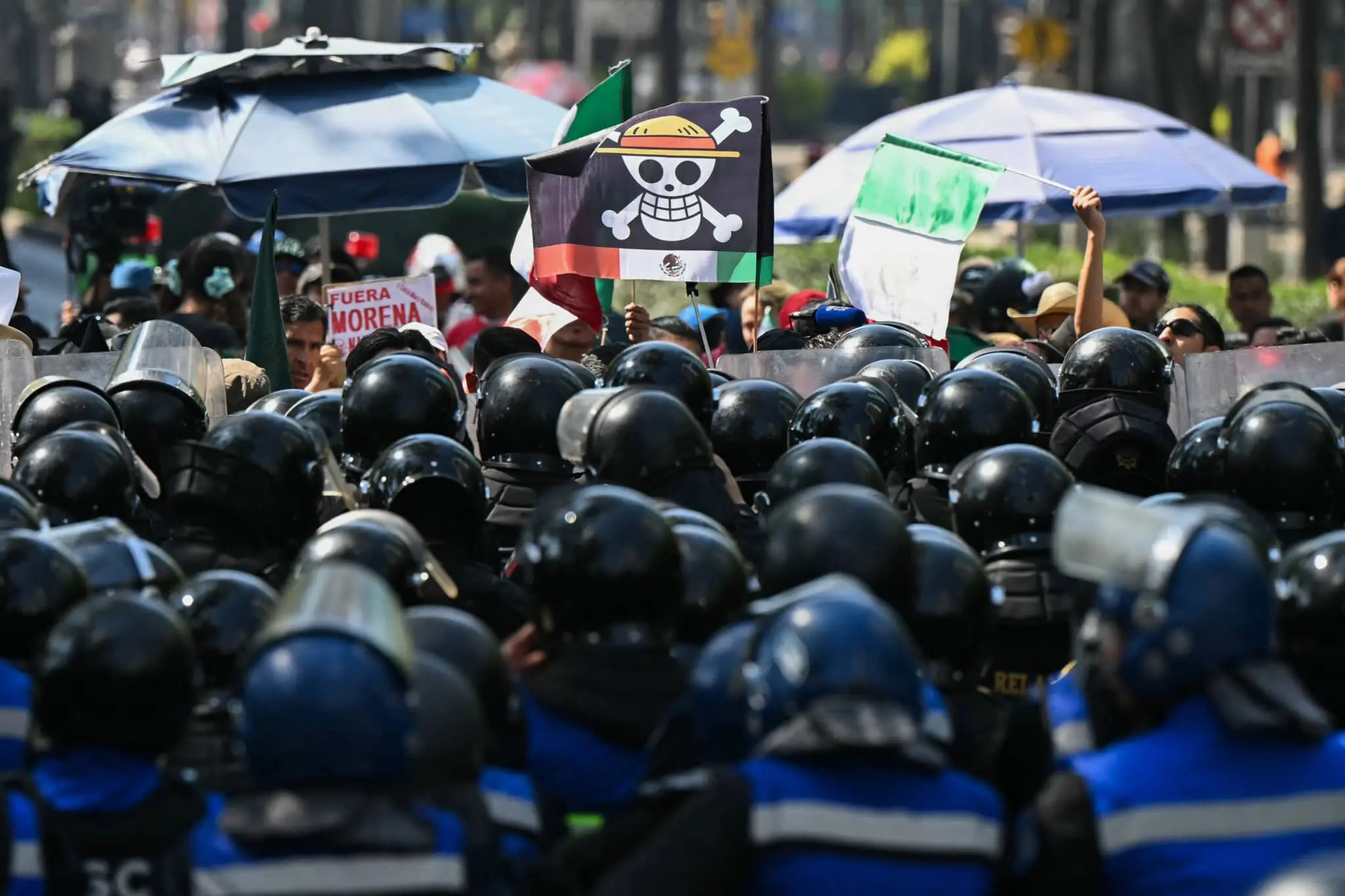
Across the movement, in Indonesia, the Philippines, Nepal, and beyond, Gen Z protesters have hoisted the Straw Hat Jolly Roger from “One Piece,” a popular anime and manga series in which the protagonist exposes hidden injustices and liberates the oppressed. For many youths, the flag is instantly recognizable shorthand for anti-elitism, freedom from repression, and solidarity across borders. As one protester said, the banner “embodies the values of freedom and resistance to injustice” and helps signal a leaderless, or multi-leader, nonpartisan identity.
Tactically Connected: The Most Networked Generation in History
Student- and youth-led movements have been on the frontlines of movements for social, economic, and political change, from U.S. civil rights and antiwar protests in the 1960s to the 2011 Arab Spring. What is unique about the current movement is the infrastructure of mobilization: TikTok and X amplify and accelerate grievances; Discord servers and group chats enable decentralized planning; virtual private networks and mirrored content help organizers circumvent internet shutdowns. Analysts note the same memes, tactics, and symbols jumping from country to country, with organizers outpacing governments’ messaging. Importantly, Discord-based coordination has not remained confined to online spaces; Gen Z has used digital these digital platforms to plan, coordinate, and rapidly deploy large-scale protests, which have surprised governments and global observers.
Shared Consciousness: More Than a Set of Data Points
Shared symbolism is significant, as it signals (and foments) a common sense of purpose. The highly networked, digitally connected nature of this generation and this movement is also significant, as it facilitates each uprising being in conversation with the others, contributing to a rapidly evolving metanarrative that shapes and reinforces the dynamics in each country. What is most significant, however, is the combination of these phenomena, producing a movement that is simultaneously hyper-local and global; rooted in issues that affect citizens daily but also woven into a philosophical and aspirational gestalt that is highly relevant to the broader project of democracy worldwide, and indicative of the waning faith in institutions.
Institutional Response and Outcomes
Governments in many of the countries experiencing Gen Z-led protests have responded with heavy-handed repression or short-term appeasement, operating from a reactive position of policy panic that treats young citizens as threats to stability rather than partners in reform. Such reactions deepen alienation and risk perpetuating cycles of unrest. The alternative is a shift in mindset: to recognize youth engagement not as a liability but as a strategic asset. Governments that can adapt more proactively to consistently include youth participation can benefit from a more diverse array of perspectives informing policy, and from increased buy-in among younger generations as a result. The inclusion of young people in governance is an investment in long-term stability, equality, and prosperity.
The outcomes of these movements fall roughly into three categories: those where protests succeeded in toppling entrenched leaders; those where governments responded with repression or limited concessions; and those where movements remain active and fluid. Together, these cases reveal lessons on the potential for transformation and the inherent volatility of this multileader movement.
In Bangladesh, a student-led campaign over public-sector hiring quotas swelled into a nationwide revolt that forced Prime Minister Sheikh Hasina to resign after 15 years in power. The interim government has since announced elections for 2026 and hinted at civil service reforms, though it is unclear how far these changes will go. In Nepal, outrage over a social media ban escalated into riots that left government buildings destroyed and pushed Prime Minister K.P. Sharma Oli from office; the caretaker administration now faces pressure to deliver credible elections this spring while navigating deep public mistrust. Sri Lanka’s Aragalaya protests, driven by inflation, fuel shortages, and corruption, toppled President Gotabaya Rajapaksa in 2022, and the government that replaced him is still scrambling to meet International Monetary Fund conditions and calm lingering youth anger. Madagascar followed in a similar pattern: The president fell, the military stepped in, and officials now signal that a transitional roadmap may precede the next election cycle. Finally, in Bulgaria, Gen-Z led protests over corruption allegations rapidly escalated into mass demonstrations that forced the prime minister’s resignation. These movements show how quickly young people can bring down entrenched leaders, but they also reveal the risks of leadership vacuums and stalled reform when a transition arrives without a clear plan for what comes next.
Elsewhere, governments have tightened their grip even as they sketch out partial concessions. Kenya withdrew its finance bill after mass youth protests in 2024 and is now weighing new fiscal policies that the administration claims will “reflect public input,” though arrests and disappearances of protest organizers continue. Morocco has rolled out small economic relief programs while prosecuting protest leaders; Serbia has promised electoral reforms under EU pressure even as police remain aggressive on the streets. Indonesia and Peru have offered narrow policy adjustments and promised broader reviews, but both continue to rely heavily on policing to manage unrest. In these places, leaders are wagering that modest reforms combined with force will buy them time without requiring deeper changes.
In the Philippines, corruption scandals and the government’s chaotic response to fires, floods, and earthquakes have fueled a new round of Gen Z-led protests. President Ferdinand Marcos Jr. has since announced an audit of disaster relief funds and a review of internal procurement rules. In Cameroon, President Paul Biya’s contested reelection has intensified tensions, and reports suggest the government may consider limited electoral reforms to ease international scrutiny without altering its grip on power. Timor-Leste’s youth won a clear policy victory after the country’s parliament revoked lifetime pensions it had awarded to lawmakers, and additional spending reviews are now underway. In Mexico, protests over corruption and crime escalated into violent clashes in November, prompting officials to signal that revisions to policing policy may be debated ahead of next year’s elections.
The story of these movements is still unfolding, and their direction will hinge on whether organizers can take lessons from earlier uprisings and turn today’s energy into something more lasting. Their real test is whether they can push beyond street mobilization and create change that endures.
Conclusion
Across much of the world, an entire generation has come of age during the most conflict-prone era since World War II. They grew up alongside technology that collapsed distances, weathered a global pandemic that unsettled the world’s sense of stability, and built communities in digital spaces where ideas and frustrations move quickly. Just as television contributed to shifting U.S. public opinion during the Vietnam War and social media helped carry the Arab Spring across borders, online platforms are linking people in unprecedented ways. Today’s Gen Z movement is not a sudden awakening but the cumulative result of growing up in an environment in which crisis and inequality are visible and institutional responses often disappoint..
Policymakers must move beyond viewing youth movements purely as a destabilizing force and instead treat Gen Z as essential partners in governance if they hope to reduce political volatility and build more durable, legitimate political systems. Inclusion of young people in policy design and implementation is not a concession but a strategic investment in long-term stability, equality, and prosperity. In alignment with the U.N. Security Council resolutions underpinning the YPS agenda, governments and international organizations must create formal mechanisms for youth consultation in policymaking, ensuring that young voices shape policies on a range of topics including and beyond those that are narrowly considered “youth issues” (climate, education, and technology). For Gen Z activists, the challenge is to turn protest into a plan and to build intergenerational coalitions to advance their interests and deliver a brighter future to people of all ages. Young leaders must define the future they wish to build rather than solely dismantling the old order. Successful movements will build bridges among generations, inside and outside institutions, and articulate post-mobilization visions that contain sustainable reform rather than persistent cycles of repression and unrest.
Policy Recommendations
The global Gen Z movement represents a growing frustration with governments and institutions that undermines global stability, economic prosperity, and democratic resilience around the world. To address the grievances driving the protests, U.S. policymakers and other stakeholders should consider these actions.
- Congress should enact legislation creating a National Action Plan on Youth, Peace, and Security, identifying youth-inclusive policymaking as a national security and foreign policy priority and allocating resources to the Department of State to lead interagency collaboration on mainstreaming and advancing the implementation of the YPS agenda.
- The Department of State should appoint a sufficiently resourced YPS coordinator with a mandate to lead the department’s efforts, and interagency initiatives, to mainstream and advance the implementation of the YPS agenda within U.S. foreign policy initiatives, framing youth-inclusive governance as a democratic principle and diplomatic priority.
- The Department of State should lead robust U.S. government engagement with the United Nations to implement all resolutions included in the YPS agenda, and to ensure that the findings of the second independent progress study on YPS are integrated into presidential statements and resolutions adopted by the U.N. Security Council and ensure that peacekeeping mandates incorporate report recommendations and that mission budgets align with mandated tasks, including the protection and participation of young peacebuilders.
- The White House should prioritize the inclusion of policy recommendations from young leaders in the negotiations taking place through U.S.-led peace processes, particularly in Gaza and Ukraine, as a matter of promoting sustainable solutions with multigenerational buy-in.
- The United Nations should continue efforts to advance the YPS agenda within peacekeeping and peacebuilding missions and prioritize the inclusion of young leaders in mechanisms designed to identify and respond to emerging challenges like climate resilience, AI governance, and a range of other global security challenges.
- Young leaders should identify clear, achievable objectives to pursue in partnership with other stakeholders and government leaders. With an emphasis on coalition-building, Gen Z activists should embrace their role as leaders and organizers and develop an affirmative vision that goes beyond upsetting the status quo and delivers improvements for all people.
- Other stakeholders, including educational institutions, civil society organizations, corporations, and other activists, should seek, identify, and develop opportunities to partner with young leaders to promote transparency and accountability in government, drive innovation, and blend a growing global consciousness with localized solutions to local problems. By supporting youth inclusion, strengthening transparency and accountability, and merging global awareness with local expertise, these actors can bridge generational divides and support resilient communities.
The views expressed in this article are those of the author and not an official policy or position of New Lines Institute.