
Signals We Choose to Ignore: How the Assault on Gender Equality Foreshadowed the Collapse of U.S. Democratic Guardrails
Editor’s Note: This analysis by Caroline Hubbard, former senior gender advisor and gender team lead in the Bureau for Democracy, Human Rights, and Governance at the U.S. Agency for International Development, and Tazreen Hussain, USAID’s former Women, Peace and Security policy adviser, includes an account of the events at the agency after the November re-election of Donald Trump to the U.S. presidency through its virtual dissolution in February 2025. Those accounts are based on the authors’ own observations, conversations with stakeholders, and consultations with former colleagues. Much of what transpired during that period has not been previously documented. The views expressed in this article are those of the authors and not an official policy or position of New Lines Institute.
Executive Summary
Across the globe, deliberate illiberal strategies that exploit entrenched gender inequality are increasingly being used to weaken democratic institutions from within . The dismantling of the U.S. Agency for International Development (USAID) was not simply a byproduct of chaos at the beginning of U.S. President Donald Trump’s second term. Rather, it followed a well-documented authoritarian strategy in which attacks on gender equality are used to consolidate power, narrow civic space, and make democratic governance harder to defend. While the process of dismantling the agency that administered U.S. government foreign assistance has been well documented, significant gaps remain between what insiders witnessed and what the broader public understands. This gap in understanding is not benign. When the public perceives these events as isolated policy shifts rather than coordinated institutional erosion, it diffuses accountability, obscures the impact, reduces resistance, and allows similar tactics to be redeployed without scrutiny.
The administration’s early actions targeting gender equality, women’s empowerment, LGBTQI+ initiatives, and diversity, equity, inclusion, and accessibility functions operated not as peripheral policy disputes but as frontline tactics that weakened foreign assistance infrastructure, government institutions, and democratic norms. Trump has used this approach since at least 2016. It was mapped out in the Heritage Foundation’s Project 2025. Drawing on firsthand experience and technical analysis, this report situates these actions within an effective authoritarian pattern of leveraging patriarchal norms and cross-ideological gender bias to justify institutional retrenchment, create administrative compliance, and accelerate structural dismantling. Ultimately, the strategic sidelining of gender equality functions increased
institutional vulnerability. Although the Trump administration’s targeting of those functions did not create the vulnerability, it recognized, exposed, and exploited it as part of a wider effort to erode democratic norms.
Rebuilding democratic systems and foreign assistance architecture, therefore, will require treating gender equality as a core resilience safeguard rather than a peripheral policy concern. Its strategic targeting is central to the broader authoritarian assault on democracy. Democracy stakeholders must name that pattern, examine the decisions that enabled it, and learn from what unfolded.
Policy Recommendations
U.S. democracy and human rights advocates cannot ignore gender equality: U.S. efforts to resist democratic backsliding should treat gender equality and women’s empowerment both as nonnegotiable democratic principles and as a structural requirement for democratic resilience.
Bilateral donors must expand, not decrease, investments in gender equality. Donor governments must reinforce international commitments and increase political and financial support for gender equality.
Institutions must rebuild and protect gender expertise: Eliminating gender advisers and dismantling gender teams weakens organizational resilience and strips away one of the most reliable early warning systems against democratic erosion.
Treat women’s movements as frontline democratic defenders and invest in them. Broad-based women’s movements are proven counterweights to authoritarian consolidation and must be supported as strategic partners in protecting democratic systems.
Recognize the authoritarian context and recalibrate advocacy strategies. U.S. women’s rights organizations must adapt their approaches by learning from global counterparts who have resisted authoritarian backsliding through mass mobilization and sustained civil society pressure.
Choose courage over compliance. Democratic resilience depends on governments, institutions, and civil society defending gender equality publicly and consistently as a foundational democratic principle.
The views expressed in this article are those of the author and not an official policy or position of New Lines Institute.
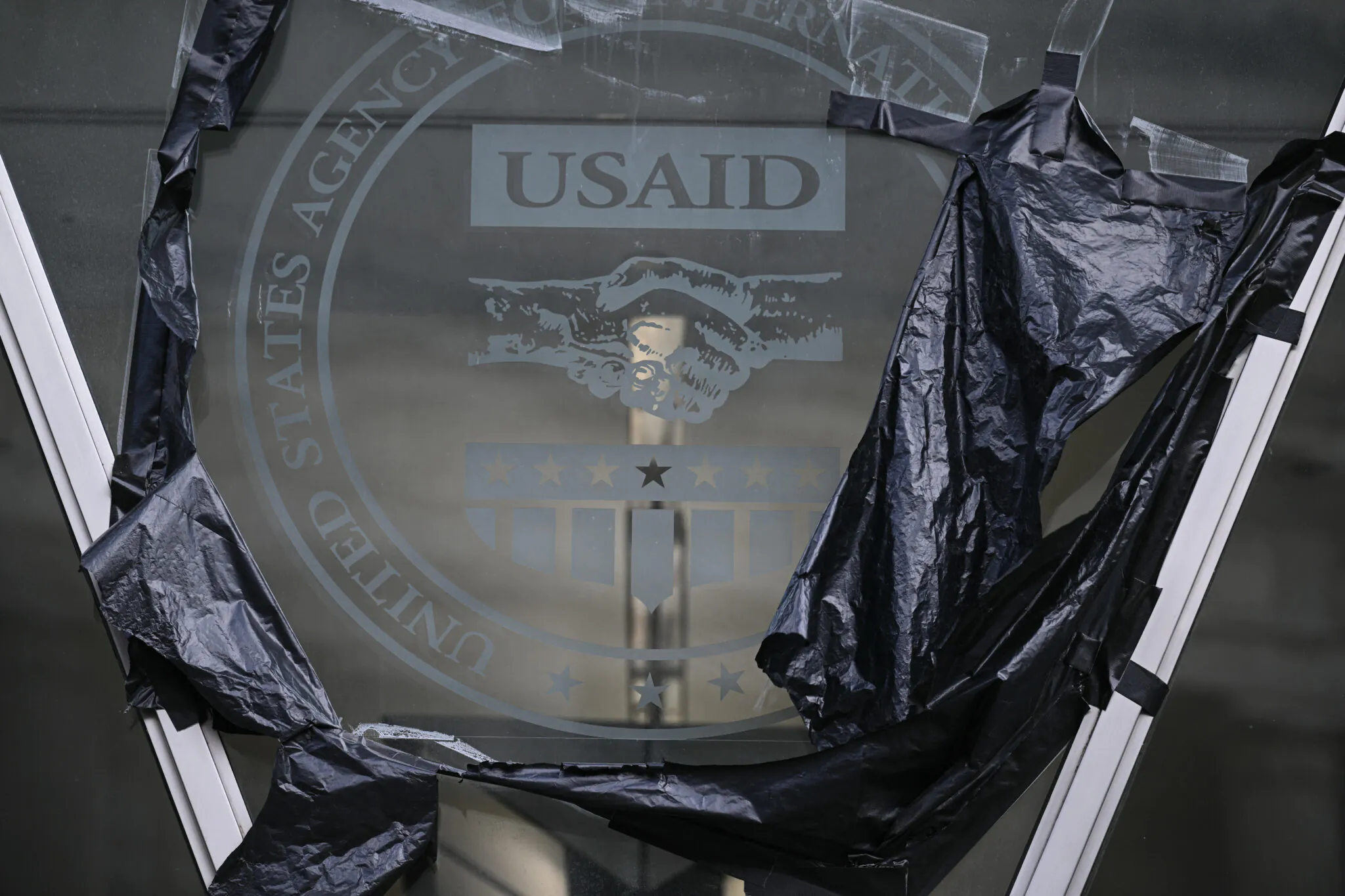
Photo: Remnants of signage for the US Agency for International Development (USAID) on the facade of the Ronald Reagan Building and International Trade Center building in Washington, DC, on December 29, 2025. (Photo by Brendan SMIALOWSKI / AFP via Getty Images)