Why the WPS Agenda is Critical to Ensuring Sustainable, Just Peace in Ukraine
On Oct. 31, 2000, the U.N. Security Council adopted the landmark Resolution 1325, which recognizes women’s essential role in conflict prevention and resolution and the need to ensure women’s equal participation to achieve and maintain peace. This resolution, in combination with subsequent resolutions, has developed into a comprehensive Women, Peace and Security (WPS) agenda, the key pillars of which are participation, relief and recovery, prevention, and protection.
Ukraine was the first state to develop and adopt a National Action Plan on Women, Peace and Security (NAP) during an armed conflict. By now, Ukraine’s third NAP has been developed and is awaiting approval following recent public consultation. As a community of female lawyers, the Ukrainian Women Lawyers Association (JurFem) is working to implement the tasks of the NAP, which offers an opportunity to identify the existing challenges of WPS implementation in Ukraine in three directions.
The first is women’s participation in peace processes. Despite the fact that the importance of women’s participation in peacebuilding processes has been declared at the highest level, in practice the representation and presence of women is often either formal, inconsistent, or completely nonexistent. According to studies, women’s participation has a long-term positive impact on the duration of peace and the comprehensiveness of the negotiation agenda. Nevertheless, policymakers tend to concentrate on how women are affected by armed conflict rather than on women’s meaningful participation in peace and security.
Another block is justice for survivors of international crimes, in particular conflict-related sexual violence (CRSV). While some international policymakers attempt to promote reconciliation or various forms of forgiveness, it is crucial to take actual measures to guarantee justice. These crimes must be properly documented and recognized. Survivors should obtain reparations, and perpetrators should be brought to accountability.
Developing a gender sensitive security and defense sector is one more area to highlight. It is not only about the number of women involved but also about the institutional development of the structures, which is challenging to achieve during active hostilities. This makes implementing these practices essential for countries not involved in an armed conflict.
These elements are critical to ensure sustainable and just peace. Moreover, all of this applies not only to Ukraine but also to the international community as a whole. WPS pillars must be integrated into the global political agenda to be fully effective.
Sustaining Peace
The U.N. General Assembly Resolution 70/262 and U.N. Security Council Resolution 2282 define sustaining peace as a long-term process based on addressing the causes of conflict, building resilient institutions, rebuilding economies, strengthening the rule of law, developing a culture of nonviolence, and ensuring equality. Importantly, though, what constitutes such peace is different for each country engaged in an armed conflict.
In Ukraine, JurFem – alongside women leaders of the civil sector, female politicians, diplomats, and veterans – has been developing Ukraine’s vision of sustaining and just peace. Among the recommendations made over the course of discussions and reflected in the resulting analytical brief is that the elements of sustaining and just peace should incorporate the key pillars of the WPS agenda along with seven dimensions recommended by international organizations (in particular the U.N. and EU), such as demining, addressing the effects of conflicts (e.g., psychological trauma, displacement of people, destruction, environmental damage), preventing conflict, strengthening rule of law, democratizing institutions, and developing education, culture, and international cooperation and support (in particular political, technical, and financial).
Notably, strengthening rule of law and ensuring equality, two main pillars of sustaining peace, are also essential aspects of justice. As such, sustaining peace would be impossible without ensuring justice. While a unified definition of just peace is nowhere to be found, it can be argued that prosecution and reparations for the victims contribute to establishing justice and are conducive to a just peace. Russia’s war against Ukraine, which began in 2014, testifies to the fact that a country that has not been held accountable for international crimes will continue to commit them, as evidenced by its 2022 full-scale invasion and accompanying unprecedented increase of international crimes.
Implementing the WPS agenda inherently enshrines women’s direct involvement in the processes of achieving a sustainable and just peace. While such processes should take the experiences and needs of the entire affected population into consideration, women’s perspectives are integral but often omitted. The benefits of including women’s perspectives cannot be realized without involving women themselves, meaning women’s inclusion and participation in peace processes is key to just, sustainable peace. Studies that analyze the effectiveness of women’s participation as negotiators, mediators, and signatories of peace agreements show that when women are involved in these processes, a significant positive impact on the duration of peace is observed, which implies higher efficiency. From a long-term perspective, agreements are 35% more likely to endure for 15 years when women participate in their design. Also, women are more likely to expand the agenda with concrete, otherwise overlooked issues.
However, the WPS participation pillar has rarely been implemented as a practical component of international political agendas. It remains a plan, which prevents actors from. accommodating all situational contexts and coordinating with women’s realities.
Furthermore, when discussing the response to international crimes in the context of the WPS agenda, policymakers tend to concentrate attention on women in terms of how they are affected by armed conflict, as opposed to how they can participate in security and defense sectors. As such, women’s representation at the decision-making level or in negotiations held at various levels is underappreciated. Such an approach minimizes women’s agency and sustains the view of women as passive actors. Therefore, it is essential to institutionalize the participation of women and women’s civil society organizations in peace negotiations and relevant decision-making processes.
Justice and Accountability for CRSV
The WPS agenda establishes that responses to CRSV must entail measures to identify survivors and bring perpetrators to justice. CRSV committed by Russia in Ukraine has in fact brought about serious and enduring consequences at all levels. The cumulative impact of these violations goes beyond the immediate survivors and has an undeniable impact on international peace and security.
The international community has taken many steps to guarantee justice. This includes the creation of a Special Tribunal for the Crime of Aggression against Ukraine and the launch of the Register of Damage for Ukraine. The Register was established within the framework of the Council of Europe and serves as a record of claims for compensation for the damage, loss, and injury inflicted by the aggression of the Russian Federation (RF) against Ukraine. These steps to guarantee justice also include certain court judgments, notably the judgment of the European Court of Human Rights (ECtHR) in the case of Ukraine and The Netherlands v. Russia:
The ECtHR unanimously found the RF liable for large-scale and systematic violations of the European Convention on Human Rights in Ukraine from 2014 to 2022, when the Russian Federation ceased to be a State Party to the Convention. One of the violations listed by the Court was sexual violence as torture in the context of armed aggression. The Court also found that Russia had exercised effective control over the occupied territories since 2014 and is therefore legally liable for violations committed by the formations it controls, the Luhansk People’s Republic (LPR) and the Donetsk People’s Republic (DPR).
On July 15, 2025, U.N. Secretary-General António Gutierres released the Conflict-Related Sexual Violence report, once again confirming the fact that the RF systematically uses sexual violence as a tactic of war and a tool of terror against Ukrainian civilians and prisoners of war. The report indicates that in 2024, the human rights monitoring mission in Ukraine documented 209 cases of CRSV perpetrated by Russian armed forces, law enforcement authorities, and penitentiary staff.
However, this data fails to reflect the actual scale of crimes. Numerous CRSV survivors are still unwilling to speak out for various reasons, such as fear of stigmatization or of being accused of collaboration with the occupation authorities.
Properly documenting and recognizing numerous crimes of sexual violence suffered by survivors is a way to obtain satisfaction as a form of reparations and bring the perpetrators to task.
It is also significant that the report by U.N. secretary-general stresses that peace and/or other agreements must address CRSV and exclude such crimes from amnesties or statutes of limitations.
Thus, the international community must take further action to hold Russia accountable. Justice and human rights issues must be high on the WPS agenda. Instead of mediation, reconciliation, or various forms of forgiveness, policymakers should prioritize actual efforts to bring perpetrators to justice and provide redress and reparations for survivors of CRSV and other war crimes.
Nothing can bring back those who were killed or tortured, but the international community can ensure justice for them.
Building a Gender-Sensitive Security and Defense Culture
Accommodating gendered dimensions in the security and defense sector and integrating gendered approaches represents one of the integral components in the WPS agenda. On one level, this entails including servicewomen in the structures of the armed forces. However, there is a deeper angle to this: Women’s presence in the security forces increases public trust and operational efficiency.
In recent years, much work has been done in Ukraine’s defense sector to implement gender policies, prevent sexual harassment and discrimination, as well as train military personnel in international humanitarian law and the treatment of survivors of CRSV. The Ministry of Defense of Ukraine reported that as of March 2025, the Armed Forces of Ukraine included more than 70,000 servicewomen, of which more than 5,500 were deployed directly on the front line. Yet, as of 2023, they only made up 11% of command billets.
During active hostilities, when protecting the territorial integrity of the state and preserving the lives of civilians becomes the top priority, the implementation of activities and policies related to gender equality and gender sensitivity becomes much more complicated. It is therefore essential for countries that are not involved in an armed conflict to engage their personnel now to develop a gender-sensitive culture during service.
Efforts to do that should be initiated from the highest-ranking officers of the defense sector. After all, it is leaders, both male and female, who are responsible for the rules and culture of behavior of their subordinates. They must consciously shape the military service environment and emphasize military personnel’s awareness of IHL and gender policy.
The gendered dimension in the defense sector is not only about the number of women, but about the institutional development of the structures across military, security, and defense bodies that are able and willing to incorporate the WPS agenda into their activities and improve human capital management practices.
Consider Ukraine’s Euro-Atlantic course toward NATO and the effective cooperation with NATO member countries. It is vital for policymakers to follow the principles and norms set out in NATO policies, especially in the Policy on Women, Peace and Security.
To fulfill policy goals, the defense sector leadership should involve gender advisers in decision-making processes, as every decision has a corresponding impact on both women and men. This gendered aspect must be taken into consideration, especially when planning military operations.
Leaders should be aware that creating a respectful operating environment without any form of harassment and discrimination – which includes service in the national armed forces where all personnel can unlock their full potential – is another aspect of effective management.
Policy Recommendations
In consideration of all the above principles, the participants of JurFem’s expert discussion on strengthening women’s participation in achieving sustainable and just peace noted several key policy measures to address the implementation of the WPS agenda in the defense sector.
- Raise gender awareness among individuals responsible for strategic and operational command.
- Accommodate the needs of servicewomen, such as appropriate individual uniforms, adaptation of military infrastructure, hygiene items, gender-sensitive approaches to logistics and supply, etc.
- Strengthen the substantive participation of women in decision-making processes in the security and defense sector.
- Provide high-quality training for both male and female officers and personnel, along with specialized training for those directly involved in this topic (gender advisers, coordinators).
- Extend institutional capacity-building by expanding the institutional capacity for implementing appropriate policies and strategies. This would include updating them to meet actual needs and challenges as they arise, and developing an institutional structure with dedicated roles, clear responsibilities, and coordination mechanisms.
The views expressed in this article are those of the author and not an official policy or position of New Lines Institute.
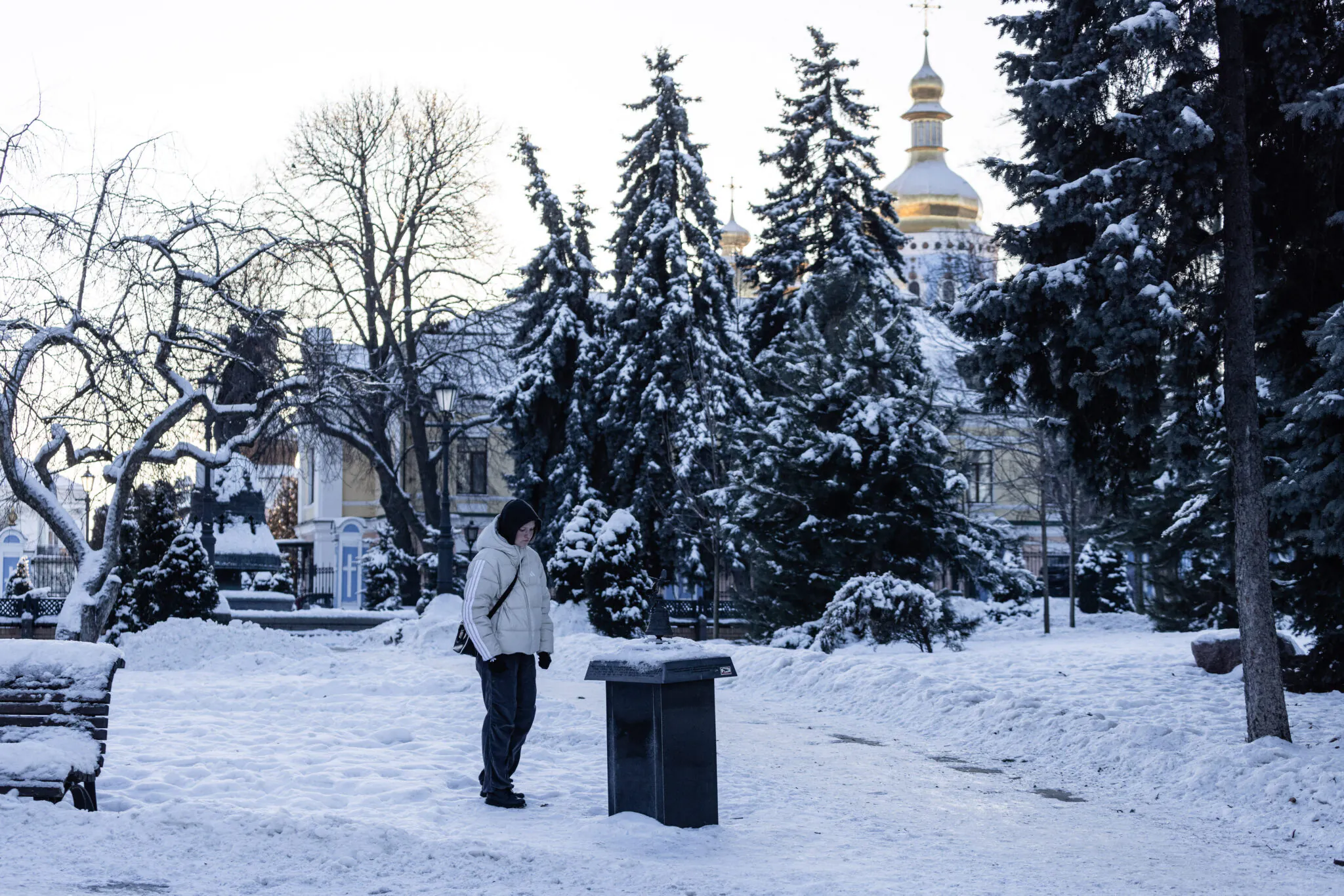
A woman stands next to an old bell exhibit in the park near St. Michael’s Monastery, with the monastery’s dome visible behind her in Kyiv, Ukraine on 2 Feb. 2026. (Photo by Daniel Yovkov / Hans Lucas / AFP via Getty Images)