About the Book
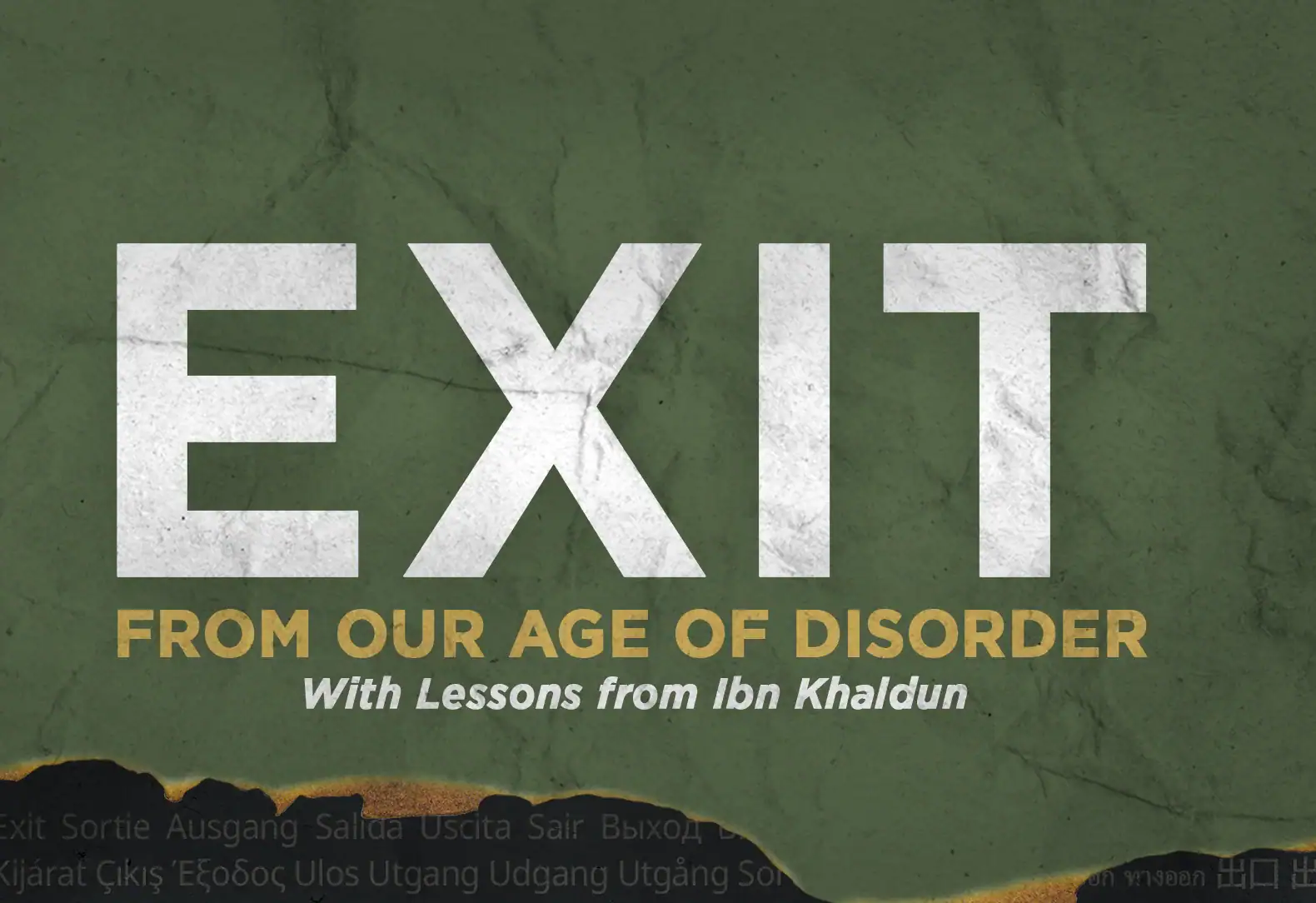
Exit is grounded in a key insight from Ibn Khaldun: political orders are never permanent. They rise when societies share cohesion, vision, and purpose, and they decline as those bonds weaken. Maçães uses this lens to interpret our current moment, showing how geopolitical shocks, technological disruption, and economic realignment reveal the growing fragility of Western institutions.
He argues that the United States has lost its ability to enforce or maintain global order, that globalization no longer operates under American direction, and that new centers of power—driven by technology and industrial capacity—are emerging beyond the Western world.
Purchase on Amazon
““For those contemplating the world from inside the existing order, change looks like collapse.””
Bruno Maçães
I. Collapsing Order
The first chapter analyzes the psychological and political dynamics of hegemonic decline over time. Dominant powers tend to view challenges to their prominent position as moral affronts, rather than as natural, recurring historical processes. The chapter contrasts Robert Kaplan’s argument that the world faces a “geopolitical Weimar” requiring stronger Western power with Ibn Khaldun’s assertion that such responses accelerate decline, not prevent it.
The chapter identifies three major markers of order collapse:
Shift from Structural to Coercive Power
American influence increasingly depends on threats and sanctions rather than the economic and institutional frameworks that previously ensured compliance. The 2022 financial sanctions on Russia demonstrated the limits of this power. It was sufficient to disrupt but not to compel surrender.
The Collapse of Legitimacy
When Biden called International Criminal Court investigations “outrageous,” he revealed that rules apply only when politically convenient. This destroys the normative foundation that previously extended American influence beyond its military reach.
Emergence of Extraction Over Insurance
Adam Posen’s analysis shows the U.S. increasingly acts as an extractor of profit from allies rather than a provider of security goods. This transformation from hegemon to dominant power reduces willingness to support the system.
This chapter draws parallels to external conflicts as symptoms of more deeply-rooted dysfunction. Sudan’s privatized militias (the Rapid Support Forces) exemplify how the absence of order creates new, more destructive forms of violence. When the legitimate authority recedes, the return maximization logic of private militias spreads.
On Gaza, the scale of destruction combined with the suppression of debate in Western democracies marks a more qualitative shift. Previous American administrations maintained some semblance of balance, such as Reagan stopping the 1982 Beirut bombing and Baker pursuing the Madrid framework. The current approach in Gaza abandons even tactical hipocracy.
II. Ukraine, Gaza, and Other Warnings
This chapter examines Ukraine and Gaza as two conflicts that are clear indications of systemic failure. Ukraine reveals the limits of Western economic coercion, whereas Gaza reveals the collapse of Western normative claims.
Russia maintained GDP growth despite unprecedented financial isolate because:
- India, Indonesia, and China absorbed Russian energy exports
- China supplied industrial inputs and machinery, compensating for Western export controls
- Alternative payment systems prevented financial collapse
- The global economy’s center of gravity has shifted sufficiently that Western exclusion no longer means total isolation
The critical point is that Biden refrained from secondary sanctions on Indian or Chinese entities buying Russian oil because doing so would expose American structural weakness. The sanctions that could work, namely cutting Russia off from Asian markets, are precisely those the U.S. lacks power to implement.
Military aid alone kept Ukraine from losing but couldn’t enable victory, because defeating a nuclear power in an existential war means crossing thresholds no one will cross. The result of this process is a frozen conflict that demonstrates the limits of Western capability.
This chapter documents the abandonment of legal constraints:
- Biden acknowledging “indiscriminate bombings,” a war crime, while continuing arms shipments
- U.S. officials defending Israel’s right to deliberately kill civilians
- Senators threatening European allies with sanctions for enforcing international law
- Deliberate targeting of journalists and aid workers
The comparison to previous conflicts matters. In 1982, Reagan stopped Israeli bombardment of Beirut with one phone call. In 1991, Baker pursued a balanced approach in Madrid. The current approach of open endorsement of actions that violate international humanitarian law signals that power no longer seeks legitimacy.
III. The Search for Universalism
This chapter systematizes positions on Ukraine and Gaza using a quadrant framework.
Westernists (bottom right)
- Support Ukrainian sovereignty
- Oppose Palestinian statehood
- Includes the Biden administration, EU leadership, German Greens, British conservatives
- Demonstrate that their principles apply only within the Western sphere
Oppositionists (top left)
- Support Palestinian rights
- Blame Ukraine for provoking Russia
- Includes parts of the Latin American left, some progressive intellectuals
- Oppose American power regardless of principle.
- Oppose both Ukrainian and Palestinian sovereignty
- Includes Trump, Congressional Republicans, and Indian nationalists
- Accept that power determines outcomes
Universalists (top right)
- Support both Ukrainian and Palestinian rights
- Group is remarkably small—the Spanish government, Chilean President Boric, a handful of intellectuals.
The analysis included in this chapter draws a crucial conclusion. Since Westernists and Oppositionists both apply principles selectively, only Darwinists are intellectually honest. If universal principles apply only to one side, they aren’t universal. The world is therefore moving toward Darwinist outcomes because the alternative requires principles surviving difficult tests in different contexts.
This chapter further argues that this trend represents the terminal phase of the liberal international order. Not because liberalism is wrong, but because its proponents have applied it selectively, revealing it as an ideology rather than a principle. The result now is that no one believes in the rules any longer.
IV. The Dialectic and Asabiya
This chapter presents Ibn Khaldun’s core concepts and their contemporary applications.
The Dialectic
Power contains its own negation. Success breeds luxury, luxury destroys the qualities that enabled success. Ibn Khaldun quotes Persian poetry: “Like the silkworm that spins and then, in turn finds its end amidst the threads itself has spun.” This isn’t moral commentary but historical observation of a pattern that repeats across civilizations.
Asabiya (Group feeling)
The social cohesion enabling collective action. Strong asabiya makes societies nearly invincible because members willingly sacrifice individual interests for the interests of the collective. But victory and wealth dissolve asabiya as competition for spoils replaces unity against external threats.
The chapter details Ibn Khaldun’s cycle of state formation:
- A group with strong asabiya conquers territory
- The ruling class grows wealthy and sophisiticated
- Internal competition intensifies as asabiya weakens
- The state loses control of peripheries
- A new group with strong asabiya challenges the weakened state
- Collapse and replacement
Contemporary Applications
American Power
The shift from structural influence to coercive threats demonstrates weakening asabiya. When Trump and Congressional Republicans advocate abandoning allies unless they “pay up,” they reveal the transactional logic that replaces collective purpose.
China’s Development
The intense national unity around technological advancement and resistance fo American pressure demonstrates strong asabiya, similar to the early American sense of civilizational mission.
The West
The inability to articulate shared purpose beyond simply “defending the rules,” which are selectively enforced, suggests advanced decay of unifying principles
On Religion and Universalism
Ibn Khaldun argued that large empires require ideology and material foundations. Narrow tribal loyalty can conquer territory, but sustained rule over diverse populations requires universal truth claims. This explains why hegemonic powers always present their particular interests as universal principles and why the collapse of credibility in those claims predicts imperial decline.
V. Cycles of Money
This chapter applies Ibn Khaldun’s dialectical Framework to the dollar system, demonstrating that reserve currency status contains contradictions that undermine the power it’s meant to support.
The Privilege
- U.S. exchanges printed dollars for real goods
- Foreign exporters accumulate dollar reserves, which they invest in U.S. assets
- Allows massive consumption funded by debt that never needs to be repaid in real terms
The Curse
- To supply the world with dollars requires running trade deficits
- Deficits destroy domestic manufacturing
- Perpetually overvalued currency makes U.S. exports uncompetitive
- Capital inflows get recycled into consumption and asset bubbles rather than productive investment
- Result: deindustrialization of economy that must provide military backing for dollar dominance
He recognizes that deindustrialization threatens American power. His solution of tariffs to force trade balances directly threatens dollar dominance. In April 2025, market volatility demonstrated this. Trump insisted on eliminating deficits which caused Treasury yields to spike and the weakening of the dollar. Markets recognized that a U.S. running trade surpluses wouldn’t be accumulating dollar reserves globally, undermining the entire system.
The chapter references Stephan Miran’s analysis. As the U.S. economy shrinks relative to global GDP, maintaining dollar dominance requires exporting an ever larger share of financial assets relative to the real economy. The mathematics of this become unsustainable. Liabilities must eventually exceed any plausible ability to honor them
The U.S. cannot simultaneously:
- Maintain dollar dominance, which requires capital inflows
- Eliminate trade deficits, which requires capital outflows or balanced trade
- Preserve manufacturing base, which requires competitive currency and domestic investment
Attempting to force all three, as Trump has tried, exposes the contradictions. This has resulted in the accelerated erosion of trust in dollar sustainability.
“The question isn't whether China will replace the dollar, but whether the U.S. can manage the transition away from a system that's becoming mathematically and politically unsustainable.”
Bruno Maçães
VI. Two Principles of Order
The final chapter proposes an alternative framework. Not another blueprint for permanent order, but principles for managing the cycle of rise and fall. The core argument coalesces around the understanding that orders rise and fall through indefinable processes, so we should build a second-order system of rules that govern how orders change rather than attempting to freeze one particular order in place.
Principle One: Every Country Should be Free to Change
States must be able to develop technologically and economically without artificial constraints imposed by the current dominant order. Attempting to slow down China’s innovation rate, which was Gina Raimondo’s explicit goal, violates this principle.
The chapter contrasts two responses to Chinese development:
- The Raimondo Aproach: Export controls, entity lists, restricting access to advanced equipment, recruiting allies to deny China critical technologies
- The Jensen Huang (Nvidia CEO) Approach: Compete by being present everywhere, making your technology indispensible, winning throug superiority rather than exclusion
The analysis suggests the restrictive Raimondo Approach backfires. China develops indigenous alternatives, builds separate ecosystems, and ultimately achieves independence from the very systems designed to constrain it
Principle Two: Every Country Should be Free to Choose
States must be able to make alignment designs without coercion, This applies to both great power competition and specific conflicts. This principle frames global politics as analogous to democracy. Great powers are candidates who must win support daily through superior offerings rather than through threats. Singapore, Switzerland, and many developing nations prefer to maintain flexibility, partnering with both sides on different issues when interests align. This flexibility should be protected rather than eliminated.
Maçães acknowledges these principles require institutional support to effectuate. Rather than prescribing specific reforms, he calls for genuinely global deliberation on mechanisms for:
- Dispute resolution when principles conflict
- Verification that restrictions on change or choice meet legitimate security criteria
- Enforcement mechanisms that don’t rely on hegemonic power
Liberal internationalism claimed universality but applied principles selectively. This framework accepts that different civilizations will have different values, but insists on procedural principles that allow peaceful competition between different versions of order.
About the Author
Bruno Maçães
Bruno Maçães is one of Europe’s most original geopolitical voices. A former Portuguese Secretary of State for European Affairs, he has advised governments and multinational corporations on the geopolitics of technology, digital sovereignty, and civilizational change. He is also the author of several acclaimed works including:
About the Ibn Khaldun Institute
Ibn Khaldun Institute
Exit from our Age of Disorder is one of the first works produced as part of the newly founded Ibn Khaldun Institute.
Ibn Khaldun (1332–1406) was a North African historian, philosopher, and scholar whose Muqaddimah pioneered an empirical science of societies. He studied states not as ideals but as living organisms, rising, thriving, and decaying according to internal forces.
He introduced concepts still relevant today:
- ʿAsabiyyah: social cohesion as the engine of power
- State cycles: predictable rise and decline
- Political economy: taxation, labor, and human capital
- Innovation and growth: technological advances as multipliers
The Ibn Khaldun Institute seeks to preserve, expand, and apply his legacy to modern challenges: structural reform, sovereignty, prosperity, and global economic networks.
→ Learn more here: ibnkhaldun.com
Media Inquiries
To request interviews with the author, schedule speaking engagements, or host launch events: [email protected]