Strengths of the Iranian Royalist Opposition for Effective Leadership
This report is part of a series exploring the strengths and weaknesses of the Iranian opposition and what this implies for policymakers. This analysis looks at the strengths of the pro-royalist opposition while the second part deals with its weaknesses. A third section deals with the ethnic camp.
Disunity and absence of strategic vision pose serious complications for the opposition
The recent protest movement in Iran was the largest and the most militant to have emerged in the country since the 1979 revolution. While the movement’s bloody suppression in a matter of days points to the exceptional brutality of the regime in power, it also highlights the opposition’s myriad peculiarities. In its current form, the movement suffers from an overall lack of unity, fractiousness, and ineffective action plans. In this first part of four, we examine the strengths of the pro-royalist opposition.
Pahlavist Advantages
On Jan. 8, 2026, 11 days after the start of the recent protest movement, up to a million people flooded the streets of Iran in direct response to a public call made by Prince Reza Pahlavi to show their opposition to the clerical rule. This was a major game-changer in the oppositional firmament. (Most of the mass killings by government forces also occurred on Jan. 8-9.)
The Pahlavist opposition has several important strengths over other opposition groups.
First, the failings of the ruling regime in governance have created a deep sense of nostalgia for the pre-revolutionary times when the economy was booming and things appeared much less chaotic for the average person.
Second, for 2,500 years, kingship and religiosity (or spirituality) have been the twin pillars of the Iranian culture; each element is ingrained in the collective consciousness of the majority of Iranians. As the legal heir to the last king, Mohammad Reza Pahlavi, Reza Pahlavi could probably bank on this reservoir of support among several million people by just being a prince.
In fact, the institution of kingship is such an overwhelming force in Iranian culture that Islamic Republic founder Ayatollah Ruhollah Khomeini’s concept of Velayat Faghih – state rule by a jurist – is nothing but an Islamicized version of Persian kingship. The supreme leader, according to the ayatollah’s vision, has near-absolute powers, is unanswerable to anyone, and there is a quasi-mystical relation between him and his followers – all the hallmarks of a traditional Iranian king.
Seen in this light, in the revolution of 1979, Iranians didn’t abolish monarchy. They just replaced one royal dynasty with another. The only complication is that if the next supreme leader – if there will be one – hails from either Khamenei or Khomeini clans, it could prove to be a rival pole of contention for Pahlavi.
The opposition’s third strength is the close association of Pahlavi with Israeli Prime Minister Benjamin Netanyahu and his less-successful embrace of U.S. President Donald Trump. These relationships have benefited him politically on the domestic scene since most Iranians have convinced themselves by means of a deeply ingrained conspiracy theory that their destiny is scripted in foreign capitals, not in their own country. The close union between Pahlavi and Netanyahu became clear when one of the project advisers on a recent action blueprint unveiled by Pahlavi recently turned out to be former Israeli National Security Advisor Eyal Hulata. There are several other instances of cooperation between the two sides.
In normal times, this close association may have been the proverbial kiss of death for the royalist movement considering the prevalent levels of antisemitism and nationalism in the country, but these are not normal times. The level of desperation of much of the population is running at such high levels at present that for many people, nationalistic sentiments can be set aside if the ultimate prize is a relief from the current conditions.
The partnership between the two sides does not necessarily point to the dearth of nationalistic credentials on the part of the movement’s leaders. Rather, it stems from an unusual conviction held by both the populace and its leaders according to which all the major political developments in Iran have been and continue to be the handiwork of foreign powers. This view is also held by many Iranian intellectuals. The Shah sincerely believed he lost his throne as a result of a plot hatched by Western powers because they allegedly favored Khomeini over him.
This conspiracy theory is apparently held by the prince himself. He told a podcaster in November 2023 that the cause of the revolution was that the West in 1979 tried to “create a religious belt to contain communism from spreading to the area,” meaning that the West preferred a militant fundamentalist cleric to a secular pro-Western individual like his father. In fact, the sudden popularity of the classical royalist brand in Iran after a short hiatus is almost entirely attributable to the widespread belief that foreign powers, chiefly the Trump administration, has decided to put into operation an action plan for regime change in Iran and that its choice for the next leader of Iran is no other than Pahlavi.
In short, Pahlavi’s ties to Israel and his pursuit of an alliance with Trump have as of now acted as an asset rather than a liability.
January 8 Inflection Point
Before Jan. 8, the Pahlavist movement had been one of the many opposition currents within the noisy and fractious world of Iranian opposition politics. What had changed was one factor: a perception, reinforced by the summer war with Israel, that major powers may be seeking regime change in Iran, in part by backing Pahlavi to lead a movement to replace the Islamic state. This was on account of the Israeli government’s open support for Pahlavi. Overnight, the prince changed for millions of people from a quaint but respected figure to a potential historic agent of change. This remarkable transformation occurred with little understanding of international politics, the regime’s staying power, or the opposition’s actual chances of success.
For most people, Pahlavi is the preferred candidate of Trump and Netanyahu, and a polysemic figure. Some Iranians see him as a historic character saving his nation from tyranny. These are the true royalists. For others, he stands for all the pre-revolution splendor and prosperity that they have heard from their parents and grandparents. For another group, he is the only viable alternative to the clerical establishment who may have a shot at bringing about change. Finally, for yet another group, a chant in support of the prince is, like a protest vote, a negation of the status quo.
This is not the first time that millions of Iranians have catapulted a politician to prominence. On May 23, 1997, some 20 million voters or 70% of the electorate flooded the polling booths to vote for an obscure mid-ranking cleric named Mohammad Khatami, the vast majority of whom had not heard his name before the election, because “the system” was backing another cleric.
Again in 2009, millions of people joined the protests that came to be called the Green Movement. This was a large grassroots movement of millions of people who believed the elections had been rigged. They poured out onto the streets not because they cared much about the movement’s two former Islamist leaders, Mir-Hossein Mousavi and Mehdi Karoubi, but because they thought the decision to support the movement was the only possible way to bring about change.
January’s protest movement was larger and generally more militant than the previous ones, but the logic was the same. This transactional use of a political figure is not opportunism. It’s a survival strategy born out of centuries of abuse and misrule at the hands of despotic rulers.
Leadership Qualities
The success or failure of the royalist movement in Iran is entirely tied to the personality of Pahlavi, making the nature of his personal attributes critical for the study of the opposition movement. According to historian Doris Kearns Goodwin, effective leadership in turbulent times involves four salient qualities: tactical mastery, strategic foresight, managerial competence, and charisma.
So far, the prince is generally short on tactical mastery and strategic foresight, and little information is available to attest for his managerial skills. But what he lacks in those features, he more than makes up for with his unique brand of charisma. While the prince is devoid of personal charisma – in sharp contrast with his father and grandfather – he possesses what the German sociologist Max Weber refers to as the Charisma of Office, a form of authority that stems from the position one holds rather than personal qualities and Pahlavi is now endowed with it to an extraordinary extent.
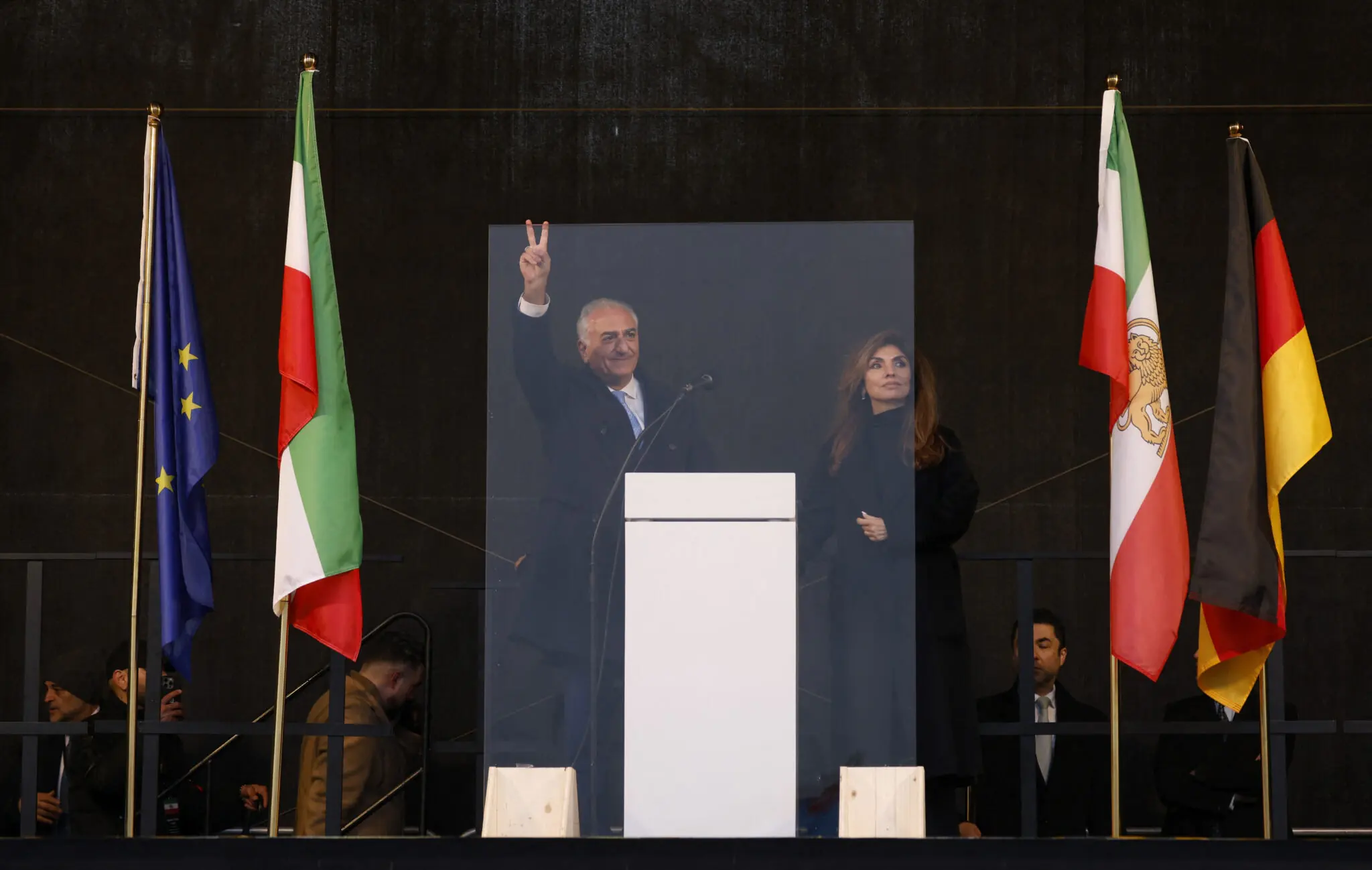
On Feb. 14, 2026, around 1 million people responded to Pahlavi’s call for worldwide support by attending public rallies in major cities outside Iran. This is a major accomplishment given the level of discord among Iranian opposition.
Policy Recommendations
The weeks and months to come will show if the prince is capable of retaining this level of support or even building on it, or if he would lose his current amity through strategic or operational missteps.
Policymakers need to examine both the strengths and weaknesses of the opposition movement before giving aid to any constituent element of it. This should include an evaluation of the opposition’s capacity to subdue and erode the power of the regime. The evaluation should also include an assessment of the opposition’s ability to prevent a civil war and outbreak of ethnic conflicts.
The views expressed in this article are those of the author and not an official policy or position of New Lines Institute.
Photo: Iran’s former crown prince and now key opposition figure Reza Pahlavi flashes the victory sign as he stands on stage next to his wife Yasmine Pahlavi during a demonstration of the Iranian opposition on Feb.14, 2026 at the Theresienwiese fair grounds in Munich, southern Germany, on the sidelines of the 62nd Munich Security Conference (MSC). (Photo by Michaela STACHE / AFP via Getty Images)