Crown Prince Mohammed’s Visit and U.S.-Saudi-Israeli Engagement
Saudi Arabia is becoming a central pillar of the Trump administration’s new U.S. geostrategy. Washington views Riyadh not merely as a Middle Eastern heavyweight but as a state whose economic scale and diplomatic reach can anchor global U.S. initiatives. Meanwhile, the kingdom needs the Trump White House to put the 20-point Gaza Peace Plan into action to remove a major obstacle to constructing a new regional security architecture. For that to happen, the Trump White House must strike a balance between Israel’s security imperatives and some measure of progress toward Palestinian self-determination.
Crown Prince Mohammed bin Salman’s visit to Washington today – his first in seven years – is set to mark a significant reset in U.S.-Saudi relations, with expectations that the crown prince and President Donald Trump will finalize several high-stakes strategic agreements. A day after Trump and the crown prince meet, a major investment summit is scheduled at the Kennedy Center, featuring roughly 1,000 Saudi officials including nearly every minister, underscoring Riyadh’s intent to anchor its economic transformation to deeper U.S. commercial ties. The visit is also expected to produce a defense arrangement guaranteeing American protection for the kingdom, alongside prospective U.S. roles in Saudi nuclear power development and expanded cooperation in AI, semiconductors, and critical minerals – areas central to long-term U.S. strategic competition with China. Ahead of the trip, Defense Minister Khalid bin Salman held high-level meetings in Washington while Trump’s son-in-law Jared Kushner, a key architect of the Abraham Accords, traveled to Riyadh for consultations with the crown prince, signaling intensive diplomatic groundwork on both sides.
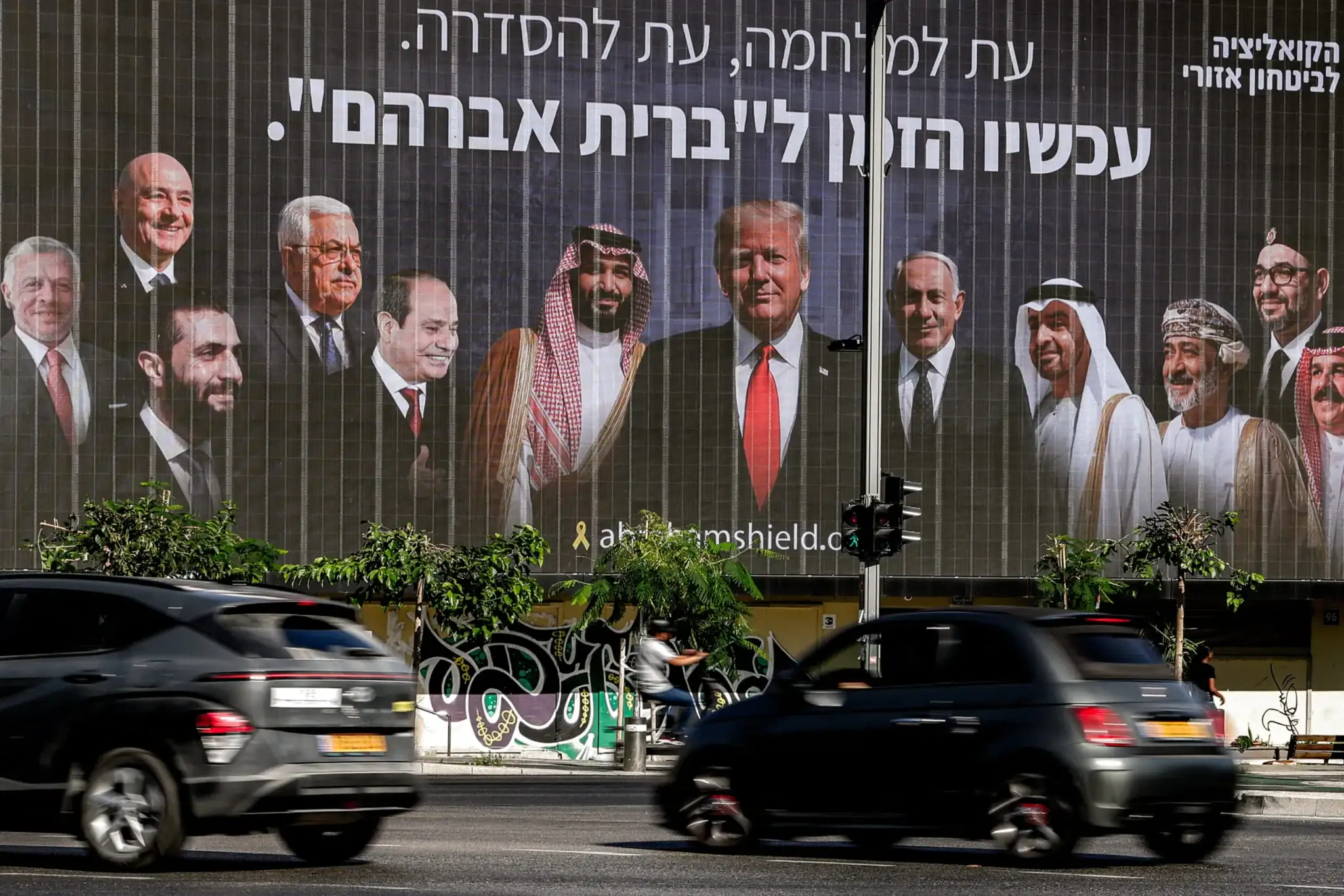
The Abraham Accords remain the most consequential issue in U.S.-Saudi relations, shaping both diplomatic and strategic calculations. Just weeks before the Oct. 7, 2023, Hamas attacks, Crown Prince Mohammed and Israeli Prime Minister Benjamin Netanyahu publicly acknowledged that normalization talks were at an advanced stage. That process abruptly halted when the Iran-backed Hamas assault prompted a massive Israeli military response, resulting in tens of thousands of civilian deaths, displacing over 2 million people, and destroying Gaza’s infrastructure. The scale of devastation has made Saudi Arabia’s return to the accords politically and diplomatically fraught, with Riyadh insisting that any normalization be contingent on Israel’s commitment to a “credible and irreversible pathway towards future Palestinian statehood.”
Cognizant of Saudi constraints and under pressure from other Arab and Muslim nations expected to contribute forces to the International Stabilization Force (ISF) for Gaza, the Trump White House revised the U.N. Security Council resolution on Nov. 13. The move immediately created tensions for the Netanyahu government, as two days later far-right Cabinet members National Security Minister Itamar Ben-Gvir and Finance Minister Bezalel Smotrich publicly urged the prime minister to reject any recognition of a Palestinian state. On Nov. 16, Netanyahu reaffirmed on X that Israel’s opposition to a Palestinian state remains unchanged, emphasizing that Gaza must be demilitarized and Hamas disarmed “the easy way or the hard way.” That same day, his foreign and defense ministers echoed his stance, signaling unified cabinet resistance to the resolution’s language and highlighting the domestic political constraints on Israeli concessions.
Such diplomatic complexity helps clarify why Saudi Arabia is more likely to join the Abraham Accords by the end of Trump’s second term. However, Trump said on Nov. 14 that he “hopes” Riyadh will enter the Accords “fairly shortly,” reflecting the White House intent more than what is likely to transpire. For the Saudis, engaging with the most far-right and unpopular government in Israel’s history offers limited strategic value, particularly with elections less than a year away and the possibility of a more stable negotiating partner emerging. Moreover, the immediate U.S. focus on operationalizing Trump’s 20-point Gaza stabilization plan further delays the conditions required for credible progress toward normalization.
That said, Saudi Arabia will not contribute forces to the ISF for Gaza. Rather, the kingdom will assume a primarily diplomatic and financial role, supporting reconstruction, shaping governance arrangements, and steering regional consensus toward a two-state outcome. Its recently signed Strategic Mutual Defense Agreement with Pakistan, which is expected to deploy a sizable contingent to Gaza, gives Riyadh indirect influence without military exposure. For the crown prince, this aligns with Trump’s expectation that Saudi Arabia will manage broader Arab geopolitical dynamics, effectively placing the kingdom at the center of any long-term effort to shepherd a viable path toward Palestinian statehood.
This approach by the Trump White House is consistent with its broader global geostrategy. Washington’s intent is to create a network of partners who assume primary responsibility for stability in their respective strategic environs, thereby reducing operational demands on the U.S. military. For Riyadh, however, this shift creates greater exposure, as the kingdom must shoulder more of the regional security burden, which it lacks the capabilities to do. This is why Saudi Arabia has pursued the mutual defense agreement with Pakistan and is seeking a formal defense arrangement with the United States similar to the one recently granted to Qatar, to offset the risks inherent in America’s strategic recalibration.
Saudi Arabia draws some reassurance from the marked weakening of Iranian capabilities during the war with Israel, including a temporary reduction of the threat from Tehran. However, Riyadh must be mindful of Iran’s shifting internal dynamics and potential rapprochement with Washington, which could lead to Tehran’s gradual rehabilitation – and the return of a long-term strategic threat.
Ultimately, Saudi Arabia recognizes the limits of U.S. engagement in the region, understanding that Washington will prioritize oversight rather than direct management of all crises. This necessitates that Riyadh assumes a proactive role in shaping outcomes, particularly where regional stability and strategic interests intersect. Its immediate priority is to lead efforts to stabilize Gaza and manage broader dynamics related to Palestinian self-determination. From Washington’s perspective, the U.S. has largely secured a cessation of hostilities and established initial structures, but it expects Saudi Arabia and other Arab and Muslim partners to shoulder the responsibility of coordinating with Israel and sustaining long-term regional stability.
This gradual approach offers a more organic and potentially sustainable pathway for Arab and Muslim states to eventually normalize relations with Israel. Achieving this U.S. objective depends on coordinated efforts among all stakeholders to construct a post-conflict framework that addresses Palestinian aspirations. At present, Israeli strategic imperatives remain largely misaligned with those of the broader Arab and Muslim world, creating persistent tensions. Consequently, even as Washington seeks to reduce its direct operational burden, it will remain indispensable in overseeing and guiding transformative changes on both sides to ensure that incremental progress toward normalization is both credible and durable.
The views expressed in this article are those of the author and not an official policy or position of New Lines Institute.