The Stability and Investment Risks Threatening Rwanda’s Economic Miracle
Rapid economic growth after Rwanda’s 1994 civil war and campaign of genocide earned it the nickname the “Miracle Country.” But entrenched authoritarian governance and escalating regional tensions, particularly with the Democratic Republic of the Congo, have created structural risks to long-term economic growth, foreign investment, and regional security. Ensuring optimal investment outcomes will require U.S. policymakers and international investors to reevaluate assumptions about the long-term political and economic durability of Rwanda’s development model and incorporate political and regional risks into engagement strategies.
Rwanda’s Post-Genocide Governance and Development
Following the 1994 genocide, which came amid a devastating civil war that shattered its economy and infrastructure, Rwanda pursued a recovery strategy centered on strengthening a centralized state led by the Rwandan Patriotic Front (RPF). For the past 24 years, the country has been led by the RPF’s Paul Kagame. The RPF derives much of its legitimacy from its role in ending the genocide, a legacy that continues to insulate it from domestic and international criticism. Its civic identity policy, encapsulated by the slogan “We are all Rwandan,” eliminated the use of ethnic labels on identity cards but also restricted public discussion of ethnicity, reinforcing a tightly controlled narrative of reconciliation.
Rwanda’s image of recovery and reconciliation has attracted significant foreign investment. In fact, its nominal gross domestic product grew from approximately $752 million in 1994 to $14.1 billion in 2023, a 19-fold nominal increase. Once adjusted for inflation, the 1994 figure is equivalnt to approximately $1.5 billion in 2023 dollars, indicating a real increase of closer to nine-fold. Economic growth has been driven by investments in the service, energy, and agricultural sectors and supported by pro-business reforms. These changes include tax incentives under the country’s Investment Code such as a 0% corporate income tax for qualifying investors and a 50% first-year depreciation rate for capital-intensive projects. In 2023, Rwanda recorded $886.9 million in foreign private capital inflows, principally foreign direct investment, with the most notable investors including Mauritius, India, Kenya, the U.S., France, Germany, and China.
In 2012, the Rwandan government established the Agaciro Development Fund, a sovereign wealth fund that aims to reduce Rwanda’s debt burden and maintain stability during economic shocks. Investing in more diverse assets aligns with Rwanda’s broader goal to become a middle-income country by 2035. Overall, the government has implemented several fiscal strategies aimed at supporting economic stability and attracting foreign investment.
The Fragility of Rwanda’s Stability Model
While Rwanda’s tightly managed centralized governance has driven notable development gains, it is increasingly creating uncertainty for international investors. While the government’s increasing authoritarianism and deteriorating relations with neighboring states have not affected investors directly, they pose significant risks.
Authoritarian Governance
Rwanda’s system of government continues to depend heavily on Kagame’s personal authority. In 2024, he won 99% of the vote to secure his fourth term, while his two challengers received only fractional support. Critics argue that these results reflect the oppressive policies of Kagame’s regime rather than genuine political competition. This concentration of power creates inherent risks for Rwanda’s political stability, as any sudden departure or weakening of Kagame’s authority could trigger internal struggles or social unrest.
The government has implemented measures to maintain an extreme concentration of power. The country’s election commission, which is nominally independent but effectively under Kagame’s control, barred several potential candidates from running. Reports indicate that critics of the reconciliation policy, particularly those who argue that it is top-down and coercive, have been arrested. Opposition figures have been subject to politically motivated trials, with journalists reporting torture in detention. Some opposition candidates who disappeared under mysterious circumstances were subsequently found dead.
These repressive measures have resulted in Rwanda’s score of 21/100 on Freedom House’s Freedom in the World index for 2025, an annual global assessment of political rights and civil liberties. The organization has in the past cited the blocking of 15 radio stations and websites owned by Rwandans living in exile criticizing the government, as well as the widespread use of surveillance tools against opposition leaders. Even non-Rwandan journalists who criticize human rights abuses in Rwanda have allegedly been targeted with government-owned spyware.
Kagame’s crackdown on political dissent relies increasingly on coercive instruments such as surveillance, arrests, and forced disappearances. These anti-democratic practices – some of which extend beyond Rwanda’s borders – undermine the message of stability that the government seeks to convey to international investors highlighting potential risks for the country’s future.
Regional Conflict with the DRC
Alongside internal authoritarian measures, Rwanda is also deeply involved in the deadly conflict across its western border with the DRC. Human rights observers, including the United Nations, have cited evidence that the Rwandan government provides weapons and logistical support to the M23 rebel group, which was formed in wake of the 1994 genocide against the Tutsi ethnic group. M23, which is primarily made up of Tutsi fighters – the same ethnic group as the RPF – claims to protect the ethnic minority against perceived threats from other communities in the DRC. Rwanda is believed to support this aim due to its own history and its stated commitment to safeguarding Tutsis in the region. Thousands of Rwandan troops reportedly fight alongside the rebels.
In eastern DRC, particularly in Rutshuru territory near Virunga National Park, several militias operate, with M23 serving as the chief antagonist responsible for numerous civilian executions on the Congolese border with Rwanda, heightening the risk of the conflict spilling into Rwanda itself. Reports also document kidnappings, mass displacement, summary executions, attacks on civilians – including children – and the looting of hospital and humanitarian facilities.
Although a U.S.-brokered peace deal was signed in June 2025, it has done little to reduce Rwandan proxy attacks in eastern DRC largely because M23 was excluded from the negotiations, and the ceasefire has been repeatedly violated on both sides.
Thus, even as Rwanda experiences notable economic gains, domestic repression and regional instability raise serious questions about the durability of this growth – especially considering its reliance on foreign aid and international investment.
Implications for U.S. Policy and Foreign Investment
The Rwandan economy depends heavily on a predictable political environment, Domestic and regional instability directly threatens its attractiveness as an emerging market for international investors.
The consolidation of power in Rwanda under Kagame and the RPF, combined with continued involvement in regional conflicts, including support for M23 in the DRC, is a source of concern for U.S. policymakers and international investors. The Kagame government’s tactics to suppress dissent and its dependence on party loyalty further expose U.S. interests to potential shocks, including sudden policy shifts, regulatory changes, and domestic unrest.
For international investors, these conditions may increase security risks. Regional instability and international scrutiny surrounding Rwanda’s actions in the DRC may affect investor confidence, disrupt supply chains, and influence perceptions of Rwanda as a stable investment destination. For U.S. policymakers, the combination of domestic authoritarian consolidation and regional entanglements complicates engagement, as cooperation on security and development objectives must be balanced with concerns about governance, human rights, and long-term stability.
Taken together, Rwanda’s political and regional dynamics make it critical for U.S. strategy and investment planning to account for both immediate gains and potential vulnerabilities. Ignoring these risks could result in unanticipated economic losses, reputational damage, and constrained policy options in East Africa.
Policy Recommendations
Given the fragility of Rwanda’s political landscape and its regional relationships, U.S. policymakers and international investors should adapt accordingly. Greater attention must be given to mitigating investment-related risks. The following recommendations offer stronger safeguards for international investors as Rwanda navigates its political identity and regional dynamics.
- Strengthen Contingency Planning – Both the U.S. government and international investors should prepare for potential transitions within the Rwandan government and the volatility these shifts may bring. Closely monitoring conflicts between the DRC and Rwanda, as well as internal disruptions in Rwanda, will be essential for anticipating future risks. This includes developing transition risk scenarios, such as pathways involving increased repression, along with securing political-risk insurance and guarantees to protect U.S. investments. Investors should also create scenario-based transition plans that account for succession of uncertainty and elite fractures, helping them anticipate regulatory or operational disruptions. Finally, diversifying investment portfolios will be crucial to reducing overexposure to state-controlled or RPF-linked entities.
- Embed Governance, Transparency, and ESG Safeguards Directly Into Investment Agreements – To protect investments, the U.S. should prioritize environmental, social, and governance (ESG) frameworks that enhance transparency and reduce risk. Governance-related ESG safeguards allow investors to monitor political risk, media openness, and civil liberties – key predictors of long-term market stability. This includes tying contract renewals or financing extensions to measurable governance indicators related to economic stability, requiring third-party reporting on governance-related risks, and using ESG-aligned investment standards that assess these political and social factors.
- Mitigate Regional Conflict Risk Through Strategic Economic Engagement – Rwanda’s involvement in eastern DRC creates regional insecurity and reputational and supply-chain risks. The U.S. should leverage its economic influence to reduce incentives for further conflict escalation. This includes tying large-scale investments – such as those in minerals and infrastructure – to commitments on regional noninterference, transparency, and conflict resolution. The U.S. should also support regional mediation efforts with economic incentives that encourage de-escalation while mapping U.S. investor exposure to potential conflict spillover or border disruptions to better anticipate vulnerabilities.
- Reinforce Monitoring and Reporting Mechanisms – Accurate information is essential to assess how Rwanda’s national and regional dynamics may affect investment risk. This requires improving data collection on political repression, regional involvement, and economic vulnerabilities; supporting international oversight mechanisms related to the DRC conflict; and strengthening regional conflict monitoring through United Nations and African Union missions to track Rwanda’s role in eastern DRC and M23 violations. Additionally, establishing a joint risk dashboard led by multilateral institutions, such as the World Bank, International Monetary Fund, and U.N. agencies, in coordination with regional bodies would provide investors with clear explanations of key political, security, and economic risks.
Conclusion
Rwanda’s current political and diplomatic trajectory comes with vulnerabilities that investors and U.S. policymakers should not overlook. These dynamics challenge the long-standing assumption that Rwanda’s predictability is ideal for an investment and partnership. Continued economic gains are possible but are contingent on mitigating governance risks and strengthening accountability. U.S. policy and strategy should shift accordingly by building safeguards into its frameworks.
The views expressed in this article are those of the author and not an official policy or position of New Lines Institute.
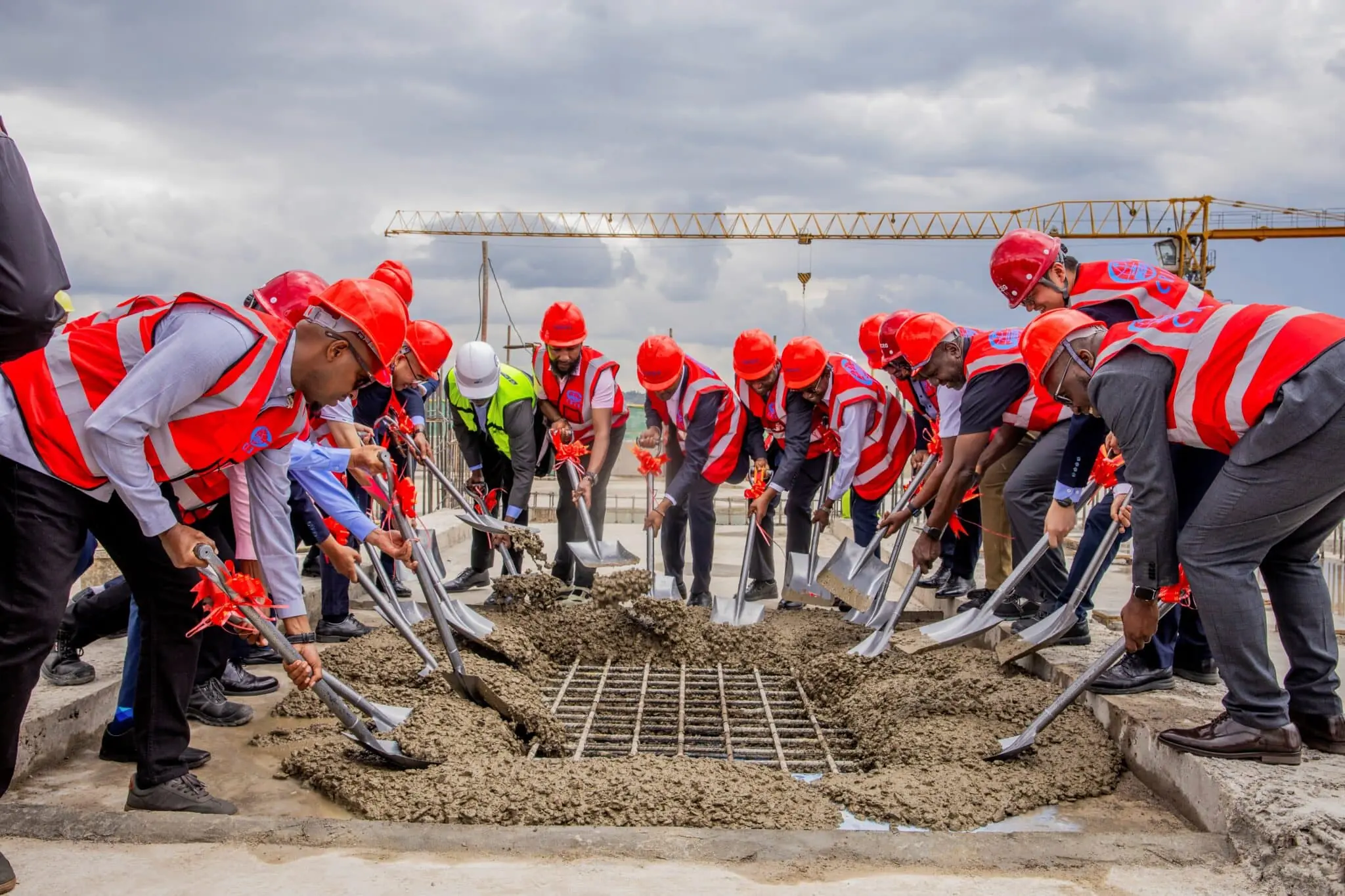
Photo: Representatives of construction partners ceremonially complete the main structural work on the Kigali Financial and Business Square, setting the stage for further phases of the project in the Rwandan capital, on Nov. 27, 2025. (Photo by Cyril Ndegeya/Xinhua via Getty Images)