New Lines Institute Launches Four Seas Initiative Policy Report With U.S. Congressional and Diplomatic Support
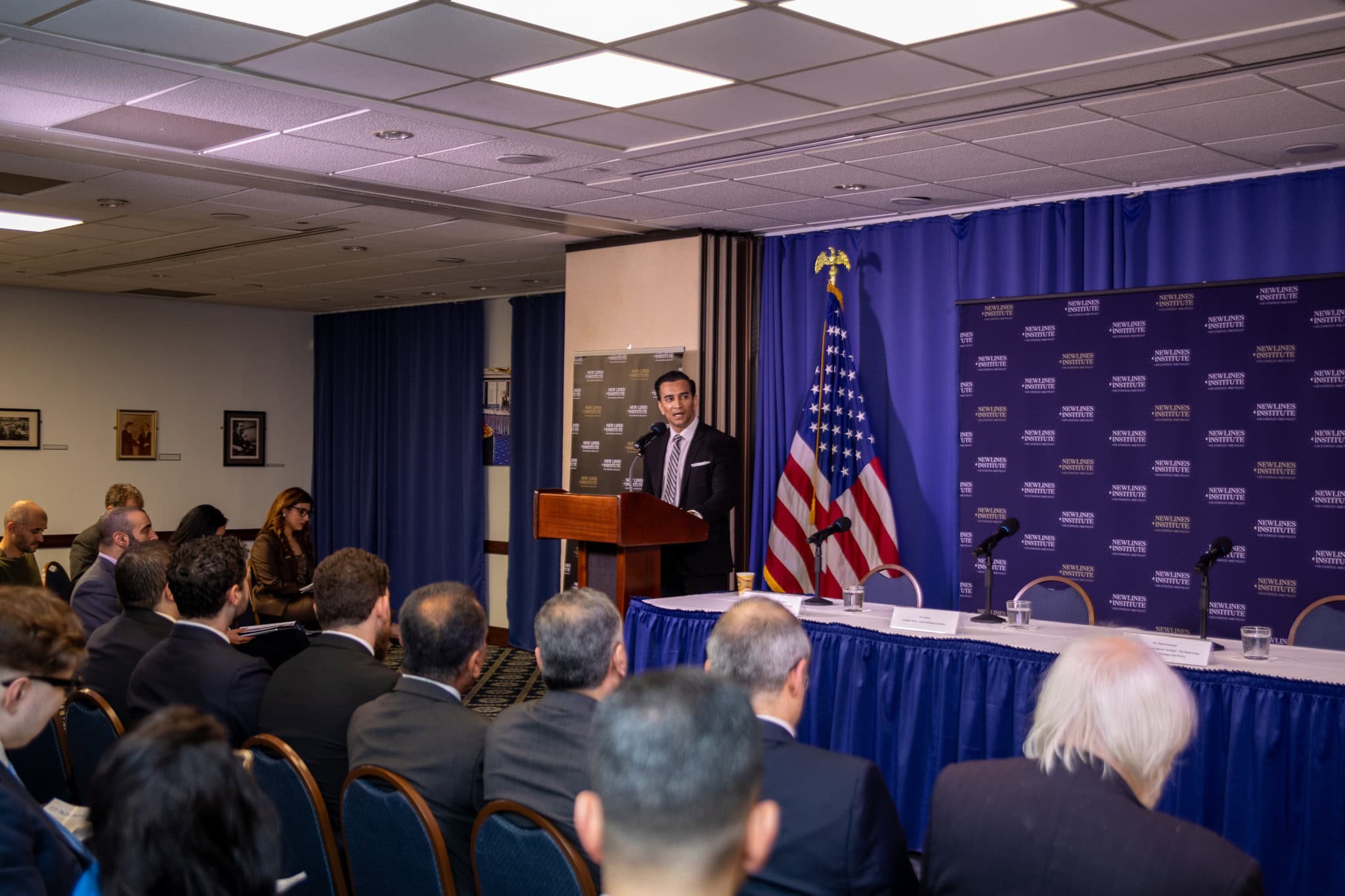
Washington, D.C., June 11, 2026 — New Lines Institute for Strategy and Policy launched the Four Seas Initiative Policy Report on Thursday, June 11, at the National Press Club in Washington, D.C., convening ambassadors, senior officials, policymakers, regional specialists, and leading analysts for a discussion on a new policy framework for regional connectivity, energy security, and Syria’s reconstruction.
The Four Seas Initiative outlines a Syria–Türkiye energy and transit corridor as the backbone of a broader multilateral framework connecting the Persian Gulf, Caspian Sea, Mediterranean Sea, and Black Sea. Modeled on the Three Seas Initiative, the framework proposes a multilateral approach to strengthening energy security, expanding regional connectivity, and supporting reconstruction through sustainable transit revenues and economic integration.
Roy Awabdeh, Middle East advisor to Senator Jeanne Shaheen on the Senate Foreign Relations Committee, delivered remarks on the senator’s behalf and emphasized the importance of continued congressional engagement. “As the Four Seas Initiative launches, Senator Shaheen and I have one ask: stay engaged with Congress. Bring us concrete recommendations, specific projects and specific needs, so we can turn this moment into something lasting.” He added: “This is a critical moment—for Syria, for the Syrian diaspora here in the United States and for what a stable, free Syria could mean for the entire region.”
In remarks shared for the launch, Rep. Joe Wilson expressed support for the initiative, stating: “Syria and NATO ally Türkiye could be integral partners for such an effort. I am pleased to endorse New Lines Institute’s creative thinking in proposing the Four Seas Initiative. Utilizing Syria’s strategic position for the transfer of petroleum and natural gas can help stabilize the region.”
Authored by Dr. Azeem Ibrahim OBE, Chief Strategy Officer at New Lines Institute, Themistoklis Asthenidis, Senior Advisor at New Lines Institute, and Dr. Dania Arayssi Program Head and Senior Analyst at New Lines Institute, the report argues that the Four Seas framework could help reduce European dependence on Russian and Iranian energy, anchor Gulf investment in Western-aligned infrastructure, and position Syria as a critical transit hub in the emerging post-Assad regional landscape.
Speaking at the launch, Dr. Ibrahim framed the initiative as an opportunity to rethink Syria’s role in the region and its place in a changing geopolitical order, stating: “For too long, Syria has been viewed as a battleground. The Four Seas Initiative offers a different vision: Syria as a bridge. A connector of regions rather than a source of division. A country whose geography becomes the foundation of prosperity rather than conflict.”
The presentation of the report was followed by two panel discussions bringing together leading regional experts and analysts.
The first panel, “The Political Economy of the Four Seas Initiative,” moderated by Dr. Arayssi, included Tim Callen, Visiting Fellow at the Arab Gulf States Institute; Maisoon Kafafy, Senior Advisor at the Atlantic Council; Ambassador (ret) Robert F. Cekuta and Dr. Karam Shaar, Director of Karam Shaar Advisory.
During this panel, Ambassador Robert F. Cekuta emphasized that advancing the Four Seas Initiative will require sustained diplomatic engagement, adequate staffing, and strong relationships with partners in Damascus and neighboring countries. “It’s going to take time, require patience, and persistence. But this is the time, with Syria’s transition underway this opportunity should not be wasted.”
The second panel, “The Politics of the Four Seas Initiative,” moderated by Dr. Sultan Alamer of the Middle East Policy Council, included Charles Lister, Senior Fellow and Director at the Middle East Institute; Wa’el Alzayat, Co-Founder of Zenobia Advisory Group and Executive Director of the U.S.-Syria Business Council; and Defne Arslan, Senior Director and Founder of the Atlantic Council’s Turkey Program.
During the second panel, Charles Lister, Senior Fellow and Director at the Middle East Institute, highlighted the strategic importance of connectivity in Syria’s evolving regional role. “If you want to get ahead of the game, as this new Syrian government is trying to do, you have to present yourself as a solution around interconnectivity,” Lister said.
Following its successful launch at the National Press Club, the Four Seas Initiative Policy Report will be introduced on Capitol Hill during a congressional launch, as well as through briefings in key international capitals, including London and Brussels, as part of a broader effort to build regional and transatlantic support.
New Lines Institute will continue to advance the initiative as a flagship policy framework through diplomatic engagement, private-sector outreach, and sustained public policy programming in the United States, Europe, and the broader region.
For more information, please visit: https://newlinesinstitute.org/project/four-seas/
For media inquiries, contact Dr. Dania Arayssi at [email protected].
About New Lines Institute
New Lines Institute for Strategy and Policy is a Washington, D.C.-based think tank dedicated to enhancing U.S. foreign policy through a deeper understanding of geopolitics, regional dynamics, and global value systems.