Momentum for The Silk Seven Plus (S7+) initiative grows with support on Capitol Hill
Vision for Central and South Asian regional economic bloc receives huge bi-partisan support from leading Member House of Representatives and The Senate
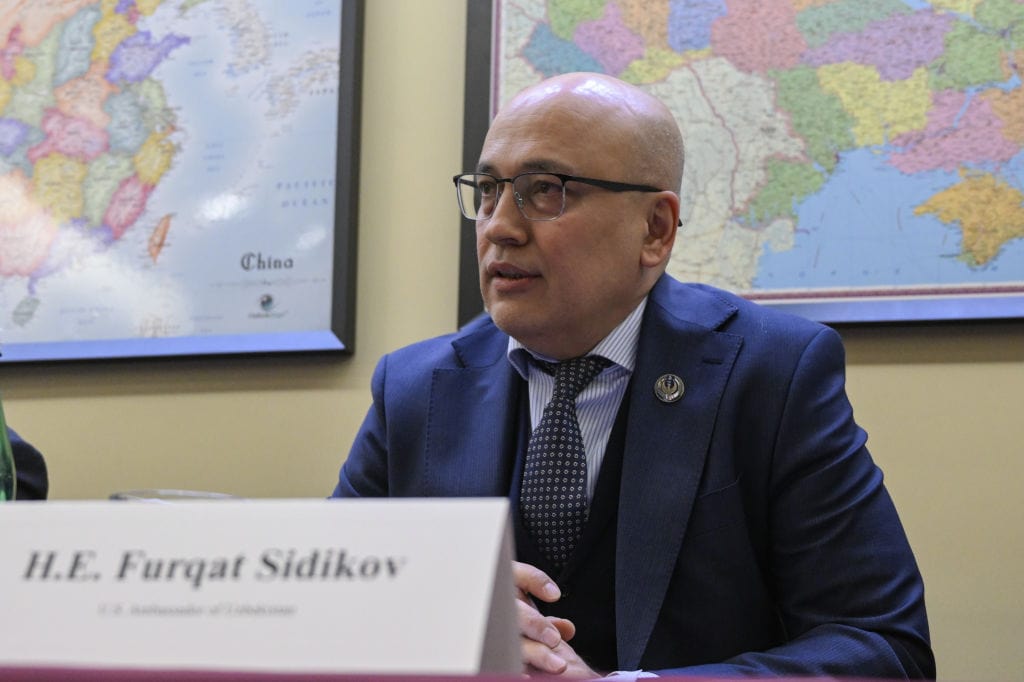
Washington, D.C., April 21, 2026 – New Lines Institute for Strategy and Policy launched the Silk Seven Plus (S7+) Initiative on Capitol Hill on April 20, with members of the U.S. Congress, Senate, former U.S. ambassadors, academics, and senior policy leaders, underscoring growing interest in strengthening U.S. engagement with Central Asia through economic and strategic partnerships.
Bringing together Kazakhstan, Uzbekistan, Turkmenistan, Kyrgyzstan, Tajikistan, Afghanistan, and Pakistan, and Azerbaijan, the S7+ is designed to unlock one of the world’s most strategically significant yet under-integrated regions. The initiative focuses on strengthening regional cooperation to address shared challenges; including water scarcity, energy deficits, and limited market access, while building new trade corridors linking the region to Europe, the Middle East, and the Indo-Pacific.
For the occasion, Dr. Azeem Ibrahim OBE, Chief Strategy Officer at New Lines Institute, said:
“At its core, the S7+ is not an abstract idea, it is practical, it is about cooperation where it counts: trade, energy, water, connectivity, security. The reality is simple; no country here can fully succeed alone. But together, aligned and connected, they can transform their economic future. Countries in this region are not looking for dependency; they are looking for options, agency, and partnerships, and the S7+ offers exactly that. Not in moral impose from the outside, but equal partnerships that helping to connect new markets and build economic resilience in concrete ways.”
For his part, Del. James Moylan (R-Guam) said:
“Incentives like The Silk Seven Plus (S7+) recognize the importance of regional cooperation, and the benefit that it brings not only for the region, but for the globe. Supporting diversified trade routes, energy, collaboration, infrastructure, development, reduces the potential for overreliance on any one actor while opportuning new opportunities for grown in South and Central Asia, Europe and the United States. Depper engagement in this region is about building durable partnerships, and advance stability, expand market access, and reinforce a free and open international system.”
National Security Advisor U.S. Sen. Steve Daines (R-Montana), Chris Anderson said:
“20 miles is all it would take. That is how close the region is to providing a new energy source to the Near East and Europe via Black Sea or Turkey. The success of the middle corridor and overarching frameworks like the S7+ advance U.S. interests and create opportunities for American countries to partner with our allies around the world and to provide both stable and sustainable energy and mineral supply chains as well as new markets for investment.”
Dr. S. Frederick Starr said:
“While we should definitely be pursuing actively and constructively the opening of corridors like The Silk Seven Plus (S7+) and opening up other transport corridors, we should also acknowledge that we’re dealing not just with a region that is central to certain supply routes and chains, but one that is self-productive and will be increasingly so in terms of talent and in the ability to organize activities in new technologies.”
Ambassador (ret.) Robert F. Cekuta said:
“It is essential, and overdue, to be thinking about Central Asia differently both in terms of Economics and Geopolitics. The U.S. needs to up its presence and engagement in the region, we need to understand Central Asia better and help these countries build closer relationships with each other as well as with us to help them build the future they want. Neglect will only hurt everyone. For these reasons, the S7+ is a needed initiative to bring appropriate focus to Central Asia, Azerbaijan and the Caucasus and to the linkages with the neighboring countries.”
Ambassador (ret.) Richard E. Hoagland said:
“This concept has been considered before, in the first two decades of this century, U.S. policymakers occasionally toyed with the idea of a north-south trade and transportation route to facilitate the growth of the Central Asian countries. In the end History always develops at its own pace, and that pace can sometimes be agonizingly slow or sometimes shockingly fast. So S7+, good luck!”
The S7+ Initiative will convene leading experts to produce a series of policy reports outlining practical pathways for regional integration. These will include proposals for a joint water and energy framework, critical minerals coordination, and the development of modernized trade and transit corridors.
The project aims to bridge the gap between academic analysis and policymaking by delivering actionable recommendations to stakeholders in Washington, Europe, and across the region. It will also examine how existing trade frameworks can be updated to facilitate deeper economic engagement and reduce structural barriers to cooperation.
Following its Capitol Hill debut, the S7+ Initiative will be introduced in key international capitals, including London and Brussels, as part of a broader effort to build transatlantic and regional support for a more connected and economically resilient Eurasia.
For more information, please visit: https://newlinesinstitute.org/workstream/silk-seven/
For media inquiries, contact Dr. Dania Arayssi at [email protected].
About New Lines Institute
The New Lines Institute for Strategy and Policy is a Washington, D.C.-based think tank dedicated to enhancing U.S. foreign policy through a deeper understanding of geopolitics, regional dynamics, and global value systems.