Real-Time Analysis: In Iran, a Tactical Victory Without a Strategic Plan
Given the overwhelming military superiority that Israel and the United States can bring to bear against an already sanctioned and weakened Iran, the achievement of their immediate tactical objectives appears highly likely. Nuclear facilities can be destroyed, missile stockpiles reduced, senior commanders eliminated, the Islamic Revolutionary Guard Corps (IRGC) degraded. The targeted killing of Supreme Leader Ayatollah Ali Khamenei sends an unmistakable signal that the military advantage rests overwhelmingly with the United States and Israel.
Yet it is equally possible that Khamenei’s death could backfire – not by strengthening the regime but by uniting Iranians around a sense of national sovereignty. In moments of external attack, societies often rally around the flag rather than rise against their governments. The desired public uprising against the regime may therefore not materialize.
But decapitation is not an end in itself. By eliminating the leadership, the U.S. and Israel appear to be operating on the assumption that elite fragmentation will follow. Fragmentation, in turn, would generate internal contestation. Out of that contestation – and with external encouragement – a more compliant set of leaders might emerge.
U.S. President Donald Trump has all but acknowledged this logic. In a moment of characteristic bravado, he suggested that Iranians might soon be calling him to ask whom he prefers as the successor to Khamenei. The remark, though sarcastic, reveals the underlying strategic assumption: that regime rupture can be shaped from the outside.
In operational terms, the tactical goals are being achieved, but they are being achieved at a very high price. Iran has begun retaliating with strikes inside Israel. It has launched attacks on multiple American bases across several Arab states. Videos circulating on social media show impacts in Bahrain, Qatar, and the United Arab Emirates. Whether every clip is authentic or not, what is undeniable is that the entire Gulf region is now under severe threat from Iranian missiles and drones.
Airspace across much of the Gulf has been closed. Commercial flights have been grounded. The Strait of Hormuz – through which roughly 20 percent of global oil supplies transit – has been shut down by Iran. Even temporary disruption at that scale carries global consequences. If shipments are delayed or halted for a sustained period, oil prices will surge. Inflationary pressures will ripple outward. Economies far removed from the battlefield – and uninvolved in the conflict – will nevertheless absorb the shock.
This is no longer a localized military campaign. It is a conflict with systemic economic implications.
But this is precisely where the strategic question emerges. While the tactical gains may be swift and decisive, the larger question remains whether the ultimate political objective – regime transformation – is realistically achievable.
Trump has framed the conflict in explicitly political terms. He has called on the Iranian people to rise up, urged security forces to stop fighting, and suggested immunity for those who surrender in a post-conflict arrangement. The implication is unmistakable: regime transformation. But transformation into what?
Suppose segments of the IRGC or senior officers in the Artesh, Iran’s conventional military, choose not to resist. Who manages the transition from a theocratic-revolutionary system to whatever successor model Washington envisions? Which institutions remain intact? Which actors gain legitimacy? Who ensures order in a state of nearly 90 million people undergoing bombardment? There is no publicly articulated roadmap.
Israel’s objective appears comparatively narrow and immediate: degrade Iran’s nuclear, missile, and military capacities to eliminate what it perceives as an existential threat. That is a military objective. The United States, however, has extended the discourse beyond degradation to political change. And if political change is the implicit aim, then Washington will bear responsibility for the aftermath. History suggests that responsibility cannot be outsourced.
The United States has pursued regime transformation before in Afghanistan and Iraq. In both cases, decapitation did not yield orderly democratization. It produced insurgency, institutional collapse, and prolonged instability. The expectation that authoritarian removal would organically generate liberal governance proved dangerously optimistic. Power vacuums were filled not by reformers but by armed actors and competing security elites.
Iran presents an even more complex case. It is larger, more urbanized, more institutionalized, and more nationally cohesive than Afghanistan in 2001 or Iraq in 2003. Its political order, while repressive, is layered, combining clerical authority, electoral mechanisms, and a deeply embedded security apparatus. If the regime fractures, the most plausible short-term outcome is not liberal democracy but intensified elite competition. IRGC remnants, Artesh commanders, clerical authorities, and regional actors could enter a struggle for primacy. A securitized nationalist order – potentially dominated by the military – is at least as likely as a pro-Western civilian government. This is the strategic paradox.
If Washington’s goal is to degrade Iran’s coercive capacity, that is a definable objective. But if the ambition is to shape the emergence of a regime more aligned with American and Israeli preferences, then the absence of a credible political blueprint becomes a profound strategic vulnerability. In that scenario, the Iranian people are not guaranteed beneficiaries of intervention; they are exposed to the instability it may unleash.
The distribution of consequences will not be equal. Israel may achieve tactical degradation of Iranian capabilities. But when oil markets react, proxy networks retaliate, reconstruction costs accumulate, and regional instability spreads, the geopolitical and financial burden will largely fall on Washington. The pattern is familiar: Israel conducts operations; the United States manages the fallout.
None of this absolves Tehran. The Islamic Republic’s human rights record is deeply troubling. Its support for armed nonstate actors across Lebanon, Syria, Yemen, and Gaza has fueled prolonged regional instability. Its nuclear ambitions have generated legitimate international concern. These are serious issues that demand a coherent strategy.
Bombing a complex state into uncertainty without clearly defining the political end state is not grand strategy. It is escalation driven by the assumption that collapse will self-organize into compliance. That assumption has repeatedly failed in the modern Middle East.
Strategic clarity requires answering three fundamental questions:
- What is the defined political end state?
- Who governs during the transition, and on what basis of legitimacy?
- How is fragmentation prevented in a country of nearly 90 million under conditions of war?
Absent credible answers, tactical success risks producing strategic ambiguity.
The Iranian people deserve more than to become the latest proving ground for coercive optimism, and the international community deserves transparency – not merely the rhetoric of liberation, but a serious articulation of what political order is meant to follow. The central question is no longer whether Iran can be weakened. It is whether those weakening it understand what comes next.
The views expressed in this article are those of the author and not an official policy or position of New Lines Institute.
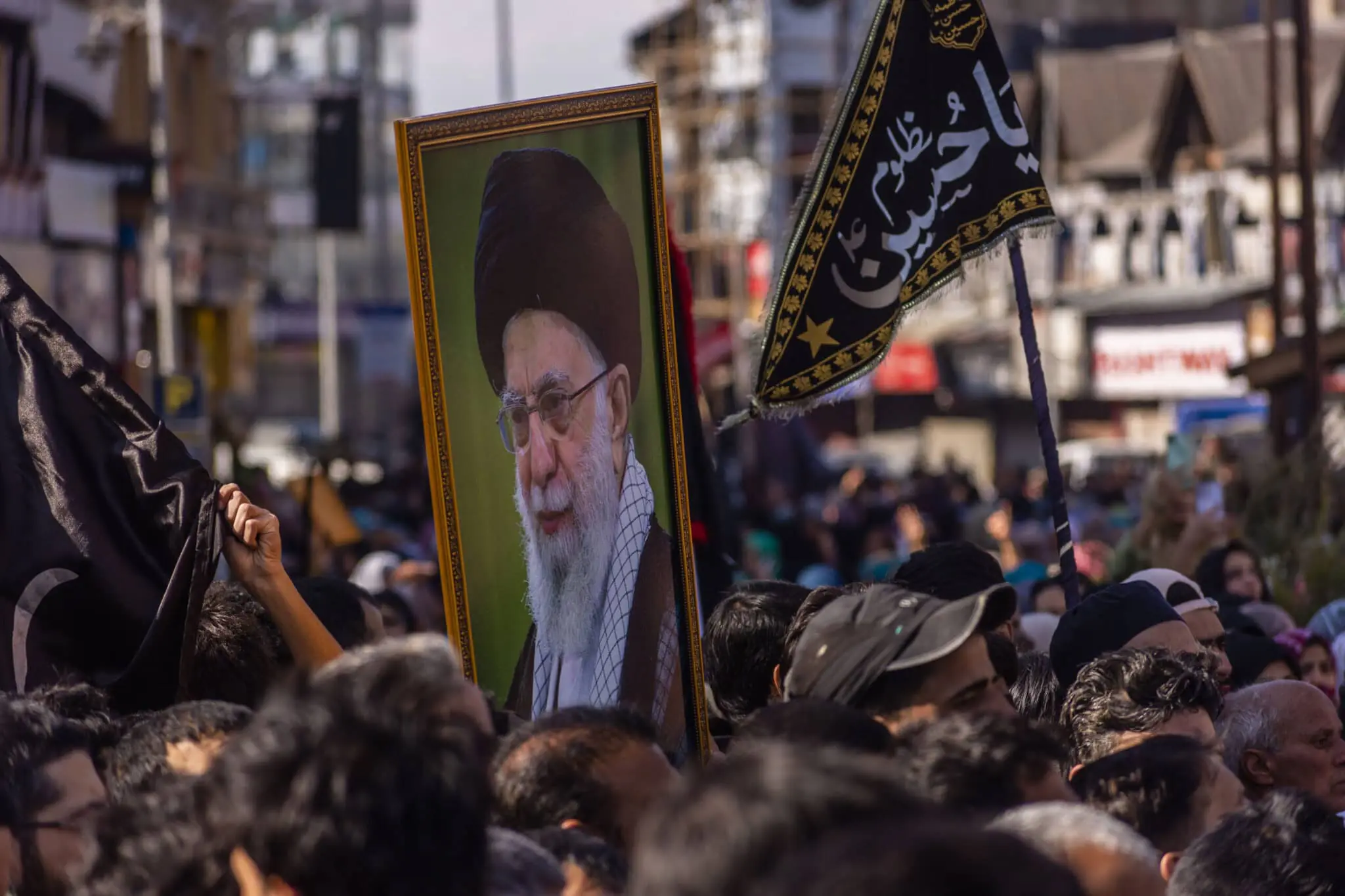
Photo: Demonstrators march in protest of the killing of Iranian Supreme Leader Ayatollah Ali Khamenei on March 1 in Srinagar, India. (Photo by Yawar Nazir/Getty Images)