Implications of the Iran War for U.S.-Saudi Relations
The U.S.-Israel war with Iran continues Saudi Arabia’s dependence on the U.S. as the only viable partner to defend the kingdom against Tehran’s escalating attacks across the Gulf. However, Saudi Arabia is likely to continue to diversify its international partnerships in the aftermath of the conflict, adjusting to long-term divergences from U.S. regional interests and structural limits to U.S. security provisions. A U.S.-Iran settlement that does not guarantee Gulf state security is also likely to intensify Saudi Arabia’s engagement with alternative global partners and could result in more direct steps to curtail the predominant role of the U.S. in the kingdom’s security and foreign policy.
Iran’s Attacks Against GCC States
Iran launched more than 500 ballistic missiles and 2,000 unmanned aerial vehicles (UAVs) at targets across all Gulf Cooperation Council (GCC) states following the U.S. and Israeli airstrikes on Iran on Feb. 28, with daily attacks continuing into the fourth week of the conflict. Despite high rates of interception by air defense systems, Iran has hit critical infrastructure, military bases, and civilian targets across the Gulf, including oil and gas facilities, international airports, and shipping ports, as well as hotels, residential buildings, and U.S. diplomatic facilities.
In the most recent escalations, the Iran-backed Houthis in Yemen declared their first attacks of the war, launching one confirmed ballistic missile at Israel on March 28. The Houthis’ entry to the conflict poses renewed threats to maritime security in the Red Sea and Bab al-Mandeb Strait, a critical passageway for oil and gas tankers which was previously targeted by the Houthis during Israel’s operations in Gaza in 2023-2025. The Strait of Hormuz, another vital transit point for global energy trade, has already been heavily disrupted by Iran’s threats to target any passing vessels since the start of the U.S. and Israeli strikes.
The Gulf States have thus far refrained from carrying out any direct strikes in response to Iran’s assault, issuing strong diplomatic condemnations and affirming the right to respond with military force. In an attempt to avert the crisis, GCC member states had supported U.S. diplomatic negotiations with Iran over its nuclear program and appear to have maintained their restrictions on the use of their territory for U.S. and Israeli operations. However, unconfirmed media reports claim that Saudi Arabia has permitted the use of King Fahd Air Base for U.S. forces to conduct operations. Iran’s expansion of targets beyond U.S. military facilities also breaks from the calibrated, pre-warned missile attacks on Al Udeid Air Base in Qatar in June 2025, directly threatening vital trade, logistics, and transport hubs.
Regional Limits of the U.S.-Saudi Alliance
The threat posed by Iran since the 1979 revolution has been one of the primary shared security concerns of the U.S.-Saudi partnership. Notwithstanding periods of diplomatic turmoil and conflicting policy interests, the Bush, Obama, Biden, and Trump administrations all pledged enduring support to the kingdom as a vital U.S. ally, delivering substantial arms deals and defense cooperation agreements.
Faultlines emerged between the two powers’ approaches with Iran with the U.S. invasion of Iraq in 2003, which Saudi Arabia strongly opposed due to the risk of long-term instability and growing Iranian influence following the ousting of dictator Saddam Hussein. The U.S. decision not to remove Syrian President Bashar al-Assad, a key Iranian ally, from power in Syria, as well as the lifting of U.S. sanctions on Iran under the Joint Comprehensive Plan of Action (JCPOA) nuclear deal in 2015, also weakened Saudi Arabia’s position against Iran in the region.
Limits to the U.S. commitment to defend the kingdom from direct Iranian attacks were then exposed in September 2019, when Iranian UAVs and missiles struck Saudi oil facilities in Abqaiq and Khurais. After initially suggesting the U.S. was ready to intervene, Trump publicly stated that the U.S. had no obligation to defend Saudi Arabia and instead temporarily deployed 3,000 additional troops and air defense systems there. In early 2019, Saudi Arabia also faced attempts by the U.S. Congress to block new arms exports to the kingdom, despite sustaining thousands of Houthi cross-border aerial attacks, enabled by Iran, from 2015 to 2022.
Saudi Arabia’s vulnerability to Iranian attacks drove a major shift in the kingdom’s regional strategy. In the years following the 2019 attacks, Saudi Arabia sought to stabilize relations with Iran and diverge from Trump’s “maximum pressure” approach, which combined expanded sanctions regimes and diplomatic measures against Iran, and led to the killing of Islamic Revolutionary Guard Corps commander Gen. Qasem Soleimani in 2018. Beginning in 2021, Saudi Arabia and Iran held several rounds of backchannel talks facilitated by Oman, which culminated in an official diplomatic normalization agreement in Beijing in 2023.
The rapprochement continued until the outbreak of the current war in February 2026, and led to unprecedented top-level political and security engagements between the two former rivals, with the last official Saudi visit to Tehran held in December 2025. Saudi Arabia’s new accommodation with Iran occurred alongside broader efforts by the kingdom to de-escalate regional tensions, including the Al-Ula accords to end the rift with Qatar, diplomatic reconciliation with Türkiye, and a truce with the Houthis in 2022, ending Saudi Arabia’s seven-year military intervention in Yemen. These approaches also aligned with the pressing domestic priorities of Vision 2030, a government program which aims to diversify Saudi Arabia’s oil-dependent industry, attract investment and tourism, and transform social and cultural life in the Kingdom.
Strategic Function of the Iran-Saudi Rapprochement
Saudi Arabia’s more stable bilateral ties with its former adversary had mitigated the kingdom’s dependency on inadequate U.S. military support, affording the kingdom a degree of protection from the escalating U.S. and Israeli tensions with Iran after the Hamas attacks on Israel in October 2023. Anticipating the Iranian response against Gulf targets from expanded U.S. or Israeli strikes, Saudi Arabia opposed the U.S. and Israeli attacks on Iran during the Twelve-Day War in June 2025, and reiterated that neither country would be permitted to use the kingdom’s territory to conduct operations. The kingdom maintained this position throughout the build-up to the U.S. and Israeli strikes on Feb. 28 and followed similar pledges by the UAE as early as March 2023.
Triggered by the U.S. and Israeli instigation of the war, Iran’s attacks against Saudi Arabia have again brought vulnerabilities in the U.S.’ defense provisions in the Gulf to the fore. The lack of any codified U.S.-Saudi mutual defense treaty raises the risk of a U.S. disengagement or an inadequate settlement with Iran, exposing the kingdom to prolonged instability and Iranian aggression with insufficient U.S. support. Despite deep U.S. ties to Saudi Arabia, the two partners never established a formal treaty with codified mutual defense articles, such as the provisions within NATO or the U.S. agreements with Japan and South Korea, which stipulate a collective response to an attack.
The U.S. defense commitment, largely conditional and susceptible to domestic political pressures, is therefore unlikely to provide adequate protection from the longer-term threats which emerge from the current confrontation, including the potential state collapse and fragmentation in Iran, continued Iran-Israeli conflict, or expanded attacks across the Gulf by the Yemeni Houthis. The Strategic Defense Agreement signed during Saudi Crown Prince Mohamad bin Salman’s visit to Washington in November 2025 also did not include any major steps towards a formal treaty, despite featuring major new weapons deals and the recognition of Saudi Arabia as a major non-NATO ally.
Long-Term Implications
Saudi Arabia’s strategy to reduce its dependency on inadequate U.S.-led security guarantees had taken shape during the decade prior to the current conflict. Using its vast oil wealth, Saudi Arabia sought to reduce its dependencies on the U.S. by expanding its geopolitical influence with various global powers, including a series of strategic partnership agreements with China (2016 and 2022) and Russia (2019). This diversification includes the defense sector, in which Saudi Arabia has acquired new capabilities and defense cooperation agreements, such as expanding ballistic missile procurement and joint-naval exercises with China, technology transfer agreements with Türkiye, or the potential procurement of Russian air defense systems. More recently, only a week after Israel’s strike on Hamas officials in Qatar in September 2025, the kingdom signed a nonbinding mutual defense agreement with Pakistan, formalizing long-running military ties between the two powers.
Although Saudi Arabia’s growing ties with U.S. competitors have caused friction in the relationship, the kingdom has avoided any direct steps to curtail the extensive U.S. role in its security and foreign policy, balancing the long-term goal of diversifying against the continued requirement for U.S. defense capabilities. The kingdom’s other international partners also cannot provide support equivalent to U.S. security provisions and are highly unlikely to intervene to defend Saudi Arabia in a major conflict. Russia and China, with major ties to both sides of the Gulf, have taken neutral stances toward Iran and abstained in a vote for a U.N. Security Council Resolution condemning its attacks. Pakistan’s involvement is also currently limited to diplomatic engagement, despite the new defense agreement. Saudi Arabia can only look to the U.S. to provide vital military support and must now depend on the success of U.S. and Israeli operations to destroy Iran’s missile and UAV arsenals and their ability to deter further Iranian aggression.
Despite this continued dependency, the war increases pressure on Saudi Arabia to improve deterrence and establish security frameworks independent of U.S. decision-making in the region. This requires not only further procurement of new defense hardware from a wider range of partners but also a continued push for localized arms production, stronger defense and diplomatic frameworks with various long-running and more recent partners, and effective cooperation between the individual member states of the GCC, an effort that has historically been constrained by diverging interests and calculations toward Iran. Accessing the necessary resources, technology, and political capital through various global powers is integral to all of these long-term goals. In the short term, while Pakistan and Türkiye are reportedly acting as key intermediaries in the conflict, Saudi Arabia may also look to China as a third party in any future engagement with Iran. The three powers established a trilateral committee under the 2023 normalization agreement, which had conducted annual meetings to progress the deal.
The scope of Saudi Arabia’s diversification will be shaped by the trajectory and outcome of the current conflict. If Iran maintains its current ability and intent to target the Gulf states, Saudi Arabia is likely to opt for a more gradual adjustment of its defense relationship with the U.S., taking limited steps to procure new defense capabilities and agreements while maintaining vital U.S. military support. A permanent cessation of Iran’s hostility to the Gulf states, plausible only with comprehensive changes in the country’s political and security apparatus, may result in bolder steps to curtail the U.S. defense relationship, removing the urgent need for U.S. military support.
A U.S. exit or settlement with Iran that does not provide sufficient guarantees of Gulf state security would also intensify Saudi Arabia’s diversification strategy. This would probably include more problematic cooperation with U.S. competitors and pose major intelligence risks to U.S. assets. China’s growing presence in the region has already caused tensions between the U.S. and its Gulf partners, including the planned construction of a Chinese military facility in the UAE and its potential access to advanced U.S. military technology exported to Saudi Arabia. Chinese telecommunications and AI companies also play a substantial role in Saudi Arabia’s growing tech sectors.
Conclusion
Previous rifts did not result in a rupture in the U.S.-Saudi relationship, with converging strategic interests prevailing over the U.S.’ shortcomings as a military ally. There is also no alternative to extensive U.S. role in Saudi Arabia’s national security in the short term. However, the U.S. and Israeli regional strategies pose increasingly unsustainable risks to critical Gulf State interests and autonomy, exacerbated by the major limits in U.S. regional defense guarantees. Potential U.S. strikes against Iranian civilian infrastructure, including power plants, oil infrastructure, and desalination facilities, an escalation threatened by Trump on 30 March, risk major retaliatory strikes by Iran against equivalent targets in the Gulf, with uncertain U.S. assurances.
Previous divergences from U.S. policy positions had not triggered such immediate, existential threats to the GCC states. The fallout from the Iraq War, for example, leading to the near-total withdrawal of U.S. forces from Saudi Arabia in 2003-2004, did not cause a direct assault on all members of the GCC. Saudi Arabia’s changing economic model is also now inherently more vulnerable to risks of instability as well as being incompatible with uncertain U.S. security provisions or volatile regional conflicts. In addition, geopolitical competition in the Gulf has intensified significantly over the past two decades as the depth of economic, diplomatic, and military influence of U.S. competitors in the region has no precedent in post-Cold War era. While the U.S. maintains unmatched military capabilities, both Russia and China are well-placed to benefit from a dysfunctional U.S.-Saudi partnership and expand their ties to a strategically vital region.
- The United States should provide suitable Gulf Arab partners with a role in any post-conflict settlement with Iran. As the Iranian regime is weakened, the U.S. should leverage the complex economic, social, and political ties to Iran shared by Oman, Qatar, and the UAE to provide economic and diplomatic opportunities to Iran after immediate U.S. policy goals are achieved.
- The U.S. will need to restrain Israel in any post-conflict settlement or ceasefire, as this is likely to risk further conflict. The U.S. should limit its support of Israel if it undermines Gulf Arab outreach or diplomatic initiatives with Iran or its regional partners, such as the Houthis. Mechanisms for this leverage include limits on the provision and use of U.S. defense hardware or reducing support for Arab-Israeli diplomatic accords. One example of this was recently observed in Trump’s decision to support Syria’s new government, probably influenced by Gulf leaders’ efforts to legitimize new Syrian President Ahmed al-Sharaa and deter Israeli attacks.
- More broadly, the U.S. should support Arab-led peace proposals to find sustainable solutions to the Israel-Palestine conflict, using its influence to moderate Israel’s attacks in Gaza and expansions in the West Bank. These conflicts will threaten to reignite regional war without a sustainable peace plan.
Strategic alignment on regional affairs would also provide the U.S. with more leverage regarding Russian and Chinese influence in Saudi Arabia, demonstrating long-term and comprehensive support for Saudi Arabia’s security, which does not require major cooperation with other global powers.
The views expressed in this article are those of the author and not an official policy or position of New Lines Institute.
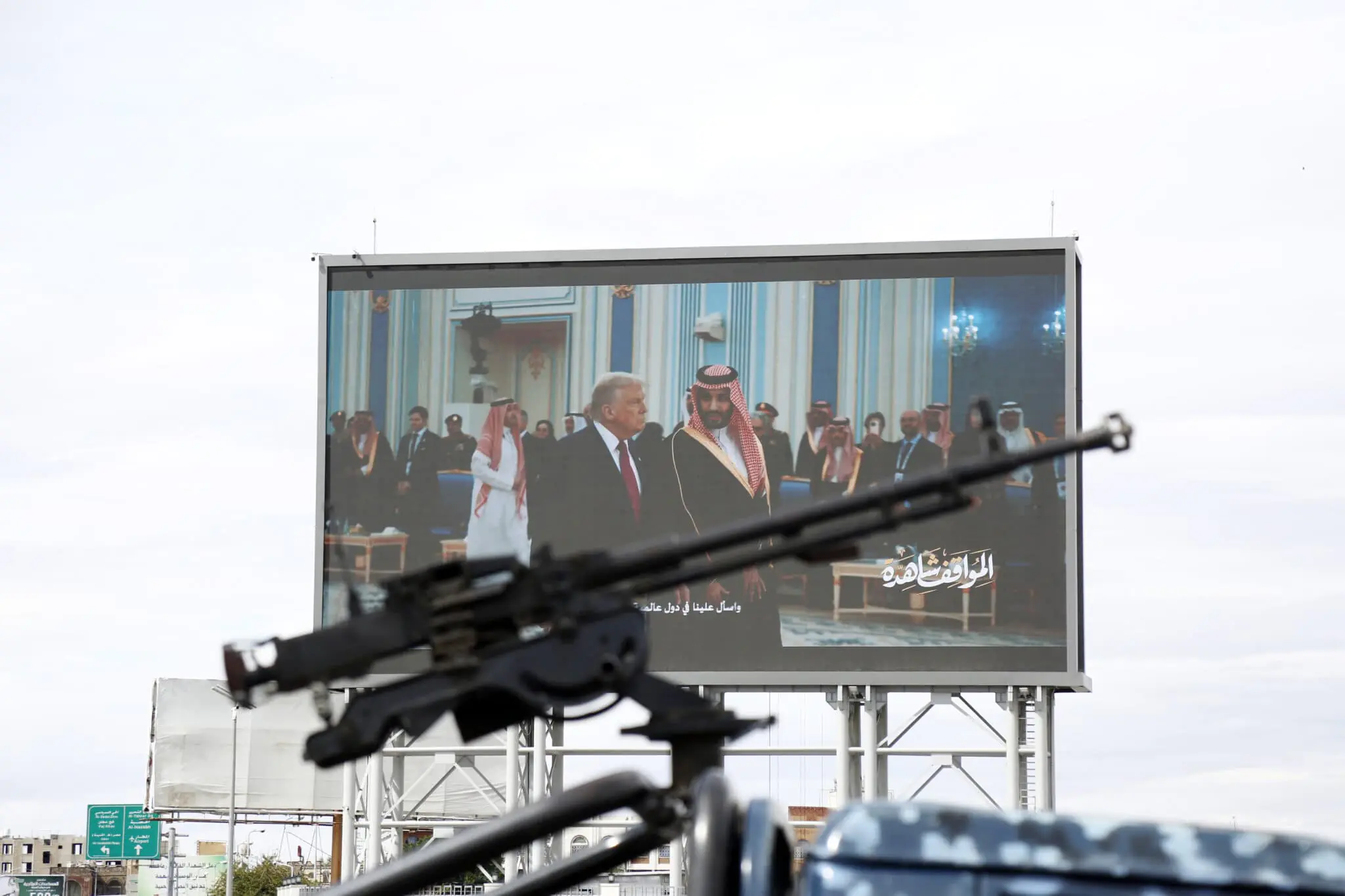
Photo: A machine gun of a Houthi soldier mounted on a police vehicle next to a billboard depicting U.S. president Donald Trump and Mohammed Bin Salman, the Crown Prince and Prime Minister of Saudi Arabia, during a protest staged to show support to Iran against the U.S.-Israel war on March 27, 2026, in Sana’a, Yemen. (Photo by Mohammed Hamoud/Getty Images)