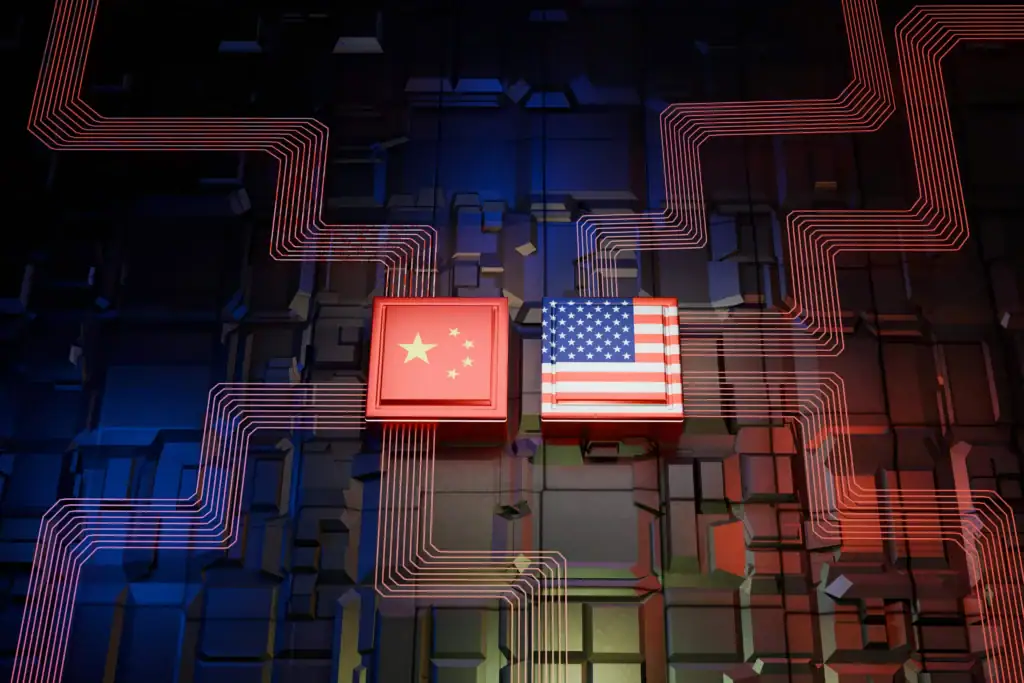
Tariffs, AI, and competition with China: experts say America’s opportunity to regain tech supremacy is now
A new series of reports by New Lines Institute outlines bold steps the U.S. needs to take to secure its strategic technological advantage.
WASHINGTON, D.C., APRIL 7, 2025 – New Lines Institute for Strategy and Policy released a set of policy recommendations and reports today under its new Tech Sovereignty & Security portfolio. The compendium, Future-Proofing U.S. Technology: Strategic Priorities Amid Chinese Tech Advancement, crafted by experts from industry, government, and academia, offers bold, actionable recommendations to secure the United States’ technological advantage amid China’s growing capabilities.
Giving insight into a diverse set of strategic technologies shaping the geopolitical landscape, the report focuses on artificial intelligence, industrial policy, cybersecurity, and critical minerals. Former U.S. Secretary of Homeland Security Michael Chertoff describes the compendium as setting “out a path forward to launch policies that take a comprehensive and strategic approach to advancing critical technologies in the West.”
Lead analyst and head of the Tech Sovereignty and Security portfolio at New Lines Institute, Kelsey Quinn, said “the technological rivalry between the United States and China transcends traditional geopolitical competition. It represents a systemic challenge that cuts across economic, security, and diplomacy domains and demands a response that harnesses America’s innovative capacity.”
America’s technological advantage, which has been a cornerstone of its economic prosperity and national security for decades, must be secured with collaborative, cross-sectoral action. This compendium’s policy recommendations serve as a strategic blueprint for the U.S. to take these kinds of solutions forward.
To learn more on the path toward U.S. technological sovereignty and security, read the full compendium here and visit here to explore New Lines Institute’s broader analyses in this space.
For media inquiries, contact Kelsey Quinn at [email protected]g.
Author Quotes
“The global race for artificial intelligence is heating up, and we have strong bipartisan support for efficient, cohesive technology policy. The time is right to be proactive, not reactive, and this work provides the actionable recommendations needed to surpass, not just defend against, Chinese critical technology development.” – Courtney Manning, Director, AI Imperative 2030, American Security Project
“The U.S. must lead the way in structuring and supporting AI governance that empowers communities to shape their own future with technology in a way that captures the nuance of values across local contexts.” – Averill Campion, Founding Director, Phaedo
“The United States is reaping the benefits of foundational investments in computing research and artificial intelligence in the 20th century. These investments laid the groundwork for American industry to take up the mantle of frontier AI research and development in the years since. Now, American AI leadership depends on not conceding the future of this technology merely to control its present.” – Vincent J. Carchidi, Non-Resident Fellow, Orion Policy Institute and Middle East Institute
About New Lines Institute
The New Lines Institute for Strategy and Policy is a nonpartisan think tank in Washington D.C., working to enhance U.S. foreign policy based on a deep understanding of the geopolitics of the different regions of the world and their value systems. Funding for The New Lines Institute is provided by the Washington Institute for Education and Research, a 501(c)(3) nonprofit registered in Washington, D.C. The Institute does not accept funding from any foreign government or entity.