How Albania Became the Anchor of NATO’s Balkan Strategy
Albania has quietly emerged as a linchpin of NATO’s regional strategy. The country’s strategic location and steadfast commitment to regional defense have made it a valued security provider for the alliance. While Albania continues to face democratic governance challenges, with organizations such as Freedom House identifying it as a hybrid regime, its role in supporting NATO initiatives—through hosting assets like the Kuçova airbase, contributing to missions, and increasing defense spending—demonstrates how states with varied democratic credentials can still influence regional stability.
Albania’s evolution showcases resilience and strategic foresight, making it a case study in how small states, regardless of political system maturity, can reshape security architectures in turbulent regions.
A Proactive Foreign Policy
Albania’s transformation is rooted in its decision to anchor itself firmly within Euro-Atlantic structures. Since joining NATO in 2009, the country has undertaken sweeping military reforms to align its defense capabilities with the alliance’s standards, prioritizing participation in NATO missions and exercises, enhancing interoperability, and contributing indirectly to NATO’s logistical and operational capabilities. As then-U.S. Defense Secretary Jim Mattis put it in 2018, Albania “punches above its weight.”
Ilir Kalemaj, chair of the Department of Political Science and International Relations at University of New York Tirana, said in an interview that since joining NATO in April 2009, Albania has consistently demonstrated its reliability as a partner through participation in NATO operations, steady increases in defense spending, and efforts to modernize its military. Kalemaj said Albania and other NATO members such as Croatia and Montenegro have contributed to regional security and have benefited from remaining uninvolved in the conflicts that affected the former Yugoslavia.
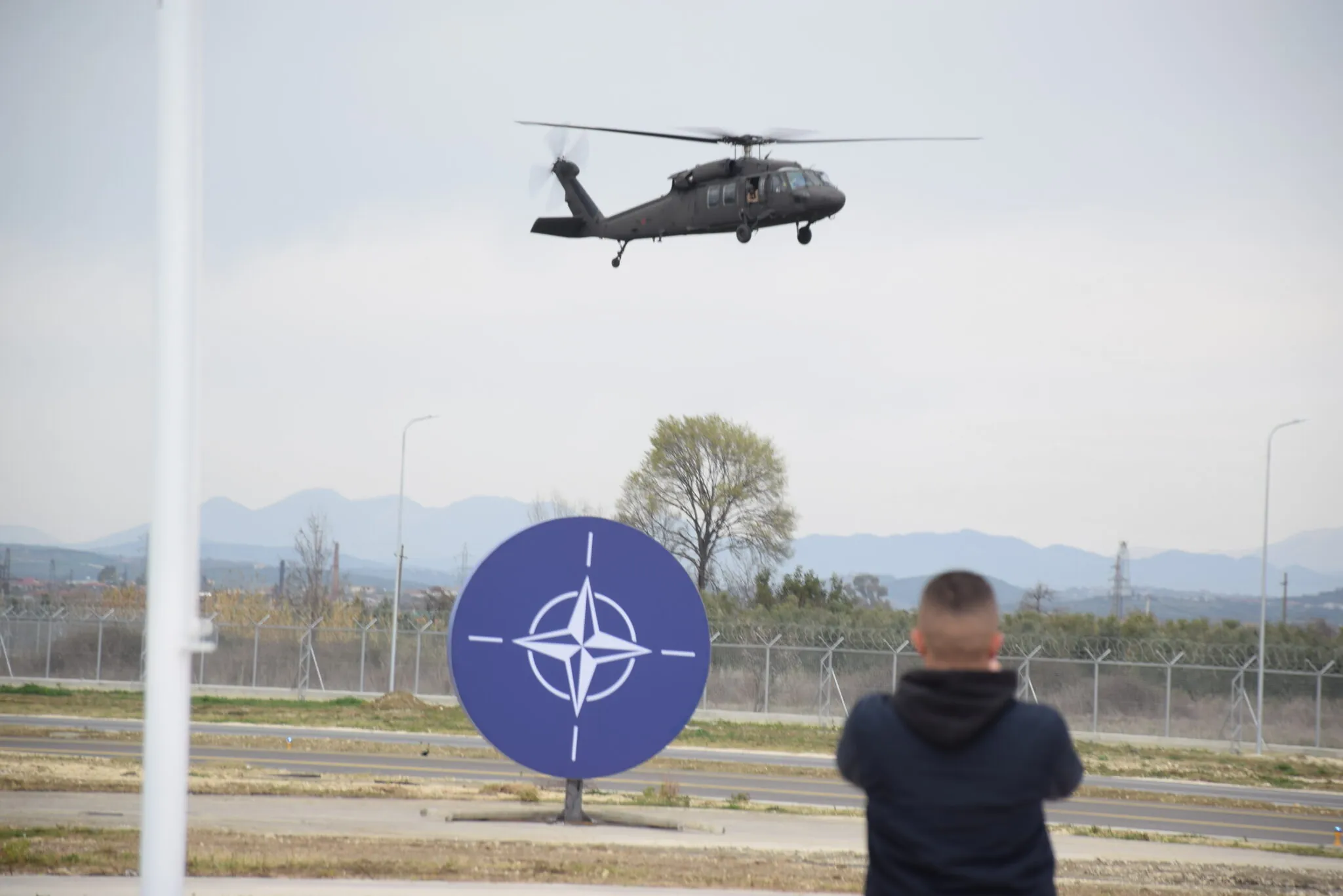
Albania’s proactive foreign policy is exemplified by its leadership in multilateral initiatives and regional dialogue. The modernization of Albania’s military infrastructure, especially the Kuçovë airbase—a €50 million NATO-funded project—exemplifies Albania’s readiness to serve as a regional security anchor.
The defense sector is undergoing rapid transformation. The country has accelerated the acquisition of advanced military systems and increased its defense budget to 2% of GDP, in line with NATO commitments. These investments are complemented by reforms in military training and international cooperation.
Defense Minister Niko Peleshi has emphasized that Albania occupies a strategically important position in the Western Balkans and stands as a reliable NATO partner, firmly committed to its Euro-Atlantic direction. He also has noted that Albania plays a key role in supporting ethnic Albanian communities not only in Kosovo and North Macedonia, but in other neighboring countries as well.
The country’s strategic geography—bordering Greece and Montenegro and facing Italy across the Adriatic Sea—makes it an ideal location for NATO to project stability and deter malign influences. The alliance sees Albania as a stable anchor in a region where other states face more delicate internal situations. If you look at a map, Albania is now a rising star, surrounded by neighbors with bubbling tensions. For NATO, it’s not just about the bases; it’s about having a reliable partner in a strategic location.
Gen. Knud Bartels, former chairman of the NATO Military Committee, emphasizes that NATO greatly values Albania’s regional role in defense and security cooperation, particularly its participation in core defense initiatives such as the Balkan Regional Approach to Air Defense and its engagement with wider security matters through the A5 framework. Bartels said Albania’s close collaboration with other NATO members and partners to advance defense capabilities and interoperability is vital to ensuring the alliance is prepared for future challenges.
Albania’s contribution to NATO involves not just participation in the KFOR peacekeeping mission in Kosovo and NATO’s mission in Iraq but also contribution of troops to multinational battlegroups in Latvia and Bulgaria. This is an important component of NATO’s deterrence and defense posture in the eastern part of alliance territory. This participation demonstrates a level of seriousness and commitment that has not gone unnoticed in NATO circles, where Albania is increasingly seen as a model for small-state contribution.
Regional Tensions
Albania’s rise has not gone unnoticed by its neighbors. The Open Balkans initiative, involving Albania, North Macedonia, and Serbia, is an example of regional cooperation, though historical and political frictions remain. Albania’s relationship with Kosovo is often more complex than their close ethnic ties would suggest. While history, language, and deep cultural bonds knit the two Albanian-majority states together, official dealings have repeatedly been marked by disagreements over leadership and representation for Albanians across the region.
In recent years, much of this tension has played out in the relationship between Albanian Prime Minister Edi Rama and Kosovo Prime Minister Albin Kurti. Their personal and political rivalry reflects competing visions over who truly sets the regional agenda—sometimes turning what should be familial collaboration into subtle competition.
Kurti, in particular, has bristled at what many in Pristina view as Rama’s paternalistic approach, especially when Albania tries to act on Kosovo’s behalf in negotiations with Serbia. Rama’s close rapport with Serbian President Aleksandar Vucic has only heightened Kosovo’s suspicions that Tirana sometimes puts broader diplomacy ahead of Kosovo’s direct interests.
Ultimately, while historical ties between Albania and Kosovo remain strong, the personalities and strategies of their leaders mean that moments of tension just beneath the surface are a recurring motif in their relationship. Many agreements between the two countries remain unimplemented, and economic ties are still weak, adding to disappointments on both sides. While there is a public sense of solidarity, in practice, their cooperation has been limited and complicated by mutual expectations and political differences.
In North Macedonia, Albania’s influence is limited by divisions within the local Albanian community and rivalry among regional political actors. Leaders from Albania and Kosovo have supported different Albanian parties in North Macedonia, which has sometimes intensified political rifts rather than fostering unity. These actions can create a perception that Albanian domestic politics are being played out across the border, complicating relationships within North Macedonia’s Albanian population.
In Montenegro, Albania’s influence is smaller due to the relatively small Albanian minority, though this group has played pivotal roles at key moments, such as supporting Montenegro’s independence. Albanian parties in Montenegro work together to maximize their voice but are constrained both by internal challenges and by Montenegro’s focus on broader national politics and its EU integration drive. Albania’s efforts to support Albanian communities in neighboring states are shaped by practical limitations and local political realities, which often restrict its ability to significantly affect outcomes.
The Open Balkan initiative—meant to foster greater economic integration and easier cross-border movement among Albania, Serbia, and North Macedonia—has brought some cooperation, but progress is mixed. Tensions persist over its effectiveness, and there are notable technical and political hurdles. Relations remain affected by historical frictions and the differing priorities of each government. For example, North Macedonia and Serbia have successfully rolled out more Open Balkan permit options than Albania, and skepticism in the region lingers about the initiative’s value and its effects on existing EU-focused frameworks.
The alliance between Albania, Croatia, and Kosovo represents an attempt to balance power in the region. This tripartite military alliance, though not yet formal, sends a clear message, primarily to Serbia, and is seen as a defensive move in response to Serbia’s growing military cooperation with Hungary. Other Balkan countries, such as Bulgaria, North Macedonia, and Montenegro, may join the initiative soon.
Nuredin Ibishi, a security expert from Pristina, told Kosovo Online that shifting power dynamics in the region have led to the formation of more defensive alliances. He noted that countries have agreed to work together on defense and to strengthen their military capabilities, including investing in weapons and ammunition production.
While every country in the region faces serious challenges, Albania’s ability to manage its own and project stability outward is remarkable. Even harsh critics of the government acknowledge the country’s coherence and ambition in foreign and security policy. Albania’s mostly pro-NATO and pro-EU orientation is not just a matter of government policy but is deeply rooted in public opinion.
“Albania belongs to the distinct category of the most pro-NATO, pro-EU, and pro-USA country in the region save for Kosovo, with no other geopolitical rivalries or potential alternative alliances. There is both 100% support of the EU and NATO by all political parties as well as over 90% popular support for both in all national polls,” Kalemaj said.
Domestic Issues
Despite its external successes, Albania does face persistent internal challenges, especially in governance, rule of law, and corruption. Progress is being made, but reforms must be deepened and depoliticized to ensure long-term stability and prosperity. The country continues to struggle with deeply entrenched issues such as widespread corruption, politicization of the judiciary, and a culture of patronage that undermines genuine reform efforts.
Meaningful progress has been made, especially under the pressure of EU integration and external scrutiny, yet reforms remain vulnerable to political interference and are too frequently superficial—a “box-ticking” exercise rather than truly transformative change. The only way Albania can secure its long-term future as a stable, modern European democracy is through a fundamental, depoliticized overhaul of its governance institutions, a relentless focus on strengthening the rule of law, and the fostering of an environment where transparency and meritocracy become the new normal. Without this, the country risks stagnation, disenchantment among its youth, and jeopardizing the stability for which it is celebrated.
Kalemaj argued that although Albania has been successful in its foreign policy and diplomatic efforts, progress on internal reforms has fallen behind. He pointed out that despite numerous anti-corruption measures, systemic and political corruption remains a significant issue for the country, as highlighted by various international assessments, and continues to hinder Albania’s prospects for faster economic growth.
Making reforms more comprehensive and ensuring they are implemented impartially, free from political influence, is essential to secure lasting stability and prosperity, and to ensure respect and dignity for every Albanian. Achieving genuine human and financial security depends on eradicating entrenched corruption and upholding the rule of law.
Punching Above its Weight
Albania’s status as a “periphery” country is being redefined. While some foreign observers still refer to Albania as the periphery of the alliance, its growing importance is clear. NATO’s presence, investment, and reliance on Albania are likely to increase in the coming years.
Albania’s ability to adapt, contribute, and lead—even with limited resources—offers lessons for other small states. The country’s journey is not just about security or geopolitics; it is about the intersection of governance, social justice, and regional stability.
Albania’s transformation from a transitional democracy to a strategic actor is a testament to the power of clear-eyed policy choices and steadfast alliance commitment. As the Western Balkans face mounting external pressures, Albania stands as a bulwark of stability, a hub for NATO operations, and a leader in regional cooperation.
For analysts and policymakers, Albania offers a compelling example of how small states can punch above their weight. In an era of renewed great power competition, Albania’s quiet leadership is a signal that the future of European security may well be written in places once considered marginal—but which are now central to NATO’s strategy.
The views expressed in this article are those of the author and not an official policy or position of New Lines Institute.