Why is Saudi Arabia Investing in Syria?
Saudi Arabia has taken a central role in Syrian economic development, using a soft-power approach to strengthen its influence there. While other powers have made diplomatic overtures to the fledgling Syrian government, Riyadh has made vital economic inroads. These include advocating for sanctions relief, establishing a joint economic council, and investing in infrastructure and reconstruction projects. Saudi Arabia sees this investment as essential to increase its regional influence. The fall of former Syrian President Bashar al-Assad weakened Iran’s standing, creating an opening in the Levant that Saudi Arabia is poised to fill. As it takes a more assertive approach to regional strategy, its investment and tolerance for risk will only increase.
In early July, the administration of U.S. President Donald Trump lifted its sanctions on Hay’at Tahrir al-Sham (HTS), after its leader, Ahmed al-Sharaa, became the interim Syrian president. HTS built an interim coalition government, ratified a temporary constitution, and started to provide basic government services. While it has established itself as the central power in Damascus, Syria’s security apparatus struggles to maintain security in greater Syria and does not control large swaths of the country.
Despite these shortcomings, the Syrian government has been acknowledged by other international powers, including the European Union and the United Kingdom, which lifted most of their sanctions in the second quarter of 2025. This sanctions relief comes after months of soft-power maneuvers by Saudi Arabia that culminated in a meeting between Trump and al-Sharaa in Riyadh, where Trump announced his plans to lift sanctions, providing much-needed relief for Syria’s economy, devastated by over a decade of civil war. Syria’s geographic position, on the Mediterranean Sea and at the crossroads of three continents, as well as its potential for postwar development, have caught investors’ attention. As al-Sharaa continues to consolidate power and relations with global players normalize, international investment will increase.
Riyadh’s Motives
For Saudi Arabia, this investment is about more than revitalization and returns. Syria has become a linchpin in Riyadh’s foreign policy strategy. Riyadh’s central motivations are to prevent the resurgence of Iranian influence and head off any renewal of illicit drug production there.
The priority for the kingdom is posturing against Iran’s diminished Axis of Resistance that had, until this year, put its Gulf rivals in a defensive stance. While Riyadh has increased its global soft power through investments in sports, media, and other facets of society, it has been limited by Iranian proxies ̶ Hezbollah, Hamas, various groups in Iraq, and the al-Houthi rebels in Yemen ̶ that allowed Tehran to apply pressure on the Gulf for decades.
The Assad regime, likewise, had been underpinned by Iranian aid, and it, in turn, allowed Tehran to use Syria as a base of operations to exert its influence. However, with the Assad regime ousted and Hezbollah weakened, the residual Iranian influence in Syria is negligible, giving Riyadh the opportunity to upend the status quo.
While regional actors like Qatar and Türkiye historically supported HTS, Saudi Arabia did not. Riyadh’s current proactive stance is born from its history with Yemen and Iraq. During the leadup to civil war in Yemen, the Iranian Quds Force supported the Houthis, but the Saudis were reserved, choosing not to match Iranian support until Yemen was already under the influence of Tehran. This approach forced Riyadh into an ongoing, costly intervention.
This pattern repeated itself in Iraq, where Saudi Arabia was hesitant to fill the void left by the withdrawal of U.S. forces in 2011. It allowed Iranian influence and instability to slow investment and the normalization of relations with the new Iraqi government. Tehran’s influence bloomed, helping it establish a coalition of proxy militias. With these mistakes of reservation weighing on decisionmakers, Riyadh is shifting its regional strategy, taking a proactive, risk-tolerant investment approach to Syria.
Paired with the threat of Iranian resurgence is the need for Riyadh to limit the trade of captagon. As global sanctions crippled Assad’s regime, the Syrian state diversified into illicit markets, the largest of which was captagon manufacturing and trafficking. Saudi Arabia rapidly became a large market for captagon and is facing a growing drug crisis. While captagon production has been pushed out of Syria, Riyadh wants to reduce the risk of its resurgence.
Riyadh’s Initiatives
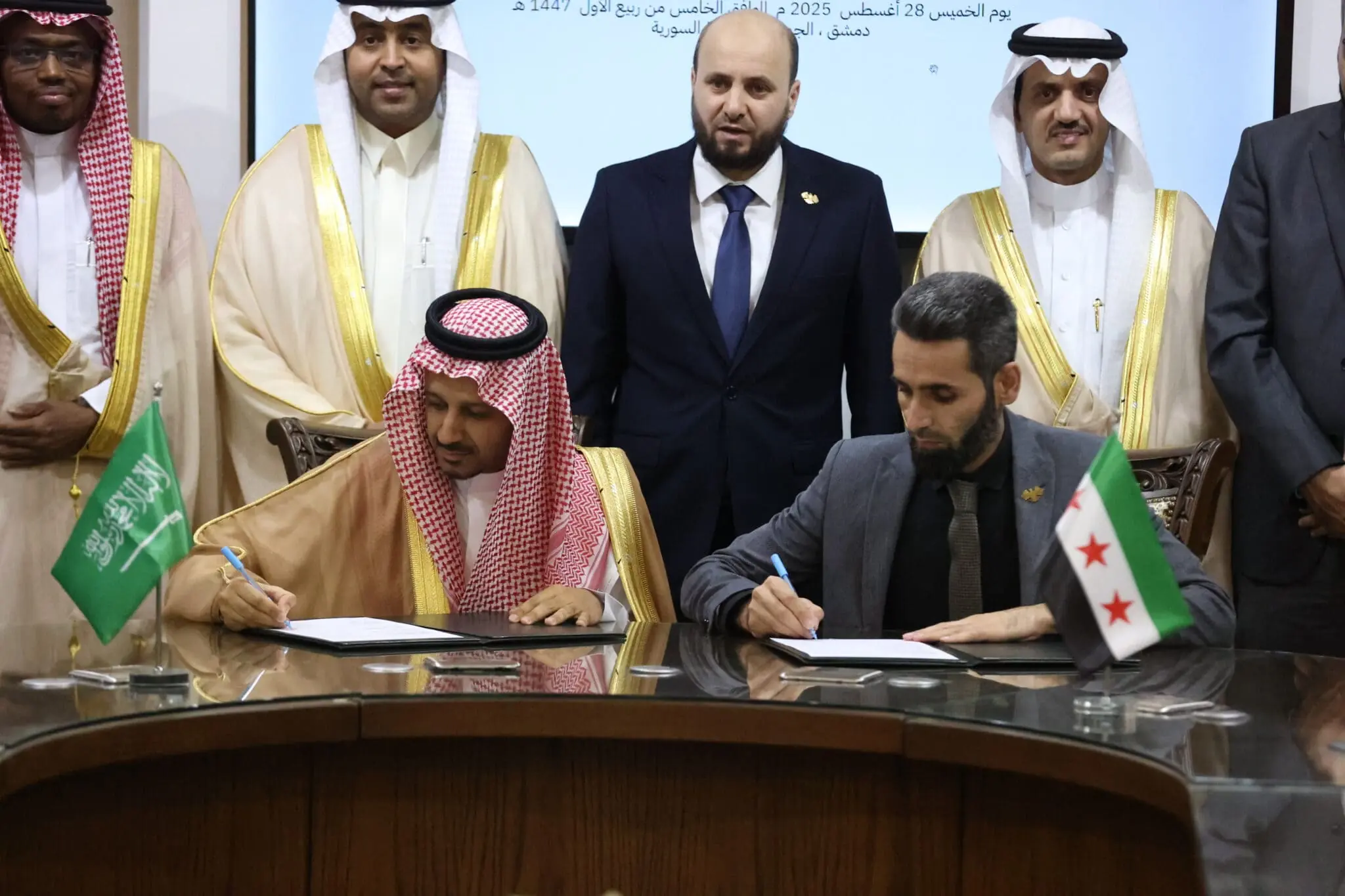
With a Syrian government that eschews both captagon and Iranian aid, Saudi Arabia’s strategic investments aim to foster Syrian independence from those income streams while increasing its own influence. To offset the Syrian government’s budget constraints, Saudi Arabia and Qatar have pledged to pay government salaries and paid off the country’s $15.5 million debt to the World Bank.
Riyadh has also struck deals and memorandums of understanding for private-sector investment, including in the energy and construction sectors. In July, Saudi Arabia’s minister of investment, Khalid bin Abdulaziz al-Falih announced $6.4 billion in deals, in real estate, infrastructure, and telecommunications. With these deals, He announced the creation of a Saudi-Syrian business council. These will all work toward reviving the Syrian economy while awarding Riyadh significant influence.
Why Syria Wants Foreign Investment
The price tag for Syria’s postwar reconstruction has been estimated at between $250 billion and $400 billion, a bill Syria cannot foot on its own. This makes economic revival a top priority for the new Syrian leadership, which must generate revenue and rebuild the country to maintain popular support.
Among Riyadh’s investments are substantial stakes in Syria’s cement and concrete sectors, which will play a vital part in the reconstruction effort. While much of the country lies in ruin from the civil war, public demand for rebuilding remains low because of high costs. Revitalization of Syria’s cement and concrete industry will provide jobs, add to government revenue, and lower the overall cost of rebuilding.
Prior to the civil war, Syria’s economy was propped up by oil and natural gas production. As the conflict brought production to a standstill, the regime began operating as an illicit drug-fueled rentier and client state. This hobbled the economy and contributed to Assad’s downfall. Oil and gas revenue atrophied during the civil war, and most of Syria’s fields are located in the northeast in areas controlled by the Syrian Democratic Forces. While al-Sharaa’s government is vying for these resources, it understands their constraints, adding attraction to the alternative that Riyadh’s investments can foster.
What Does the Future Hold?
Israeli military action in Syria, short of a campaign of regime change, likely will not deter continued Saudi investment. Even without Israeli intervention, much of the country outside Damascus is wracked by instability. While this instability increases investment risk, it would take a considerable amount of chaos for Saudi Arabia to rethink its Syrian strategy.
While Saudi tolerance for risk in Syria is high, internal and external factors could surmount it. Possibilities include infighting between HTS and the Syrian Democratic Forces, the resurgence of the Islamic State, a collapse of al-Sharaa’s governing coalition, or an all-out Israeli offensive. These events are possible, to varying degrees of probability. However, the more investment that Saudi Arabia and other regional actors make, the more its central government is strengthened, reducing the chances of those events occurring.
Syria’s hunger for investment makes the tradeoff of increased Saudi influence more palatable to its leaders. Additionally, Damascus’s goals regarding combating captagon production and limiting a return of Iranian influence align with Riyadh’s imperatives. There is minimal chance of the new Syrian government limiting investment.
As other regional powers are also vying for influence in Damascus, Riyadh’s tolerance for risk could be pushed to new heights. As Qatar and Türkiye remind al-Sharaa of their history and make their own moves, Riyadh will be forced to increase its investments. This combination of imperatives, potential, and competition will lead to a significant increase in Saudi investment moving forward.
The views expressed in this article are those of the author and not an official policy or position of New Lines Institute.