Washington’s Turn to State-Based Counterterrorism in Syria
By early 2026, U.S. counter-jihadist policy in the Middle East appeared to be shifting. After more than two decades of relying primarily on nonsate partners to confront jihadist threats, Washington has signaled a possible turn toward a state-based strategy.
Syria has emerged as a key manifestation of this reassessment. For years, the United States relied on the Syrian Democratic Forces (SDF) – a Kurdish-led coalition with Arab tribal participation – as its principal operational partner against the Islamic State (IS). In January, Syrian government forces advanced into areas previously administered by the SDF in the country’s northeast. At the same time, U.S. political messaging increasingly pointed toward transferring greater responsibility for containing IS to Damascus. U.S. envoy Tom Barrack articulated this shift, arguing that the SDF’s original role as the primary anti-IS force had “largely expired” and that Syrian state institutions would increasingly shoulder responsibility for preventing the group’s reconstitution.
This shift matters because the core IS threat in Syria is no longer territorial. The group’s post-caliphate strategy centers on decentralized networks that operate in anticipation of opportunities created by governance vacuums. The question, therefore, is not whether Syrian authorities can suppress IS activity in the short term but whether a more state-centric U.S. approach – implemented amid political uncertainty – can prevent IS regeneration without reproducing the failures that enabled its rise after 2014.
The Proxy Playbook
Since the 9/11 attacks, U.S. counter-jihadist policy has consistently relied on nonstate partners to confront militant threats, often with immediate tactical effect but limited political durability. In Afghanistan, for example, Washington worked through the Northern Alliance to dismantle Taliban rule; two decades later, however, the Taliban returned to power, underscoring the fragility of victories built on militia-centric arrangements.
In Iraq, the United States shuffled among several nonstate partners to confront successive jihadist threats. Shia militias and the Sunni Awakening Councils played decisive roles in confronting al-Qaeda in Iraq, yet unresolved grievances and fragmented authority later enabled IS to seize control of large Sunni-majority areas in 2014. A similar pattern followed the campaign against IS itself: Shia militia forces proved effective on the battlefield, but elements of the same networks later became sources of instability, including attacks on U.S. positions.
The recurring lesson is that even if proxy forces succeed militarily, they rarely deliver durable political outcomes. They suppress threats without resolving the governance vacuums and legitimacy deficits jihadist movements typically exploit. Syria now risks a reverse of this pattern – an assumption that shifting responsibility to the state will result in success where proxy models fell short.
Why the Syrian State Now?
Part of the logic behind viewing the Syrian state as a potential counter-IS actor lies in the background of its new ruling elite. Jabhat al-Nusra, later Hay’at Tahrir al-Sham (HTS), emerged from the same al-Qaeda ideological ecosystem that produced IS before the jihadist movement fractured into rival currents. That split was not merely doctrinal but violent, marked by sustained confrontation between competing jihadist projects.
After being pushed out of eastern Syria and consolidating control over its Idlib enclave, HTS adjusted its approach to IS. Rather than pursuing territorial expansion, it combined overt security campaigns with covert intelligence efforts against IS cells, including infiltration, arrests, targeted killings, and attempts to fracture IS-leaning networks internally. This trajectory produced a leadership with a granular understanding of IS’s ideology, recruitment pathways, and internal fault lines.
Following the fall of Syrian President Bashar al-Assad’s regime, former HTS commander Ahmad al-Sharaa emerged as the central authority capable of mobilizing significant Sunni constituencies. Together, these factors help explain why the Syrian state is now assessed as possessing potential comparative advantages in confronting IS’s post-caliphate form, despite the political risks such an approach entails.
Capacity Is Not Legitimacy
The ability of Syria’s new rulers to counter IS operationally does not, by itself, distinguish their approach from earlier security-first models. Military capacity can suppress violence, but it does not automatically generate durable stability. Al-Sharaa’s authority derives primarily from his role in toppling the Assad regime and consolidating power, not from an inclusive political process or the construction of durable institutions. His core support base remains concentrated among conservative Sunni constituencies long marginalized under Assad, alongside allied armed factions – an inherently uneven foundation for national governance.
This imbalance has produced mixed signals. Al-Sharaa’s January 2026 decree granting cultural and language rights to Syrian Kurds was widely described as a landmark step, and it drew international welcome as a potential confidence-building measure, even as implementation and political follow-through remained uncertain. By contrast, earlier episodes – his inability to restrain allied militants during violence in Alawite areas in March 2025 and the mobilization of tribal forces in Suwayda later that year – reinforced perceptions of selective inclusion. Such inconsistencies complicate integration and limit the state’s ability to command broad-based legitimacy.
IS exploits precisely these legitimacy gaps. While indifferent to minority rights or democratic norms, the group actively seeks to erode confidence in rival authorities. In a recent editorial in al-Naba, the Islamic State’s propaganda organ, al-Sharaa was portrayed as indistinguishable from past “tyrants,” rhetoric seeking to both discredit his rule and attract swing jihadists within his own ranks. For IS, destabilizing legitimacy is as important as exploiting chaos.
This is not a repetition of the earlier IS emergence, which was rooted in exploitation of Sunni feelings of exclusion. Sunni rule in Damascus raises the bar for IS, to mobilize Sunnis through the familiar ‘exclusion’ narrative but it does not eliminate its pathways. IS is not looking for a broad Sunni support to operate at this moment; it needs instability, institutional weakness, and ideological space at the margins. Minority unrest and sectarian incidents matter not because IS seeks support but because the group generates disorder that strains security and governance. Within Sunni constituencies, IS focuses on discrediting rather than replacing the new leadership – targeting conservative elements by portraying al-Sharaa as tyrant, infidel, or insufficient. In parallel, gaps in justice, detention oversight, and local governance provide the practical entry points for the jihadist group.
The Post-Caliphate IS Model: Networks, Not Territory
IS’s post-caliphate strategy reflects a shift from territorial control to decentralized individuals and networks. Following its military defeat in Iraq and Syria, the group moved away from the costs of governance toward decentralized recruitment, ideological inspiration, and selective violence. Rather than rebuilding hierarchical structures, IS now exploits local grievances, sectarian tensions, detention systems, and social fragmentation to regenerate influence below the threshold of sustained military confrontation.
Recent IS-inspired attacks in Manchester, England, and Bondi Beach, Australia, as well as attacks and attempted attacks in Syria, were either weakly claimed or left unattributed, despite clear ideological alignment. This ambiguity is deliberate. IS increasingly frames allegiance as a religious bond rather than an organizational link, allowing it to inspire violence without direct command-and-control responsibility. Front groups and loosely affiliated actors provide distance while expanding reach.
Suppressing attacks, therefore, does not equal neutralizing the threat. As long as legitimacy deficits and unresolved grievances persist, IS retains the capacity to rebuild quietly, incrementally, and outside conventional counterterrorism metrics.
The Al-Sharaa Test
Beyond detention infrastructure—especially the management of IS detainees and prison oversight— broader institutional challenges in Syria remain unresolved. Its security and military structures are still transitioning from insurgent- and enclave-based logics toward national-level security governance. Effective containment of IS requires professional intelligence coordination, oversight mechanisms, and interagency cooperation – capacities that cannot be improvised through revolutionary legitimacy or ad hoc control. These are not technical gaps, but political ones: failures of institutional design that directly shape the environment in which IS seeks to reconstitute its networks.
The transition from armed movement to governing authority represents a decisive test for Syria’s new leadership. Precedents drawn from Idlib, where HTS held sway before Assad’s overthrow, are misleading. There, al-Sharaa and his militia governed a relatively small, socially cohesive enclave under conditions of constant external threat. Governing Syria as a whole presents a fundamentally different challenge, defined by geographic scale, social diversity, and unresolved political grievances.
At the national level, countering IS depends less on coercion than on managing pluralism, building institutional accountability, and projecting inclusive authority across contested regions. These dimensions are not supplementary to security; they form the practical framework through which IS narratives are either neutralized or reinforced. A state that cannot integrate diverse constituencies, regulate allied armed actors, or institutionalize authority risks reproducing the legitimacy vacuums IS exploits. In this sense, al-Sharaa’s leadership challenge is structural rather than personal. The success or failure of this transition will shape IS’s future in Syria more decisively than ideological positioning or battlefield outcomes.
What Washington Should Watch
Washington’s gradual move away counter-jihadism through nonstate entities carries potential advantages, including a perception of greater neutrality among communities where nonstate partners have long lacked legitimacy. This dynamic was visible in parts of northeastern Syria, where dissatisfaction with SDF governance had become increasingly evident. However, rather than immediate security outcomes, measuring the effectiveness of a state-centric approach will depend on longer-term conditions.
The key question is not whether the state replaces nonstate actors but whether it functions in ways that reduce the instability that gives insurgent groups space to grow. Relevant benchmarks include the state’s ability to manage detention transparently, regulate allied armed actors, mitigate communal tensions through inclusion of minorities, and sustain basic governance across diverse regions. Conversely, recurring local clashes, sectarian violence, or fragmentation within security structures should serve as warning signs of the disorder IS seeks to exploit.
Conclusion
IS has been militarily weakened before – and yet it returned. Its resurgence was driven less by battlefield dynamics than by the absence of inclusion and functioning governance. Conditioning U.S. engagement with Syria’s new authorities solely on Damascus’ counter-IS performance risks repeating that pattern, increasing the ability of the jihadist group’s networks to reactivate.”. Long-term containment depends on whether security gains are paired with institutional development, force professionalization, and political frameworks that offer representation and credible justice. These factors shape the counternarrative IS seeks to undermine. For Washington, the central question is not who fights IS today but whether the conditions being reinforced will prevent its return tomorrow.
This analysis was published in collaboration with the Middle East Policy Council.
The views expressed in this article are those of the author and not an official policy or position of New Lines Institute.
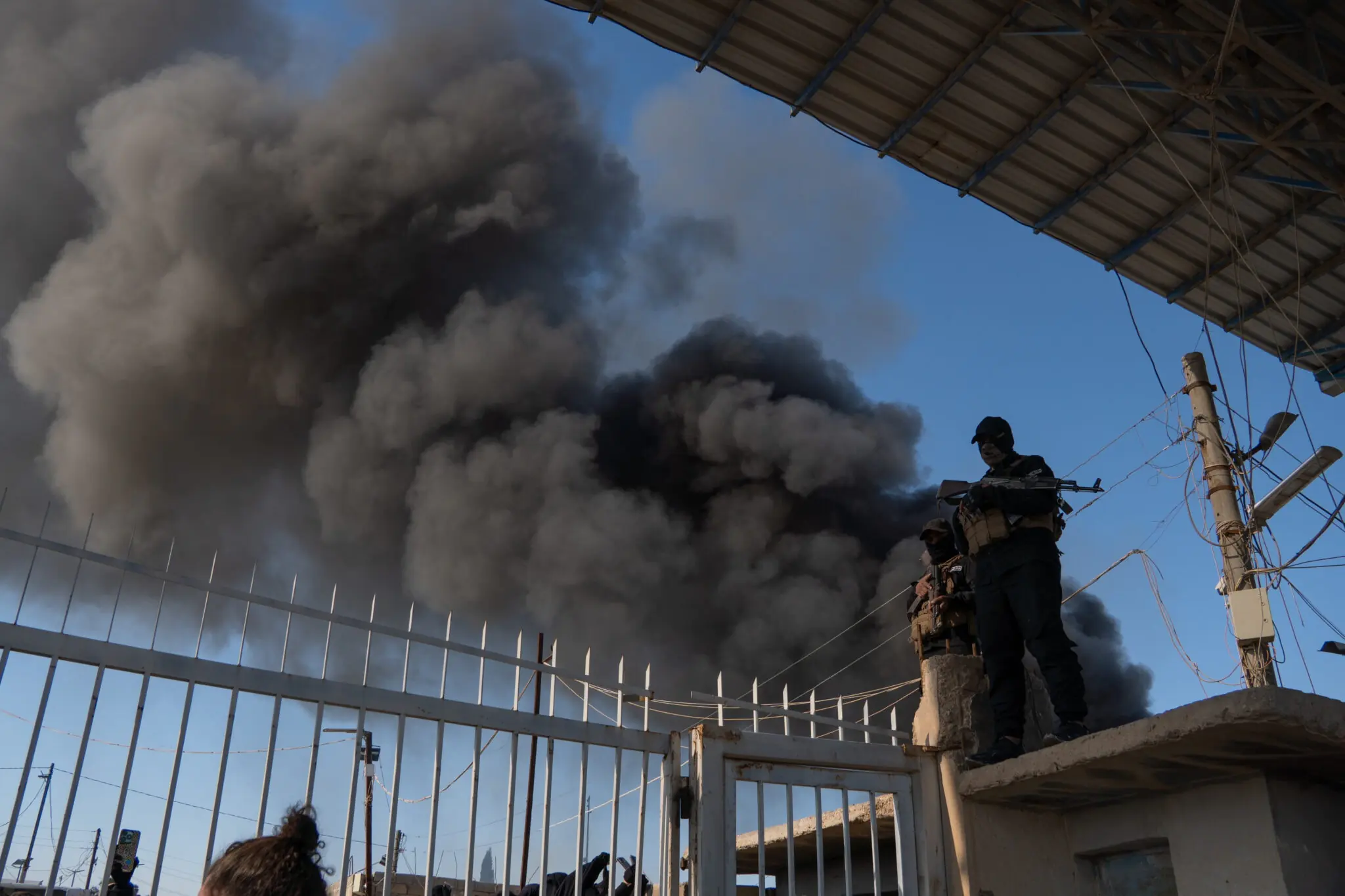
Syrian security forces take security measures at the al-Hawl Camp after taking control of the facility from SDF, on Jan. 21, 2026. The camp holds the families of Islamic State members, most of whom are women and children, in Al-Hasakah, Syria. (Photo by Anagha Subhash Nair/Anadolu via Getty Images)