Special Project on the Captagon Trade
In recent years, a spike in the production, trade, and consumption of the amphetamine-type stimulant captagon has introduced a new challenge to public health, stability, and human security in the Mediterranean-Gulf zone. The drug’s evolving formula, combined with participation from malign actors aligned with the former Assad regime in Syria, plus Hezbollah, Iran-sponsored proxies, and criminal syndicates, exacerbates insecurity and ultimately raises the risk of conflict in the region.
Syria’s decade-long civil war enabled armed actors, including violent and organized crime groups, to profiteer from various illicit markets – a dynamic similar to those in Afghanistan, Brazil, and Colombia. The forecast for the impacts of the captagon trade is serious; in the wake of a supply shortage created by the fall of the Assad regime, the spillover of captagon production and trafficking into new transit hubs creates a more complicated, challenging road ahead for governments.
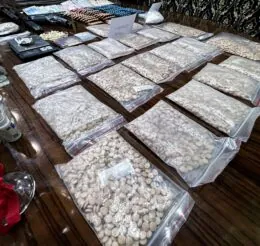
The captagon trade has emerged as a major transnational challenge in the Mediterranean and Persian Gulf. Millions of pills continue to flood overland and maritime ports across the Middle East, southern Europe, and even as far as East Asia, pointing to growing production capacity, sophisticated smuggling tactics, and emerging demand. This has given rise to new concerns and questions about the captagon trade’s implications for regional law enforcement, health care, security, and geopolitics.
The Captagon Trade Project is one of the leading research efforts generating new, cutting-edge qualitative and quantitative analyses about all aspects of the captagon trade. The project uses open-source intelligence to maintain a comprehensive database recording all reported captagon-related arrests, seizures, laboratory raids, and other developments—data that can help reveal trade patterns and emerging challenges. The project also maintains a live interactive map tracing the trade’s evolution and geographic scope. Through intelligence reports, articles, podcasts, hosted Track II dialogues, and public events, the project serves to encourage innovative, effective policy solutions to address the captagon trade’s security, geopolitical, and health implications.
The Captagon Trade Project was created and is led by Caroline Rose and is part of the Crime-Conflict Nexus Portfolio.
The Captagon Trade Interactive Dashboard
The Captagon Trade Interactive Dashboard is the most comprehensive open-source data resource for all interdictions related to illicit flows of the amphetamine-type stimulant, captagon. Launched in December 2025, the dashboard pulls from open-source data compiled by the New Lines Institute Captagon Trade Project and Observatory for Political and Economic Networks that catalogue drug seizures, arrests, violent clashes, laboratory busts, and other captagon-related interventions. The dashboard reflects an interactive map of the captagon trade as well as charts, graphs, and other illustrations of how the change has quantitatively evolved over time. This tool can help researchers identify how the captagon trade has grown in the Mediterranean-Gulf zone, in addition to capturing new patterns in production, trafficking, and consumption.
For ideal user experience, interact with this dashboard via PC.