Global Hotspots: Outlook on the U.S.-Iran Ceasefire and Japanese Force Posturing
This week, U.S. President Donald Trump extended the ongoing ceasefire with Iran, while Iran rejected negotiations with U.S. Vice President...

This week, President Donald Trump suggested the United States could take ownership of Gaza during a meeting with Israeli Prime Minister Benjamin Netanyahu, while negotiations continued in Doha on the implementation of the next phase of Israel’s cease-fire deal with Hamas. In the Indo-Pacific, China announced several retaliatory measures following Trump’s implementation of 10% tariffs […]
The Geopolitical Hotspots Monitor examines the outlook for key geopolitical hotspots around the world.
The Russia/Ukraine war trended toward diplomatic de-escalation and hybrid escalation scenarios, as Zelenskyy stated that he was open to negotiating directly with Putin and allowing allies access to Ukraine’s rare earth mineral deposits. U.S. Special Envoy to Ukraine and Russia Keith Kellogg is set to provide updates on Trump’s peace plan for Ukraine during the Munich Security Conference Feb. 14-16. Kellogg also called for Ukraine to hold presidential elections. Ukrainian defense officials claimed that dozens of Russian and North Korean officers were killed in a strike against a command center in Kursk, and South Korean intelligence officials reported that North Korean soldiers in Kursk suspended participation in direct combat operations in mid-January. Meanwhile, Russian bloggers claimed that Ukraine has renewed its offensive push in Kursk, gaining territory in the southeast portion of the region, but Ukrainian officials have not confirmed the reports.
Conflict in the Middle East trended toward diplomatic de-escalation and military escalation scenarios as negotiations began in Doha over the details of the second phase of the Israel/Hamas cease-fire. Hamas released three hostages to Israel in exchange for 183 Palestinian prisoners. Netanyahu visited Washington, where Trump said the U.S. will “take over” and “own Gaza” after the permanent displacement of Palestinians. Trump also hinted at support for the Israeli annexation of the West Bank. Syrian President Ahmed al-Sharaa conducted diplomatic visits to Saudi Arabia and Türkiye and was invited to France by President Emmanuel Macron. Meanwhile, Trump revived his “maximum pressure” campaign targeting Iranian oil exports, while simultaneously announcing that he wants to “make a deal” with Tehran.
Tensions in the Indo-Pacific trended toward hybrid escalation, as Trump announced 10% tariffs on all Chinese imports. Beijing responded with a series of retaliatory tariffs, investigations, trade restrictions, and offers of a deal that are expected to be discussed between the countries’ leaders next week. The Philippines carried out naval and air patrols with U.S. counterparts in the South China Sea following multiple Chinese patrols around the disputed Scarborough Shoal. China and the EU have separately mentioned the possibility of enhanced cooperation if their relations with the U.S. were to come under tariff pressure.
Trump agreed to postpone the imposition of 25% tariffs on Mexico and Canada following calls with both countries’ leaders in which they agreed to commit more resources to counter the flow of migrants and fentanyl to the United States. Forecast – diplomatic de-escalation scenario
The EU stated it was preparing to use its “anti-coercion instrument” to target U.S. tech companies with retaliatory trade measures should the U.S. follow through with its threat of tariffs. Forecast – hybrid escalation scenario
The rebel group in the Democratic Republic of the Congo known as the Congo River Alliance, which includes Rwandan-backed M23, has declared a cease-fire for humanitarian reasons after recent fighting against the military resulted in over 900 deaths and nearly 3,000 injuries. Forecast – diplomatic de-escalation scenario
The Global Connectivity Tracker examines the impact of geopolitical dynamics on key themes like trade, technology, and energy/climate.
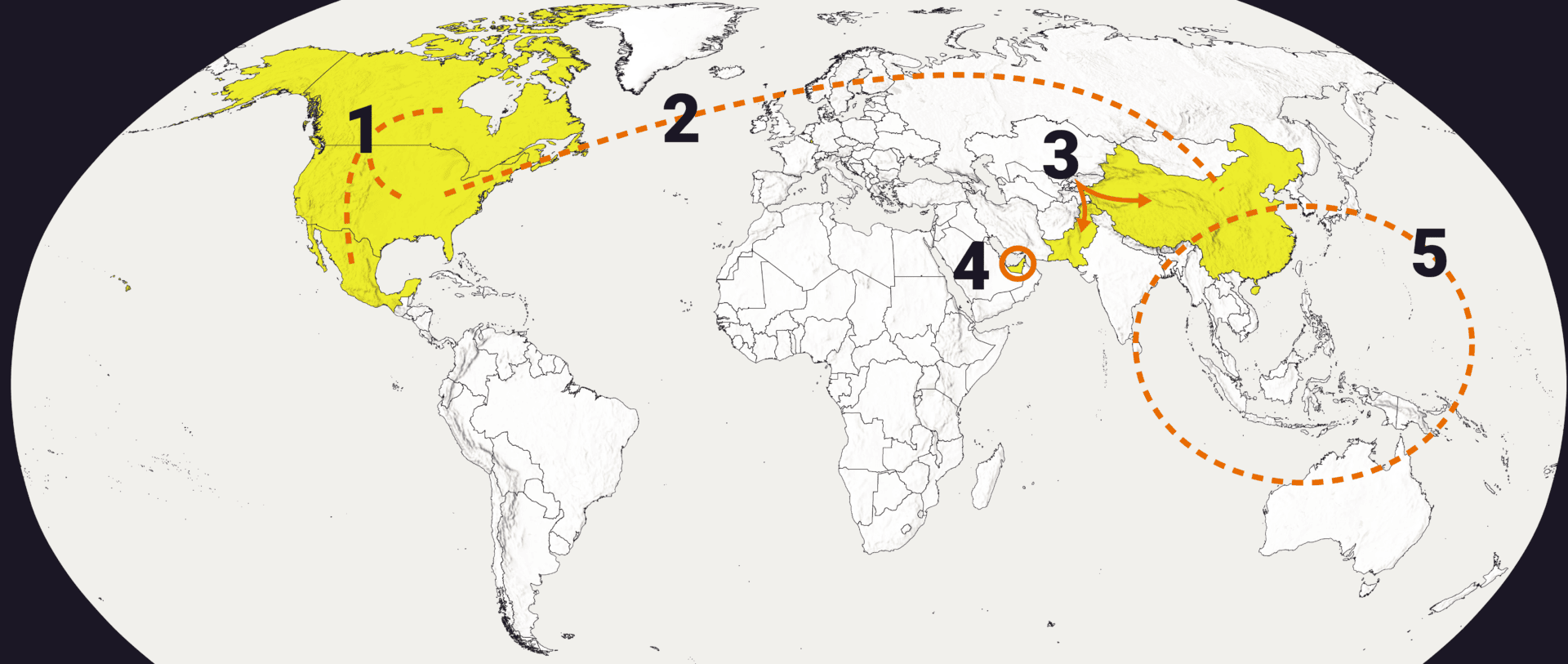
Disruption level: High
Trump’s tariffs and Canadian retaliation would have an outsized effect on the U.S. energy sector, with the risks of unemployment among energy industries rising. Tariffs would also mean higher prices for domestic consumers.
Trump imposed 25% tariffs, currently suspended, on all Canadian and Mexican imports, including petroleum exports. The tariffs, if implemented, could drive up fuel prices, hit the bottom lines of oil firms, and cause slowdowns at refineries as they could have trouble sourcing suitable alternatives to crude oil supplied by those countries.
About 60% of U.S. crude oil imports originate from Canada and 7% from Mexico. U.S. facilities use a combination of specific grades of oil to refine gasoline and diesel fuel, meaning that they would find difficulty in adjusting to oil sourced from other regions. Reduced refinery output would likely cause U.S. gasoline prices to rise, affecting consumers. Additionally, Canada supplies natural gas, electricity, and uranium to the United States, meaning the effects of the tariffs would be felt more sharply across the energy sector and regionally in border states.
Disruption level: High
The tariffs may result in an escalating cycle of retaliation, harming the global economy. Chinese export restrictions on critical raw materials could hamper the U.S. electrical, energy and aerospace industries.
Trump’s recent tariffs prompted China to impose 15% tariffs on U.S. liquefied natural gas and coal imports and 10% on crude oil. China also set limits on exports of critical raw minerals such as tungsten, molybdenum, and tellurium to the United States.
Chinese retaliatory tariffs on U.S. goods reflect economic tensions between the world’s largest economies. The newly implemented tariffs on both sides will affect the flow of trade and drive up costs, as well as affecting consumers, inflation, and supply chains and adding uncertainty to global markets. Tariffs can make U.S. goods less competitive in China, lowering export volumes and potentially increasing the trade imbalance between the countries. Last year, the U.S. supplied 1.7% of China’s crude oil, 6.4% of its coal, and 5.4% of its LNG. The outcome of these trade disputes will be determined by how both countries react to these issues and whether they are able to come to an agreement.
Enhancement Level: Medium
Chinese investments will help Pakistan overcome infrastructure challenges and accelerate the achievement of its EV targets, especially as the rapid implementation of this joint project positions the country on the path toward diversifying its transportation sector.
China launched a $340 million joint project with Pakistan to expand electric vehicle manufacturing and charging infrastructure in Pakistan.
This partnership between Pakistan’s Malik Group and China’s ADEN Group marks a significant step in Pakistan’s EV transition. As part of this investment, ADEN Group is developing an EV production facility in Karachi, set to begin operations by December 2025 with an annual output target of 72,000 units. Additionally, ADEN is funding the installation of 3,000 charging stations in the country, with 30 set to be delivered within 10 days. Meanwhile, foreign direct investment in Pakistan has surged by 64% in 2024 compared to 2023. This growing FDI trend, coupled with new Chinese investments, could further boost economic growth and accelerate Pakistan’s transition to sustainable mobility.
Enhancement Level: Medium
The exploration of advanced cloud seeding technologies presents a promising opportunity for enhancing water security, though current infrastructure and environmental concerns, such as the impact of salt particles used in current seeding methods and emissions from cloud-seeding aircraft, remain a challenge.
Amid water security concerns, the United Arab Emirates is exploring technologies to enhance rainfall through cloud seeding.
The UAE depends on desalination to meet its growing water needs, but this method is 25 times more expensive than cloud seeding, according to Abdullah Al Mandoos, director general of the National Center of Meteorology. The country is testing new cloud seeding technologies, including the use of nanotechnology, which could triple rainfall output, and electrical impulses, which may increase it ninefold, offering a more affordable alternative to desalination. However, without necessary infrastructure upgrades, such as improving existing dams and groundwater reservoirs, managing excess rainfall will remain a challenge, increasing the risk of future flooding.
Enhancement Level: High
As nuclear technology advances and modular reactors become more commonplace, the costs of plant development could be expected to decline, allowing more countries to afford them. International financing for nuclear energy is also expected to be more available, with one group of 14 major financial institutions recently setting a goal of tripling global nuclear capacity by 2050.
As Southeast Asian countries look to bolster their future energy output and phase out dependence on fossil fuels, more are considering nuclear power, a source that until recently has been largely financially unviable in the region.
The Philippines, Vietnam, Malaysia, and Singapore have all signed recent nuclear power development agreements, many focused on smaller modular reactors, which are generally considered safer and more economical than the larger plants typically built over the past few decades. One exception comes in the Philippines, where a South Korean company is working to revive a plant that was built in the 1970s but never put into operation because of safety concerns. In Vietnam, talks are set to begin this month with partners including Russia, Japan, and the United States to build its first two nuclear projects, resuming plans that had been shelved in 2016 after the Fukushima disaster. Over the next decade, energy demand in Southeast Asia is expected to skyrocket, accounting for a quarter of all global demand growth.
This week, U.S. President Donald Trump extended the ongoing ceasefire with Iran, while Iran rejected negotiations with U.S. Vice President...
This week, the United States imposed a blockade of Iranian ports in the Strait of Hormuz during the ongoing two-week...
This week, the U.S. and Iran agreed to a two-week ceasefire following President Donald Trump’s threats of targeting Iran’s power...
This week, the conflict in Iran intensified as the U.S. bombed military facilities on Iran’s Kharg Island and Israel bombed key Iranian energy facilities, with Iran responding...