This week, the U.S. Defense Department confirmed that North Korean troops have been deployed to Russia’s Kursk region, while Ukraine and South Korea agreed to deepen intelligence exchanges. In the Middle East, Israel conducted airstrikes against Iranian military infrastructure and passed a law preventing UNRWA workers from operating in Israel. In the Indo-Pacific, the U.S. approved military aid packages to Taiwan and the Philippines, and Japan’s long-ruling Liberal Democratic Party failed to gain a majority in parliamentary elections.
Weekly Forecast Monitor: Nov. 1, 2024
The Geopolitical Hotspots Monitor examines the outlook for key geopolitical hotspots around the world.
1 Russia/Ukraine Conflict
Summary
The Russia/Ukraine conflict trended toward military escalation and diplomatic de-escalation scenarios, as North Korean troops were confirmed to be in Kursk and Russia made advances in Donetsk. Ukrainian President Volodymyr Zelenskyy expressed support for Indian President Narendra Modi to mediate peace efforts, and Finnish President Alexander Stubb discussed potential resolutions to the conflict with Chinese President Xi Jinping.
Forecast indicators
Military escalation scenario
- The Pentagon has confirmed that a “small” number of North Korean troops have been deployed to Russia’s Kursk region. U.S. Secretary of Defense Lloyd Austin said thousands of North Korean troops in Russia are expected to be sent to Kursk within weeks.
- North Korean Foreign Minister Choe Son-hui pledged that North Korea would support Russia “until victory” in the war against Ukraine, during a visit to Moscow.
- Russian forces have captured the city of Selydove in Donetsk oblast and continued to advance toward Pokrovsk.
- Ukraine said it will draft an additional 160,000 men into the regular armed forces.
- Russian strikes continued across Ukrainian cities, with Kyiv experiencing intensified waves of drone strikes.
Hybrid escalation scenario
- Zelenskyy and South Korean President Yoon Suk Yeol agreed to deepen intelligence cooperation and develop a counterstrategy to North Korean military operations.
- Ukraine continued drone strikes against ethanol plants in southwest Russia.
- The U.S. imposed sanctions on 400 individuals and companies in Türkiye, India, China, and Switzerland accused of helping Russia in its war effort in Ukraine.
Diplomatic de-escalation scenario
- Zelenskyy again expressed support for Modi to act as chief mediator of any future peace talks between Russia and Ukraine.
- Ukraine and Russia are in talks to end strikes against each other’s energy infrastructure.
- Xi and Stubb discussed peace options between Russia and Ukraine while meeting in Beijing. Details of their conversation have not been made public.
2 Middle East
Summary
Tensions in the Middle East trended toward military escalation and diplomatic de-escalation scenarios , as Israel hit Iranian military infrastructure with airstrikes and continued operations in Gaza and Lebanon. Israeli intelligence reported Iran is planning a large-scale attack against Israel from Iraq. Egypt proposed a short-term cease-fire deal in Gaza, and the U.S. pushed for the implementation of U.N. Security Council Resolution 1701, which would require the withdrawal of Israeli forces from Lebanon. South Africa continued its case in the International Court of Justice accusing Israel of genocide in Gaza.
Forecast indicators
Military escalation scenario
- Israel bombed military infrastructure in Iran in retaliation for its Oct. 1 missile barrage. Iran described the damage as minimal but promised counterretaliation, with a spokesman for Supreme Leader Ayatollah Ali Khamenei vowing a “harsh and regretful response.”
- Israeli officials have disclosed intelligence that Iran plans to conduct a large-scale drone and missile barrage against Israel from Iraqi territory. The attack is expected to be carried out by pro-Iranian Iraqi militias.
- Israeli airstrikes continued across southern Lebanon, particularly in Beirut and Tyre, while Hezbollah conducted drone strikes inside Israel.
- At least 10 Israeli soldiers were killed in ground clashes with Hezbollah. Israel ordered the evacuation of three cities in the eastern Beqaa Valley.
- Several dozen Palestinians were killed as Israel continued operations in northern Gaza. At least 93 people, including 20 children, were killed in a single strike on a residential building in the city of Beit Lahiya, an incident the U.S. State Department termed “horrifying.”
- During a raid against Kamal Adwan Hospital in Beit Lahiya, Israeli forces captured 100 Hamas militants, including many dressed as civilians and medical professionals. Kamal Adwan staff said damage from the raid rendered the hospital inoperable.
- U.S. airstrikes killed an estimated 35 Islamic State members in Syria.
Hybrid escalation scenario
- The Israeli Knesset passed legislation prohibiting the United Nations Relief and Works Agency for Palestinian Refugees (UNRWA) from operating in Israel. The legislation designates UNRWA as a terrorist organization and prohibits Israeli officials from coordinating relief efforts with it.
- South Africa submitted a legal briefing to the International Court of Justice (ICJ) extensively detailing military operations in Gaza. South Africa is arguing to the ICJ that Israel’s war in Gaza legally qualifies as genocide.
- Iran executed dual German/Iranian citizen Jamshid Sharmahd over terrorism charges after what the U.S. Department of State described as a “sham trial.” . Sharmahd, who resided in California at the time of his arrest, was detained by Iranian security operatives while visiting Dubai in 2020.
Diplomatic de-escalation scenario
- Officials from the Qatari Ministry of Foreign Affairs expressed confidence that peace mediations between Israel and Hamas will continue smoothly regardless of the outcome of the U.S. presidential election.
- Egyptian President Abdel Fattah al-Sisi called for a 12-day cease-fire between Israel and Hamas in Gaza as international mediators resumed efforts in Qatar. Al-Sisi’s proposal includes an exchange of four Israeli hostages for an unspecified number of Palestinian prisoners held by Israel.
- U.S. mediators are proposing a 60-day cease-fire in Lebanon with the intention of implementing U.N. Security Council Resolution 1701, which calls for the withdrawal of Israeli forces from Lebanon and a joint U.N./Lebanese national army force to secure the Israel/Lebanon border. Israel is insisting on unrestricted access to Lebanese airspace, and the right to engage in “active enforcement” on the ground in Lebanon as needed.
3 U.S./China/Indo-Pacific
Summary
Tensions in the Indo-Pacific trended toward military and hybrid escalation scenarios as the U.S. approved new military aid packages to Taiwan and the Philippines. Japan’s Liberal Democratic Party failed to gain a majority in the Diet, though Prime Minister Shigeru Ishiba will remain in power for the time being. The U.S. unveiled new guidelines for investments in China and outlined a strategy for the use of artificial intelligence in the military. China and India have started a troop disengagement process along their contested border.
Forecast indicators
Military escalation scenario
- The U.S. State Department approved a $2 billion weapons sale to Taiwan, including surface-to-air missile systems. China responded that it would take necessary “countermeasures” to assert its sovereignty over the island.
- China held naval exercises in the South China Sea involving both of its active aircraft carriers, the Liaoning and Shandong, for the first time.
- Taiwan’s coast guard escorted Chinese coast guard vessels from restricted waters around Kinmen on two separate occasions.
- The U.S. has pledged $8 million for the modernization of the Philippines’ coast guard, including infrastructure, training, and resource acquisition.
- South Korean intelligence said Wednesday that North Korea has readied an intercontinental ballistic missile launcher that Seoul warned may be used for testing around the time of the U.S. presidential election. A day later, the longest-ever North Korean ICBM flight was recorded, flying for 87 minutes and reaching an altitude of 7,000 kilometers and a distance of 1,000 kilometers.
- A French naval ship transited the Taiwan Strait in a freedom-of-navigation operation.
- Ishiba said he would remain in his post and would continue to focus on modernizing Japan’s defensive capabilities after his ruling coalition lost its majority in snap parliamentary elections.
- China’s navy conducted military drills in the South China Sea focused on air defense, missile interception, anti-surface attacks, and vessel damage control.
- China has integrated large language models in drones equipped with electronic warfare tools, in a first series of tests aimed at boosting drone warfare decision-making speed and capabilities.
- Taiwan’s armed forces held military exercises in central and southern Taiwan.
- Airbus partnered with Tata Advanced Systems in India to finalize the assembly line inauguration for the new Airbus C295 military transport aircraft, which is expected to be operational in the Indian air force by September 2026.
- Taiwan’s Ministry of National Defense tracked 68 Chinese aircraft and 28 naval vessels around the island this week, with 46 aircraft crossing the Taiwan Strait median line.
Hybrid escalation scenario
- U.S. government sources said former President Donald Trump and vice presidential candidate Sen. J.D. Vance were targeted by a broad Chinese hacking campaign.
- Beijing filed a complaint with the World Trade Organization against the European Union following the latter’s vote to impose tariffs on imported Chinese electric vehicles.
- The White House unveiled its first-ever strategy for the use of artificial intelligence in military and intelligence agencies in a national security memorandum, aiming to advance American technological leadership over rival countries such as China while providing guardrails for safe usage, potentially increasing tech and military competition with Beijing.
- South Korea has imposed restrictions on exports through third countries to North Korea of 15 components needed in the production of solid-fuel missiles.
- Taiwan Semiconductor Manufacturing Co. suspended shipments to Chinese chip-designer Sophgo and another unnamed organization suspected of trying to circumvent U.S. trade restrictions.
- The U.S. Treasury Department issued a rule restricting American investments in Chinese ventures in artificial intelligence, microchips, and quantum computing.
- The U.S. sent senior officials to Taiwan to ensure local adherence to U.S. trade restrictions on Huawei and other blacklisted Chinese companies.
Diplomatic de-escalation scenario
- U.S. Secretary of State Antony Blinken and other U.S. diplomats met with senior Chinese officials in Washington to persuade China to take proactive steps in curbing Russian and North Korean cooperation in the war in Ukraine.
- India and China have moved most of their troops away from the contested shared border following on an agreement signed last week between both nations’ militaries.
- U.S. semiconductor company Intel announced it would expand its chip packaging and testing facilities in Chengdu, China.
- Chinese President Xi Jinping met with Finnish counterpart Alexander Stubb, vowing to increase cooperation on developing green technologies, artificial intelligence, and digital economies.
4 Other Hotspots
United States
- Ahead of the Nov. 5 presidential election, Vice President Kamala Harris held her campaign’s concluding remarks at the Ellipse in Washington, D.C., while former President Donald Trump held his last rally in Madison Square Garden in New York, where his campaign received bipartisan backlash for comments made at Puerto Rico’s expense by comedian Tony Hinchcliffe.
- An investigation is ongoing to determine the cause and perpetrators of a series of arson attacks targeting ballot boxes in Washington state and Portland, Oregon .
- A man was arrested in Florida and charged with threatening Harris supporters with a machete.
- Prediction markets, such as Kalshi, PredictIt and Polymarket, favor Trump as the likely winner of the election, while the Trump campaign had repeatedly asserted it is leading in all swing states, rejecting contradicting poll numbers put forth by the media.
- Significance: In the last week before the election, the Trump campaign is setting the stage for a contested election, eroding its supporters’ trust in the media and election result coverage should Harris emerge as the winner. Until now, there have been only isolated attacks on election volunteers and infrastructure, mostly committed by lone actors, but the White House has warned of potential violence akin to the Capitol riot on Jan. 6, 2021, or worse. The repercussions of a contested election will be felt across all major hotspots.
Venezuela
- Venezuela recalled its ambassador to Brazil following President Luiz Inácio Lula da Silva’s rejection of Venezuela’s application to join BRICS at the recent summit in Kazan, Russia.
- Violence against Venezuelan opposition party members has intensified, with two members of María Corina Machado’s Vente Venezuela movement detained, and Edwin Santo, an activist from the Voluntad Popular party, was found dead after being detained by security forces . It is unclear the circumstances that preceded his death, however the Assistant Secretary of State for Western Hemispheres Affairs called for a transparent investigation and independent autopsy.
- Significance: President Nicolás Maduro aimed to reinforce Venezuela’s legitimacy by pursuing BRICS membership, but Brazil’s denial signals broader regional skepticism about Venezuela’s upcoming inauguration of Edmundo González. The recent detentions and targeted violence against opposition figures raise concerns about potential political destabilization ahead of Jan. 10, when Maduro is expected by the international community to begin the process of transitioning the Presidency to González
South Africa
- The South African government is running a large budget deficit, placing pressure on public finances, as indicated by the medium-term budget policy statement delivered on Wednesday, the first since the formation of the Government of National Unity (GNU).
- The budget deficit came in at 4.3%, higher than the 3.7% that had been forecasted. Finance Minister Enoch Godongwana also announced plans to invest more heavily in infrastructure companies, the country’s state-owned freight-rail system Transnet, and water-management systems.
- Significance: South Africa’s finances point to signs of economic destabilization, despite months of growing economic optimism, highlighting the need for the GNU to attract foreign investment.
‘The Global Connectivity Tracker examines the impact of geopolitical dynamics on key themes like trade, technology, and energy/climate.
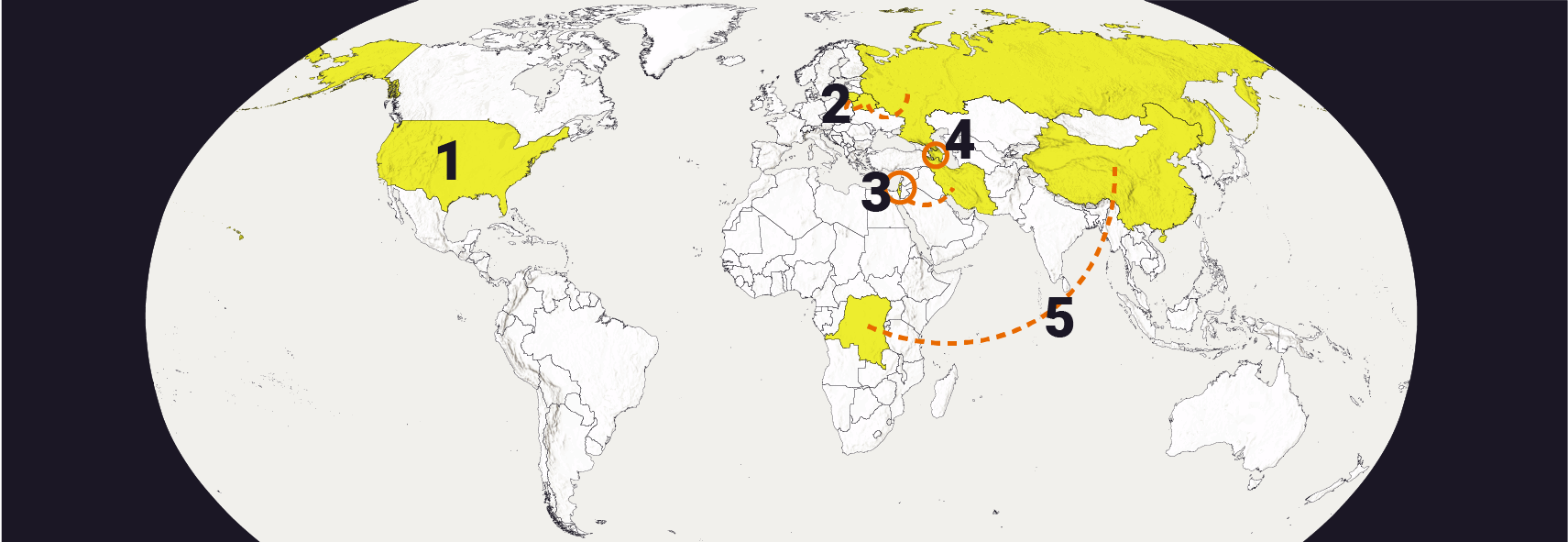
1
United States
Lithium
While the recent news represents bright spots for the U.S. lithium industry, the uncertain economics of developing domestic extraction and processing capabilities means the country will likely continue to rely on imported lithium for the foreseeable future, carrying with it the risks of supply chain disruption.
What Happened
Weeks after the announcement that discovery of a significant lithium deposit in Arkansas was made, the U.S. Bureau of Land Management (BLM) gave final permit approval for a lithium/boron mine in Nevada as part of a strategy to boost domestic supplies of the metal, which is crucial to production of rechargeable batteries.
Significance/Outlook
Chile and Argentina supply the U.S. with over 90 percent of its raw lithium supply, which is processed largely by facilities in Canada. The new Nevada mine is scheduled to come fully online in 2028 to become only the third U.S. source for mined lithium. It will have its own processing facilities and could produce enough lithium to support the production of about a third of a million electric vehicles a year, the BLM reported. Meanwhile, the U.S. Geological Survey (USGS) announced the discovery of an estimated 5 million to 13 million tons of lithium dissolved in underground brine reservoirs in Arkansas. The material was found in the Smackover Formation, a geological feature that stretches from Texas to Florida. Companies there are studying ways to extract that lithium directly from the water, a process less prone to contamination of fresh groundwater than evaporative methods commonly used in South America.
2
Lithuania/Russia/Belarus
Energy
What Happened
Lithuanian electricity transmission system operator Litgrid will disconnect power transmission lines with Russia and Belarus to synchronize Baltic energy systems with Western Europe.
Significance/Outlook
The electrical grid operators of Estonia, Latvia, and Lithuania informed Russia and Belarus in July that they will exit the Russia power system and terminate a 2001 deal known as the BRELL agreement that connected them to Moscow’s transmission system. Connections are set to be disconnected on Feb. 8, 2025, when the agreement expires. The Baltic countries have already stopped purchasing electricity from Russia to minimize their reliance on Moscow following Russia’s invasion of Ukraine.
3
Israel/Iran
Oil prices
Further political de-escalation between Israel and Iran will help oil prices to remain low and lessen supply disruption in the region. This is also seen as an opportunity for oil-importing countries and energy-reliant industries to manage costs and strengthen their economies. This of course is contingent on how long the stability and lower prices last and if demand pressures from regions like China remain subdued.
What Happened
Global oil prices fell this week following Israel’s limited attacks on Iran.
Significance/Outlook
Anticipation was high regarding the potential impact on energy prices from an Israeli attack on Iran, especially with concerns about strikes targeting oil and nuclear facilities. However, Israel’s decision to conduct a limited operation focusing on military assets helped to lower the risk of a significant supply disruption in the region. In response, Iran’s Supreme Leader Ayatollah Khamenei delivered a speech stating that Iran would not retaliate directly, which further eased tensions and contributed to the stabilization of oil prices. Following the incident, Brent crude prices dropped from $76.05 to below $72, while West Texas Intermediate fell from $71.78 to $68.01. Additional factors driving the price drop include declining global oil demand and high levels of spare capacity, particularly in China.
4
Azerbaijan
Climate
At the global level, the countries are required to cut their emissions by 50% by 2030 and reach net-zero emissions by 2050. Azerbaijan's energy and climate policies, which prioritize gas production expansion and exports, contradict the COP climate action goal to keep global warming limit below 1.5°C and to achieve the net zero emissions.
What Happened
Azerbaijan, which is set to host the COP29 global climate summit in November, plans to significantly increase production of fossil gas over the next ten years.
Significance/Outlook
Azerbaijan plans to expand gas production by 32% in response to increasing European demand caused by supply disruptions from Russia. An agreement between Azerbaijan and the EU aims to double gas exports by 2027.
5
China/Democratic Republic of the Congo
Critical Minerals
What Happened
China’s critical mineral dominance in the Democratic Republic of the Congo (DRC) is hindering U.S. efforts to reduce dependency on Chinese-controlled resources in its supply chain.
Significance/Outlook
According to a study by Benchmark Mineral Intelligence, approximately two-thirds of cobalt production in the DRC is controlled by China. This dominance places China as a “Foreign Entity of Concern” (FEOC) under the U.S. Inflation Reduction Act. Additionally, 60% of the global cobalt supply mined in 2024 is projected to come from sources either classified or at high risk of FEOC classification. While U.S. investment in the Lobito Corridor and other projects aims to diversify cobalt supply chains, reliance on the DRC’s high-grade cobalt remains substantial.