Global Hotspots: Outlook on the U.S.-Iran Ceasefire and Japanese Force Posturing
This week, U.S. President Donald Trump extended the ongoing ceasefire with Iran, while Iran rejected negotiations with U.S. Vice President...

This week, the Middle East saw heavy military escalation after Israel launched a ground assault against Lebanon following the death of Hezbollah commander Hassan Nasrallah. Iran responded with a missile attack on Israel. In the Indo-Pacific, Russia and China conducted a joint naval patrol along the Arctic, while the U.S. imposed further trade restrictions against […]
The Geopolitical Hotspots Monitor examines the outlook for key geopolitical hotspots around the world.
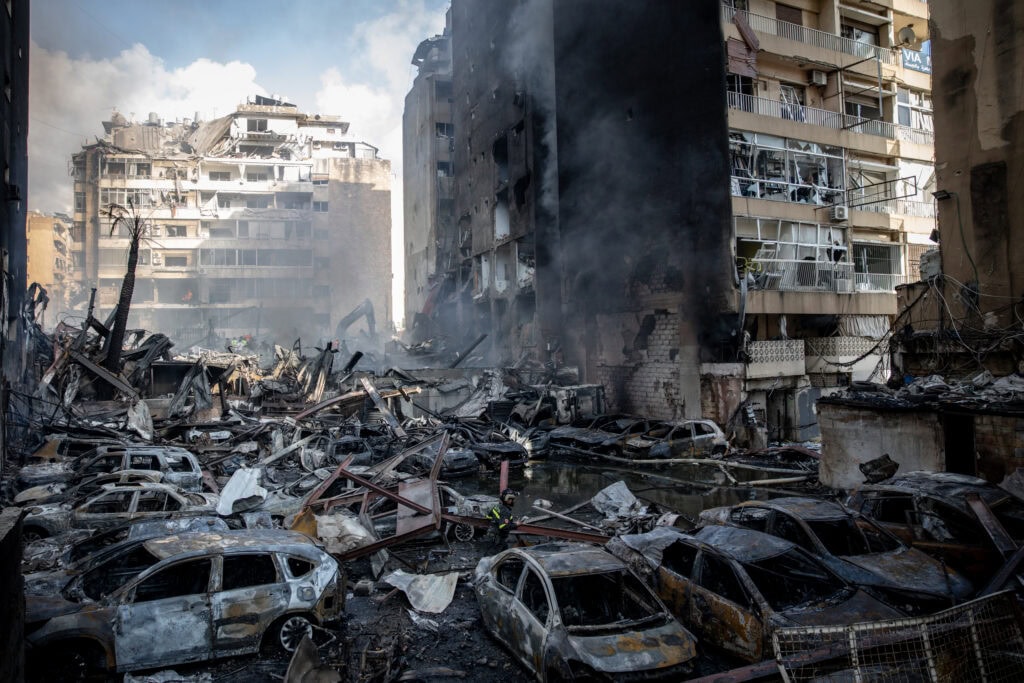
Tensions in the Middle East trended toward military and hybrid escalation scenarios as Israel killed Hezbollah chief Hassan Nasrallah, continued bombing campaigns in Gaza and Lebanon, and initiated a ground invasion of southern Lebanon to combat Hezbollah forces. Iran targeted Israel with nearly 200 ballistic missiles, prompting Israeli leaders to vow strong retaliation.
Tensions in the Indo-Pacific trended toward a hybrid escalation scenario as the U.S. banned imports of steel and food additives from Chinese companies accused of human rights abuses. Taiwan received a new military aid package, which will include delivery of the first batch of U.S.-supplied Abrams battle tanks. Russia and China conducted a first joint Arctic patrol. The EU voted to impose tariffs on Chinese electric vehicles despite opposition by certain members.
Tensions in the Russia/Ukraine conflict trended toward military and hybrid escalation scenarios as Russia captured the town of Vuhledar in Donetsk and targeted Ukrainian cities with indiscriminate bombardment. Ukraine launched a large-scale drone strike into Russian territory and announced updates on its domestic drone production capability, and Russia signed an energy deal with Iran.
‘The Global Connectivity Tracker examines the impact of geopolitical dynamics on key themes like trade, technology, and energy/climate.

Enhancement Level: High
As countries increase production in an effort to meet their pledges of tripling renewable electricity output by 2030 set at the COP 28 climate conference, renewable generation costs are expected to continue to decline. Battery storage options are also becoming more affordable thanks to advances in materials science and manufacturing methods, and to economies of scale.
A report recently issued by the International Renewable Energy Agency noted that about 80 percent of the 473 gigawatts of renewable power installations added globally in 2023 produced electricity more cheaply than did fossil fuel-powered plants. According to the report, electricity generated by onshore wind cost on average 3.3 cents per kilowatt-hour (kWh), while photovoltaic solar produced 1 kWh for 4.4 cents on average. Fossil fuel-generated power cost 10 cents per kWh on the whole.
The continuing energy transition from fossil fuels to renewables appears to have reached a point in which the costs of development and deployment of solar, wind, and hydroelectricity are becoming increasingly competitive with those for traditional fuels. The report emphasized the importance of boosting the storage capacity of electricity grids to pair with variable renewable sources like solar and wind. This will allow power production in excess of demand to be banked for use when those resources are offline, such as at night in the case of solar generation.
Disruption level: Low
The risk of supply chain disruptions has been significantly reduced with the agreement in place. The deal ensures the continued flow of goods, especially with the holidays approaching. The potential ripple effects from even a short period of uncertainty could linger in the logistics and transportation sectors, making it crucial to strengthen the resilience of key industries for the future.
Longshoremen at U.S. ports on the East and Gulf coasts have suspended their strike after reaching a tentative deal with the U.S. Maritime Alliance.
The longshoremen’s union had been pushing for increased wages and protections against automation. If the strike had continued, it could have led to huge economic losses. The tentative deal, which included a contract extension through Jan. 15, includes a 62% wage increase over six years, a middle point between the union’s initial demand for a 77% wage increase and the Maritime Alliance’s offer of 50%. A lengthy strike could have cost the U.S. economy up to $5 billion per day. Other issues remained unresolved, but the two sides said they’d continue to negotiate. Shipping stock prices had tumbled across Asia and Europe due to fears of global trade disruptions. The agreement has stabilized the situation and alleviated immediate concerns about further disruptions.
Enhancement Level: Low
Disruption level: Low
The EU was the largest buyer of Russian LNG, purchasing 50% its exports, followed by China (21%) and Japan (18%). Energy security is the top priority for India, which will continue to purchase Russian fossil fuel. India was the second largest purchaser of Russian fossil fuels in August 2024, buying about 3 billion euros worth of petroleum, three-quarters of which was crude oil.
India has decided not to purchase liquefied natural gas from the Arctic LNG 2 project in Russia, which has been sanctioned by Western countries.
U.S. and EU sanctions on the Arctic LNG 2 project are designed to restrict Russia’s profits from oil and gas. Even though India is avoiding sanctioned Russian LNG, the country continues to pursue inexpensive oil and gas supplies, including those from Russia. India will not alter its energy policy, which is to purchase oil and gas at the lowest feasible prices and will continue buying petroleum from Russia.
Enhancement Level: Medium
This breakthrough could revolutionize sustainable energy use, however, the handling and long-term safety of high-energy isotopes poses a radiotoxicity hazard risk. If such risks can be managed, it would enable the full potential of nuclear-powered batteries to be harnessed.
Chinese scientists say they have developed a nuclear battery with a photovoltaic cell capable of generating electricity for centuries by harnessing alpha radiation from decaying isotopes.
The battery, which is still in development, is highly efficient and offers long-lasting energy solution and is up to 8,000 times more efficient in energy conversion compared to conventional batteries. A built-in energy converter functions similarly to a solar panel, capturing alpha rays and converting them into light, which is then transformed into electricity. Despite energy loss from self-absorption, the use of alpha radiation offers significant potential for applications requiring sustained power over a long term, such as space missions or remote operations. While a practical application for the technology may take time to develop, this breakthrough addresses the global strategic needs in nuclear safety and sustainable development and offers an innovative approach to using nuclear waste for long-term energy production.
Enhancement Level: Medium
AI innovation and economic growth will be driven by infrastructural investments in the U.S. and U.S. partner countries.
Investment manager BlackRock expects the AI boom and data centers will increase Asia-Pacific energy demand by 50% over the next decade.
As a result of the demand for data centers and the development of artificial intelligence, technology companies have begun to negotiate long-term power contracts in Asia. Overall energy demand in Asia is expected to increase more than had been previously anticipated. The Asian market will offer sizable infrastructure investment possibilities, especially energy infrastructure for the transition to renewable power and digital infrastructure to accommodate AI growth.
This week, U.S. President Donald Trump extended the ongoing ceasefire with Iran, while Iran rejected negotiations with U.S. Vice President...
This week, the United States imposed a blockade of Iranian ports in the Strait of Hormuz during the ongoing two-week...
This week, the U.S. and Iran agreed to a two-week ceasefire following President Donald Trump’s threats of targeting Iran’s power...
This week, the conflict in Iran intensified as the U.S. bombed military facilities on Iran’s Kharg Island and Israel bombed key Iranian energy facilities, with Iran responding...