Global Hotspots Outlook: Energy and Economic Disruptions Grow Amid Iran Conflict
Register your interest to gain access to the latest Geopolitical Forecast Report and information on the forecasting and risk management platform...

This week, Beijing hosted the Forum of China-Africa Cooperation, and a Chinese naval vessel entered Japanese territorial waters. Russia seized more Ukrainian territory as the Ukrainian offensive in Russia continued. In the Middle East, Israel ended its West Bank operation near Jenin as Hamas executed Israeli hostages.
The Geopolitical Hotspots Monitor examines the outlook for key geopolitical hotspots around the world.
The Russia-Ukraine conflict trended toward military and hybrid escalation as Russia continued to seize territory in Ukraine’s Donetsk oblast and attacked Ukrainian cities with heavy bombardment. Ukraine conducted a large-scale drone attack against Russian energy infrastructure. Ukrainian President Volodymyr Zelenskyy dismissed numerous ministers from his Cabinet and met with allied defense ministers in Germany
Tensions in the Middle East trended toward military escalation and diplomatic de-escalation scenarios as Hamas executed Israeli hostages and Israel concluded its ground operation near Jenin. Mediators from the U.S., Egypt, and Qatar are working to finalize the details of a cease-fire and hostage release deal.
Tensions in the Indo-Pacific trended toward a military escalation scenario, as a Chinese surveillance vessel entered Japanese territorial waters. China and the Philippines traded accusations over incidents of coast guard ships ramming one another in an escalating confrontation in the South China Sea. Beijing hosted over 50 African nations at the Forum of China-Africa Cooperation. Japan and Australia agreed to increase defense cooperation.
‘The Global Connectivity Tracker examines the impact of geopolitical dynamics on key themes like trade, technology, and energy/climate.
Enhancement Level: n/a
Disruption level: Low/medium
The intrusion has been identified and is being addressed. However, Volt Typhoon’s history indicate the hack to be a part of a pattern that shows no signs of abating given current geopolitical circumstances.
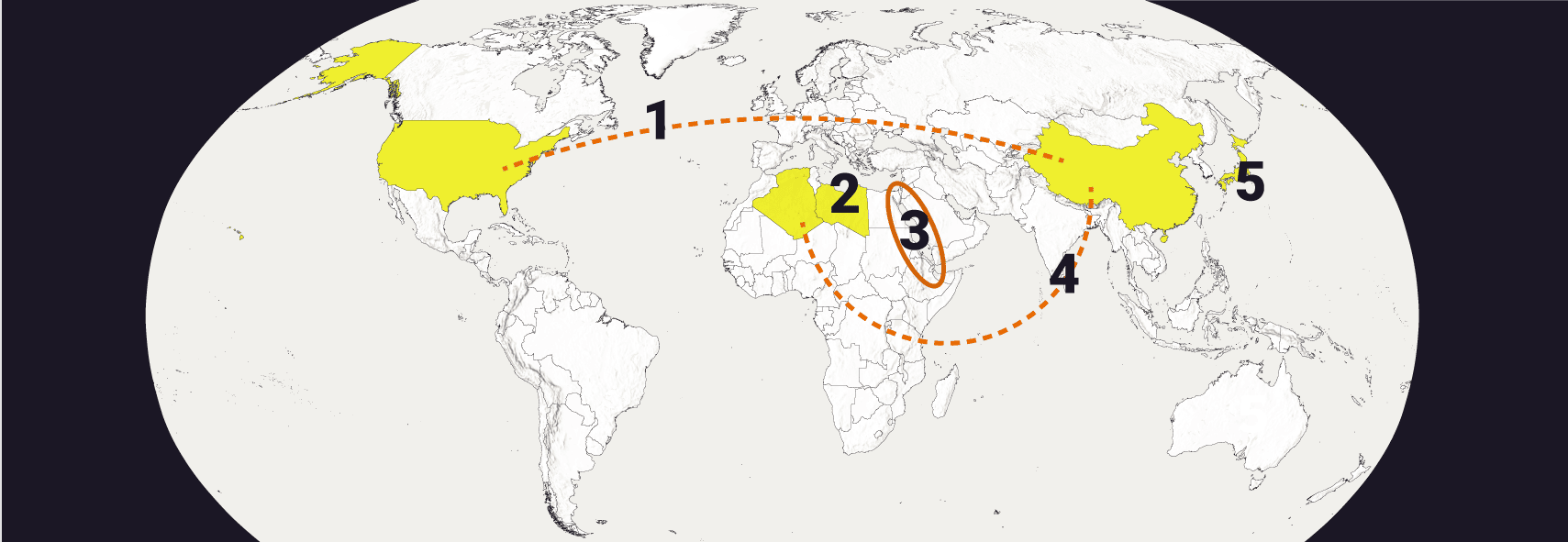
U.S. cybersecurity firm Lumen Technologies announced it had found a key vulnerability in U.S. computer network servers that has been exploited by a Chinese hacker group.
Versa Director, a network management tool created by leading network services provider Versa Networks, was the target of an intrusion. Versa’s offerings, including cloud management and cybersecurity services and network optimization tools and integration services, are used by a range of different companies. As such, the exploitation of Versa Director meant that hackers could access and control the networks of a large number of U.S. entities. Lumen Technologies, which discovered the vulnerability and widely shared the information, including with the U.S. government, attributed the intrusion to the Chinese government-backed Volt Typhoon group based on patterns of attack. Although patches to the vulnerability are being employed by private and governmental agencies, the threat of intrusion remains.
Enhancement Level: n/a
Disruption level: Low
As oil prices have dropped, the number of producing countries facing deeper recessions has also increased.
The apparent resolution of a political crisis that had brought Libyan oil production to a standstill sent crude prices significantly lower.
In the wake an apparent compromise between Libya’s rival governments over control of the country’s central bank, the price of oil fell to its lowest point in nine months. The decline, along with concerns about global economic weakness, reportedly has led OPEC+ members to delay a planned production increase that had been scheduled to start in October. Concerns over weak demand from China, the world’s largest crude oil importer, also drove the price decline.
Enhancement Level: n/a
Disruption level: Medium
The Red Sea is a critical maritime route for global oil shipments, and any disruption could have significant implications for both regional and international trade. An escalation of attacks could further destabilize shipping operations and increase oil prices and insurance costs.
Al-Houthi rebels have claimed responsibility for attacks on two crude oil tankers in the Red Sea this week.
The U.S. Central Command confirmed that the Iran-backed Houthis attacked two crude oil tankers, the Panama-flagged, Greek-operated MV Blue Lagoon I and the Saudi-flagged MV Amjad, with ballistic missiles and a drone, damaging both vessels. Despite the strikes, the ships were able to continue their journeys. According to the Associated Press, the Blue Lagoon I was en route to an undisclosed destination from the Western Russian port of Ust Luga, signaling that it was transporting Russian crude. The Saudi-flagged tanker can hold up to 2 million barrels of crude, while the Blue Lagoon I has a capacity of 1 million barrels. Ongoing attacks may continue to disrupt regional and global trade, potentially pushing oil prices higher due to concerns about supply chain disruptions and rising shipping insurance costs.
Enhancement Level: n/a
Disruption level: Low/medium
The revitalization of the field will extend its life, helping ensure a steady supply of gas for the global market while meeting the growing demand within the country.
Algeria’s Sonatrach has signed a $210 million contract with China Petroleum Engineering & Construction Company for a comprehensive upgrade of the Alrar gas field in the Illizi basin.
This project represents Sonatrach’s commitment to investing in upstream gas projects to meet rising national demand. The upgrade will allow Sonatrach to extend the life of the Alrar gas field, which has been operational since 1984, through 2048 by managing the inevitable reduction in output as its reserves dwindle. In addition, the renewal of production will make it possible for Sonatrach to fulfil its commitments to global customers and help Algeria continue to play a significant role in that market.
Enhancement Level: Low
Disruption level: n/a
Researchers have yet to achieve a self-sustaining fusion reaction with experimental reactors, meaning that absent a breakthrough, the development of a commercial fusion project may be unlikely within a decadelong time frame.
Japanese start-up Helical Fusion announced plans to put a pilot fusion reactor in service by 2034, with a commercial-scale power plant to follow a few years later, Reuters reported. The planned 50- to 100-megawatt reactor would use a helical magnetic field design to create a sustainable fusion reaction. If the plan is realized, the company could become the first to put a commercially viable fusion power project in service.
Technical, regulatory, and financial hurdles remain before Helical Fusion’s reactor project could start producing electricity on a commercial scale. Japan’s NIFS, one of the world’s largest fusion research facilities, has held hydrogen fuel at a temperature of 180 million degrees Fahrenheit for almost an hour. However achieving that result required a net input of energy, a problem that fusion research has yet to overcome. Helical Fusion CEO Takaya Taguchi said an investment of 1 trillion yen ($6.9 billion) would be needed to build the pilot reactor.
Register your interest to gain access to the latest Geopolitical Forecast Report and information on the forecasting and risk management platform...
Register your interest to gain access to the latest Geopolitical Forecast Report and information on the forecasting and risk management platform...
This week, the United States and Israel launched air- and naval-based attacks against Iran, killing Supreme Leader Ayatollah Ali Khamenei. Iran retaliated with strikes against neighboring Gulf states and by closing the Strait of Hormuz. Meanwhile,...
This week, the United States conducted a major military operation against Venezuela resulting in the capture of President Nicolas Maduro...