Global Hotspots: DRC Former President Joseph Kabila Vows to Overturn Government
On today’s episode, Milos Maggiore, Sebastian Dittgen, Andrew Loftesnes and Jared Jeter discuss the new ideological front opening in the...

The fourth quarter of 2026 will be marked by rising geopolitical tensions in several global hotspots. Conflicts in the Middle East and Russia/Ukraine are expected to intensify, and several other countries will trend toward destabilization as politically polarizing elections occur in Q4. These trends are likely to cause political, social, and economic disruptions, especially to the energy sector. Technological advances may mitigate some disruptions, but all eyes will be on artificial intelligence development and deployment, as that may add instability to the international system.
In the Middle East, Q4 military escalation due to regional fallout from the U.S./Iran war, Israeli election season, and developments in Yemen’s civil war is most likely. Houthi escalation against Saudi Arabia will increase the likelihood of Turkish and Pakistani military intervention in the conflict. The U.S. is likely to escalate both its sanctions campaign against Iran and the frequency of strikes in Iran, including against nuclear infrastructure. Israeli Prime Minister Benjamin Netanyahu is likely to escalate military action in Lebanon and Syria in the weeks leading up to Oct. 27 elections.

The Indo-Pacific will likely maintain the status quo, with diplomatic engagement offering opportunities for de-escalation. The September summit between the U.S. and China led to a two-month extension of last year’s trade truce, and the Association of Southeast Asian Nations and Asia Pacific Economic Cooperation summits may provide opportunities for progress on regional disputes. At the same time, the potential for hybrid escalation remains moderately high in Q4 as the U.S. and Taiwan enter midterm election cycles, concern about Chinese interference grows, and trade and defense tensions between China, the EU and Japan persist.

Hybrid escalation is expected to dominate the Russia-Ukraine conflict, with Ukraine likely to increase the scope and efficacy of attacks against Russian infrastructure. Russia is expected to escalate its hybrid campaign against European NATO countries, while its winter attacks on Ukrainian energy infrastructure are expected to reach their highest levels since the invasion in 2022. Ground fighting in Ukraine will remain intense throughout the quarter, with high casualty rates for both armies, especially on the Russian side, while Russian bombardment of Ukrainian cities is expected to escalate.

Economic tensions between Canada and the U.S. may rise as retaliatory Canadian tariffs come into effect in Q4. U.S. pressure on may force Cuba to make concessions about market deregulation and possible cooperation with U.S. security demands, while major military action against Cuba remains unlikely. Meanwhile, increased U.S. pressure on Colombia, Ecuador, and Guatemala over cartel activity will heighten regional tensions. Expanded U.S. military action against the cartels will likely lead to an escalation in violence and political destabilization in the affected countries.

Around the world, the Horn of Africa will remain a key area of concern in Q4, as renewed tensions in Ethiopia, Eritrea, Tigray, and Sudan risk connecting conflicts across the region and increasing instability along the Red Sea. In Central Africa, continued insecurity and humanitarian pressures in the Democratic Republic of the Congo will persist despite diplomatic efforts to constrain fighting. Across Southeast Asia, Myanmar and Indonesia face continued security pressures, including armed conflict and civilian displacement in Myanmar and escalating violence in West Papua and growing domestic economic and political tensions in Indonesia. In the Western Hemisphere, Cuba’s deepening humanitarian crisis and rising U.S. pressure stand in contrast to improving economic conditions in Venezuela.
In Q4, the U.S. is expected to expand the use of tariffs and other trade restrictions against countries with whom tensions already exist and ease restrictions on cooperative partners. While the broader U.S.-China trade truce is likely to hold, competition in sectors such as AI, semiconductors, and technology will intensify. Meanwhile, disruptions to shipping corridors in the Middle East will increase pressure on alternative trade routes and reinforce efforts to diversify global supply chains.
U.S. tech policy will take center stage in Q4 as it aims to pass legislation to strengthen AI competitiveness, advance quantum initiatives, and reduce dependence on China for critical technologies and minerals. The outcome of the Trump-Xi summit will shape the trajectory of advanced-chip exports to China, while the American AI Exports Program and continued competition with Chinese AI models accelerate U.S. technology development. Federal action on AI safety is unlikely, while congressional efforts on quantum technology and critical-minerals diversification could establish priorities for 2027.
Global energy markets will remain volatile in Q4 as the U.S.-Iran war, disruptions to Gulf exports, and threats to Red Sea energy flows constrain oil and gas supplies. Limited OPEC bypass capacity and constrained alternative routes will make it difficult to fully offset supply losses, keeping oil and LNG prices elevated while increasing competition among European and Asian importers. Governments and major energy consumers are likely to place greater emphasis on securing shipping corridors, diversifying supplies, and developing alternative energy sources.
Global power demand and electricity grid stress will increase in Q4 as AI data centers, electrification, and a potentially colder European winter will pressure energy systems. Growing power demand and elevated fossil-fuel prices will support continued investment in renewables, energy storage, small modular reactors, green hydrogen, and AI-enabled grid management, though supply-chain constraints could limit deployment. Record-breaking climate events are in store as intensifying El Niño conditions coupled with ongoing climate change is likely to bring more severe droughts, storms, and flooding toward the end of the year.
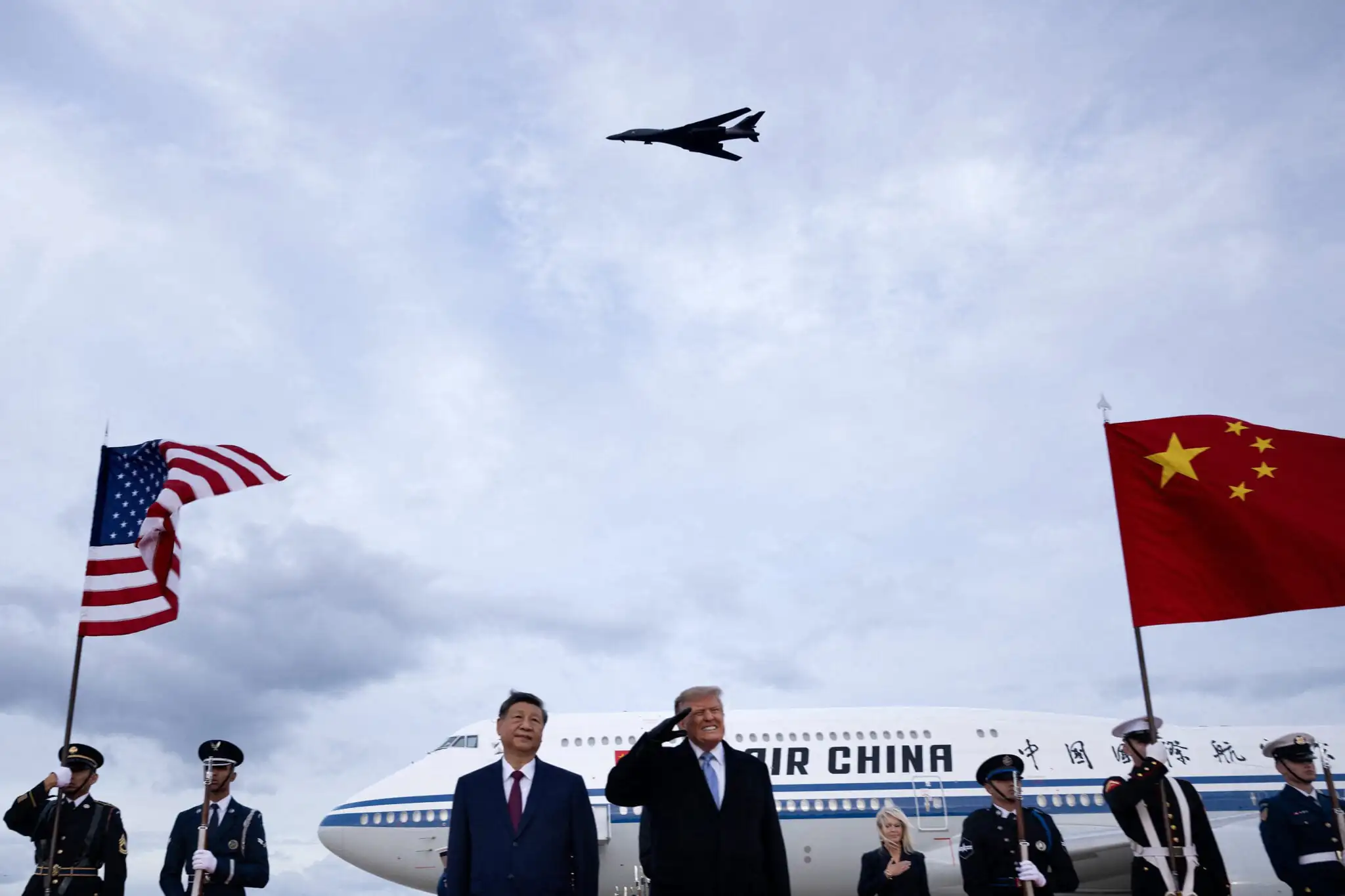
Photo: US President Donald Trump reacts as a bomber flies overhead during the US national anthem at an arrival ceremony for Chinese President Xi Jinping at Joint Base Andrews in Maryland on September 23, 2026. Xi is visiting the United States from September 23 to 25. (Photo by Brendan Smialowski / AFP via Getty Images)
Register now for a 28-day free trial of the Geopolitical Forecasting Platform. During your trial, you will have full access to the platform and its capabilities, allowing you to track how diplomatic shifts impact global supply chains and anticipate potential future shocks to international trade systems.
On today’s episode, Milos Maggiore, Sebastian Dittgen, Andrew Loftesnes and Jared Jeter discuss the new ideological front opening in the...
On today’s episode, Milos Maggiore, Jared Jeter, and Andrew Loftesnes unpack the results from Brazil’s first round of elections. Elsewhere,...
In this special edition of Global Hotspots, Milos Maggiore, Jared Jeter, Andrew Loftesnes, and Sebastian Dittgen break down some of the...
In this week’s episode, Milos Maggiore, Jared Jeter, and Andrew Loftesnes are joined by in-house guest Sebastian Dittgen to examine...